Introduction
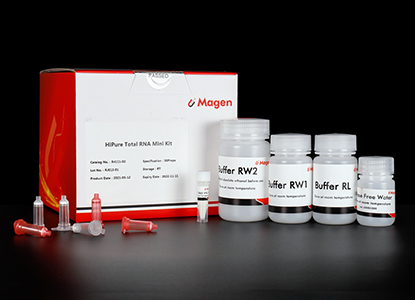
The HiPure Total RNA Plus Kit (R4111) is designed for purification of high-quality total RNA from animal tissues and cultured cells using silica membrane spin column technology. The system integrates an additional genomic DNA removal step that eliminates genomic DNA contamination prior to RNA purification, enabling reliable RNA preparation for downstream gene expression analysis.
The extraction workflow combines efficient sample lysis with silica membrane RNA adsorption to selectively purify RNA molecules while removing proteins, genomic DNA and other contaminants. The resulting RNA is suitable for RT-PCR, transcriptomic analysis and other RNA-based molecular biology workflows.
Within the Magen RNA extraction systems, the HiPure Total RNA Plus Kit serves as a core column-based solution for high-purity RNA preparation when removal of genomic DNA contamination is critical for downstream applications.
Details
Workflow
Workflow Overview
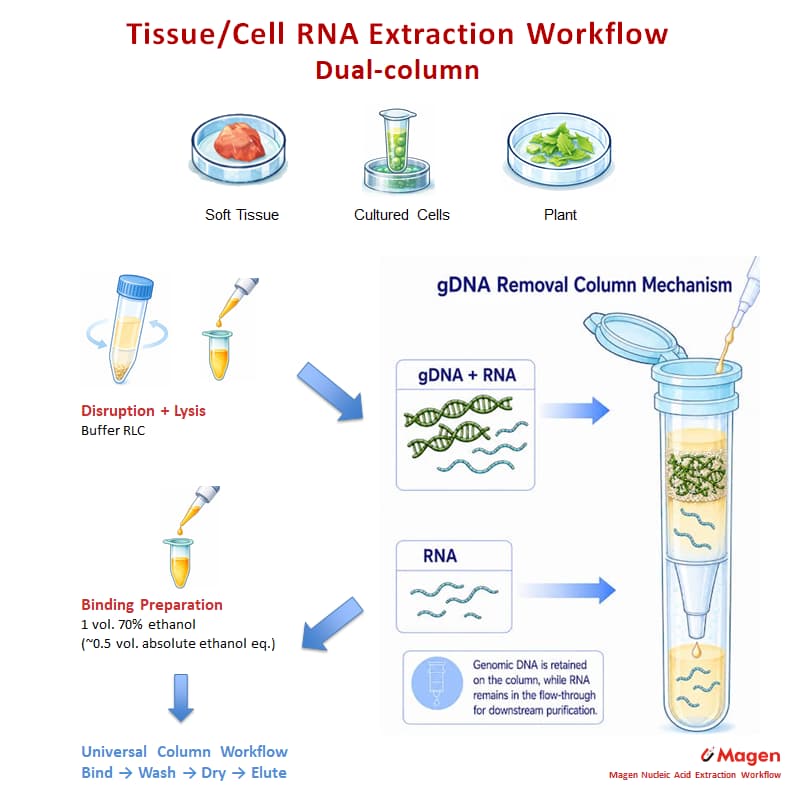
The HiPure Total RNA Plus Kit uses a dual-column silica workflow for purification of RNA from cultured cells, animal tissues and plant samples. Following disruption and chemical lysis, the lysate is first passed through a gDNA removal column so that genomic DNA is reduced before RNA binding is established. The RNA-containing flow-through is then adjusted with ethanol and loaded onto the RNA column, where RNA is captured, washed, dried and eluted in RNase-free water.
Sample Handling Logic
This workflow is designed for routine tissue and cell RNA extraction where operational simplicity and upstream gDNA removal are important. The main sample-dependent variation occurs during disruption and lysis, especially for tissue and plant material. Once the lysate has been cleared and passed through the DNA removal column, the downstream RNA-binding, washing and elution steps follow a consistent column workflow.
Time and Workflow Characteristics
Under typical manual operation, the workflow is usually completed within about 25–45 minutes, depending mainly on sample disruption and lysate viscosity. This route is suitable for laboratories that require a straightforward dual-column RNA workflow with gDNA reduction before RNA purification. For detailed step-by-step conditions, workflow guidance and estimated processing times, please refer to the Workflow Note in the Download section.
Specifications
|
Features
|
Specifications
|
|
Main Functions
|
Isolation total RNA from 20mg tissue, 150mg plant, 5 x 10⁶ cell using two columns (gDNA removed column)
|
|
Applications
|
RT-PCR, qRT-PCR, Northern hybridization, second generation sequencing
|
|
Purification method
|
Mini spin column
|
|
Purification technology
|
Silica technology, DNA filtration technology
|
|
Process method
|
Manual (centrifugation or vacuum)
|
|
Sample type
|
Animal soft tissue, cultured cells, lymphocytes, simple plant tissue
|
Sample amount
|
Cells:≤1 x 10⁷
Animal tissue sample: 1-20 mg
Plant tissue: 50-150 mg
|
|
Yield
|
2-100μg
|
|
Elution volume
|
≥50μl
|
|
Time per run
|
~25-45 minutes(Depends on sample type)
|
|
Liquid carrying volume per column
|
800µl
|
|
Binding yield of column
|
100µg
|
Engineering Characteristics
Integrated genomic DNA removal
The workflow includes a dedicated gDNA removal column that eliminates genomic DNA contamination before RNA purification, reducing the need for additional DNase treatment.
Efficient RNA binding chemistry
Silica membrane adsorption enables selective binding of RNA molecules while cellular proteins and other contaminants are removed during washing steps.
Optimized lysis and inhibitor removal
The extraction buffers efficiently disrupt cellular structures and remove contaminants that may interfere with downstream reverse transcription reactions.
Spin-column workflow
The purification procedure is compatible with routine laboratory centrifuges and supports rapid RNA purification workflows in research laboratories.
Technical Validation
HiPure Total RNA Plus Kit was evaluated as a rapid silica column-based total RNA extraction workflow with integrated genomic DNA removal. The kit uses a DNA Mini Column before RNA binding, enabling total RNA purification from cultured cells and animal tissues without phenol / chloroform extraction or isopropanol precipitation. The purified RNA is intended for downstream applications such as RT-PCR, Northern blotting, poly(A)+ RNA purification, nuclease protection and in vitro translation.
In protein- and lipid-rich tissue testing, RNA was extracted from 10 mg chicken liver and 10 mg chicken brain samples. From 10 mg chicken liver input, the kit produced RNA yields of 45.46–48.24 µg, with A260/280 values of 2.11–2.12 and A260/230 values of 1.75–2.23. From 10 mg chicken brain input, RNA yields were 4.29–4.55 µg, with A260/280 values of 2.13–2.18 and A260/230 values of 1.90–2.15 under the tested conditions.
A comparison with a reference column-based RNA extraction workflow was performed using chicken liver input amounts of 5 mg, 10 mg, 20 mg and 40 mg. With 40 mg chicken liver input, R4111 produced RNA yields of 147–156 µg, compared with 147 µg from the reference workflow. With 20 mg input, R4111 produced 95–98 µg RNA, compared with 84 µg from the reference workflow. With 10 mg input, R4111 produced 41–47 µg RNA, compared with 37 µg from the reference workflow, while 5 mg input produced 19–21 µg RNA under the tested conditions.
Across the tested chicken liver input range, R4111 maintained A260/280 values of approximately 2.11–2.15 and A260/230 values of approximately 2.07–2.28. Agarose gel electrophoresis showed intact RNA band patterns and no obvious genomic DNA contamination, supporting the effectiveness of the gDNA removal column for routine DNA reduction before RNA purification.
The kit was also evaluated in a rapid cultured-cell extraction workflow using 5 × 10⁶ cultured cells per sample. Six cell samples were processed in approximately 30 minutes, and electrophoresis analysis showed clear total RNA bands with good integrity. These results support R4111 as a fast total RNA extraction workflow for routine animal tissue and cultured-cell samples where reduced genomic DNA background and short hands-on processing time are required.
Application Scenario Summary
R4111 is a dual-column total RNA workflow designed to reduce genomic DNA background before RNA purification. By adding a front-end gDNA removal step, the workflow is suitable for RNA-seq, RT-qPCR, infected-cell RNA analysis, viral RNA quantification and transcriptomic studies where DNA carryover may affect data interpretation. The selected applications below include viral infectivity studies, antiviral restriction-factor screening, stem cell differentiation, endogenous retroviral element analysis and cancer-related transcriptional research.
|
Application Scenario
|
Sample Source
|
Downstream Research Use
|
|
Zika virus genome RNA structure and viral infectivity research in infected cells
|
ZIKV-infected Huh7, U87MG and Vero cells, as well as virus-containing supernatant samples
|
Total RNA extraction for qRT-PCR quantification of ZIKV RNA, supporting analysis of viral genome RNA structure, Asian- and African-lineage ZIKV infectivity, and functional long-range RNA–RNA interactions.
|
|
SARS-CoV-2 spike variant screening using mammalian cell-surface display
|
HEK293T cells carrying lentiviral spike-variant libraries after ACE2-binding and monoclonal antibody selection
|
RNA recovery from sorted cell populations followed by reverse transcription and PacBio SMRT sequencing, enabling high-throughput identification of spike variants with altered ACE2 affinity, infectivity-related behavior and monoclonal antibody evasion.
|
View more application scenarios
|
Application Scenario
|
Sample Source
|
Downstream Research Use
|
|
Human pluripotent stem cell lineage specification and SOX2 regulatory mechanism research
|
Wild-type, PCGF6-knockout and SOX2-regulatory-element knockout human pluripotent stem cells during neuroectoderm differentiation
|
RNA-seq and qRT-PCR analysis of lineage marker and regulatory gene expression, supporting investigation of PCGF6/MYC-mediated SOX2 activation, WNT signaling suppression and neuroectoderm versus mesendoderm fate balance.
|
|
Endogenous retroviral element regulation in human pluripotent stem cells
|
Human ESCs, HUES8 / H9 cells and feeder-free extended pluripotent stem cells used in LTR / HERVK regulatory studies
|
Total RNA extraction for Illumina RNA-seq and RT-qPCR analysis of LTR5 Hs / LTR5 / HERVK transcripts and host gene expression, supporting studies of active endogenous retroviral elements as enhancer- or promoter-like regulators in pluripotent stem cells.
|
|
Mitochondrial dysfunction, human pluripotent stem cell self-renewal and lineage differentiation research
|
Human pluripotent stem cells with inducible TFAM depletion, embryoid bodies and directed ectoderm / mesoderm / endoderm differentiation samples
|
RNA-seq and qRT-PCR analysis of mitochondrial gene expression, cell-cycle genes and lineage markers such as SOX1, PAX6, FOXA2, GATA4, SOX17, OCT4 and NANOG, supporting investigation of how TFAM-dependent mitochondrial dysfunction disrupts hPSC proliferation, self-renewal and multi-lineage differentiation.
|
|
Liver cancer drug-response and N-myristoylation-related signaling mechanism research
|
HCC cell lines, desloratadine-treated Huh7 / HepG2 cells, xenograft-derived and patient-derived HCC experimental systems
|
Total RNA extraction for qRT-PCR and RNA-seq analysis of drug-induced transcriptional changes, NFκB/Bcl-2 pathway regulation and NMT1/VILIP3-related liver cancer progression mechanisms.
|
|
Colorectal cancer tumor microenvironment and IgG1 variant–associated antitumor immunity research
|
Human colorectal cancer tumor tissues, murine colon carcinoma models and immune-cell populations from the tumor microenvironment
|
Transcriptomic and qPCR-based immune-response analysis to study how the Asia-specific hIgG1-G396R variant shapes the tumor microenvironment, including plasma cell differentiation, CD8+ T cell activation, dendritic cell recruitment and tertiary lymphoid structure formation.
|
Related Products
• HiPure Universal RNA Kit (R4130) – purification of total RNA including small RNA fractions using MagZol reagent chemistry
• MagPure Universal RNA Kit (IVD3020) – magnetic bead-based automated purification of RNA from tissue and cultured cells
• MagPure Blood RNA Kit (R6611) – magnetic bead purification of RNA from whole blood samples
• HiPure Universal miRNA Kit (R4310) – enrichment and purification of small RNA molecules from tissue samples
Kit Contents
|
Contents
|
R411102
|
D411103
|
|
Purification Times
|
50 Preps
|
250 Preps
|
HiPure DNA Mini Columns
|
50
|
250
|
|
HiPure RNA Mini Columns
|
50
|
250
|
|
2ml Collection Tubes
|
100
|
2 x 250
|
Buffer RLC
|
50 ml
|
200 ml
|
|
Buffer RW1
|
50 ml
|
200 ml
|
Buffer RW2*
|
12 ml
|
2 x 50 ml
|
RNase Free Water
|
10 ml
|
30 ml
|
Storage and Stability
HiPureKit can be stored dry at room temperature (15-25°C) and are stable for at least18 months under these conditions. During shipment, crystals or precipitationmay form in the Buffer RLC. Dissolve by warming buffer to 37°C.