Details
Workflow
Workflow Overview
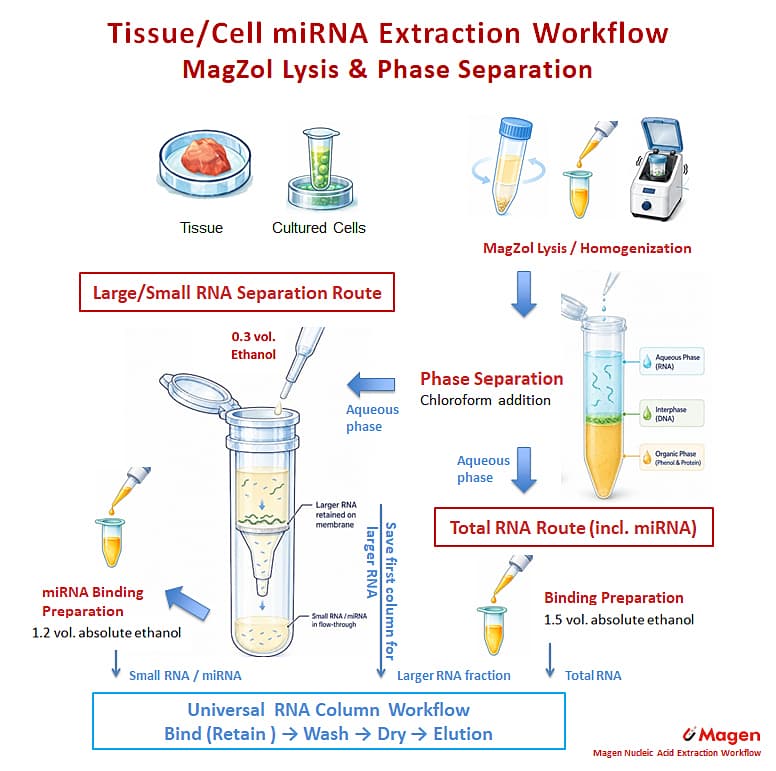
The HiPure Universal miRNA Kit combines MagZol lysis and phase separation with downstream silica-column RNA purification. Samples are lysed in MagZol Reagent, and the aqueous RNA phase is recovered after chloroform-assisted phase separation. The recovered aqueous phase can then be processed either as total RNA including miRNA, or separated into larger RNA and miRNA-enriched fractions by sequential alcohol-controlled binding on silica columns.
Sample Handling Logic
This workflow is designed for cultured cells and tissue samples, including samples that benefit from stronger phenol / guanidine-based disruption and front-end matrix reduction. The MagZol phase-separation step helps recover RNA into an aqueous phase while reducing protein, lipid and DNA background before column purification. After this front-end separation, the downstream route determines whether total RNA including miRNA is recovered together, or whether larger RNA and small RNA fractions are collected separately.
Time and Workflow Characteristics
Under typical manual operation, the workflow is usually completed within about 40–70 minutes, depending mainly on homogenization quality, phase separation handling and whether total RNA or separated RNA fractions are prepared. This workflow is more involved than a direct column route, but provides stronger front-end lysis and flexible recovery of total RNA or miRNA-enriched fractions. For detailed step-by-step conditions, workflow guidance and estimated processing times, please refer to the Workflow Note in the Download section.
Specifications
|
Features
|
Specifications
|
|
Main Functions
|
Isolation miRNA and other small RNA molecules (18nt), from cultured cells and various animal and human tissues, using MagZol reagent and column
|
|
Applications
|
RT-PCR, Northern Blot, poly A+purification, nucleic acid protection and in vitro translation
|
|
Purification method
|
Mini spin column
|
|
Purification technology
|
Silica technology
|
|
Process method
|
Manual (centrifugation or vacuum)
|
|
Sample type
|
Animal tissues, adherent cells, suspension cells, bacteria, etc
|
|
Sample amount
|
Eukaryotic culture cells: ≤ 10^7, Animal tissue:<100mg, Yeast culture cells:<5 x10^7, Bacteria:<10^9
|
|
Elution volume
|
≥15μl
|
|
Time per run
|
~40-70 minutes
|
|
Liquid carrying volume per column
|
800µl
|
|
Binding yield of column
|
100µg
|
Extraction Principle
The kit combines phenol/guanidine-based lysis with silica membrane purification to enable efficient isolation of total RNA and enrichment of small RNA species including miRNA. During the lysis step, MagZol reagent disrupts cells and tissues while denaturing proteins and RNases, preserving RNA integrity. Subsequent chloroform extraction separates RNA into the aqueous phase while removing proteins, lipids, and most genomic DNA.
RNA purification is then achieved using silica membrane adsorption under ethanol-controlled binding conditions. When a higher ethanol concentration is applied, both large and small RNA molecules bind to the membrane, enabling recovery of total RNA including miRNA. Under lower ethanol conditions, larger RNA molecules preferentially bind to the first column while small RNAs remain in the flow-through. After increasing ethanol concentration, these small RNA species bind to a second column, allowing isolation of an miRNA-enriched fraction while preserving the larger RNA fraction for parallel purification.
Engineering Characteristics
Phenol/Guanidine RNA Stabilization Chemistry
MagZol reagent rapidly lyses cells and tissues while denaturing RNases, preserving RNA integrity and preventing degradation of small RNA molecules during extraction.
Ethanol-Controlled RNA Size Selection
Differential ethanol concentrations regulate RNA adsorption to silica membranes, enabling selective enrichment of small RNA fractions while larger RNA molecules are captured separately.
Efficient Recovery of Regulatory Small RNAs
The extraction chemistry and binding conditions are optimized to efficiently recover miRNA and other regulatory small RNA species that are frequently lost during conventional RNA purification workflows.
Technical Validation
HiPure Universal miRNA Kit was evaluated as a MagZol-based phenol / guanidine lysis and silica column purification workflow for recovery of total RNA including miRNA and other small RNA molecules.
Small RNA recovery was first evaluated using 50 mg chicken tissue samples, including liver, kidney, spleen, heart, muscle and lung. From 50 mg liver input, the miRNA-enriched small RNA fraction yielded 26.0–29.3 µg, with A260/280 values of 1.88–2.04. Other tested tissues produced small RNA yields of 8.4–19.2 µg under the tested conditions. Analysis by 3% agarose gel electrophoresis showed that the enriched small RNA fraction was mainly located below the 50 bp marker region, with no obvious large-RNA contamination observed in the tested lanes.
The larger RNA fraction was also recovered from the same animal tissue workflow. From 50 mg chicken liver input, large RNA yields were 169.2–181.5 µg, with A260/280 values of 2.07–2.11 and A260/230 values of 1.94–1.98. From 50 mg kidney and spleen inputs, large RNA yields were 103.7–103.9 µg and 127.6–127.7 µg, respectively. Lower-yielding tissues such as muscle and lung produced 6.7–11.2 µg and 32.4–34.8 µg RNA, respectively, while maintaining generally acceptable absorbance ratios under the tested conditions.
Plant sample compatibility was tested using 100 mg soybean, maize and paddy leaf inputs. The miRNA-enriched small RNA fraction produced yields of 14.2–16.1 µg from soybean leaves, 9.7–10.7 µg from maize leaves and 1.9–2.2 µg from paddy leaves. The A260/280 values varied by plant type, especially in soybean and maize small RNA fractions, indicating matrix-dependent purity differences in plant samples. Gel analysis still showed enrichment of small RNA mainly below the 50 bp region, supporting small RNA recovery from plant material under the tested conditions.
Large RNA recovery from plant samples was further evaluated using the same 100 mg inputs. From soybean leaf input, the larger RNA fraction yielded 72.34–81.02 µg, with A260/280 values of 2.19–2.20. Maize and paddy leaf inputs produced large RNA yields of 9.94–12.40 µg and 13.38–14.58 µg, respectively, with A260/280 values of approximately 2.06–2.12. Electrophoresis analysis showed clear larger RNA band patterns with little visible small-fragment carryover, supporting fractionated recovery of larger RNA after small RNA separation.
Together, these results support R4310 as a universal miRNA and RNA fractionation workflow for animal tissue, plant tissue and other biological samples where small RNA enrichment and larger RNA recovery are both required. The data are strongest for animal tissue small RNA enrichment and large RNA recovery, while plant small RNA results should be interpreted with attention to sample-specific inhibitor and pigment background.
Performance Comparison
Compared with conventional RNA purification systems designed primarily for large RNA (>200 nt), the Universal miRNA Kit provides improved recovery of small RNA molecules through ethanol-controlled binding and sequential silica purification.
Key advantages include:
-
Efficient enrichment of small RNA fractions including miRNA
-
Simultaneous recovery of large RNA (>200 nt) for parallel analysis
-
Reduced loss of regulatory RNA molecules during purification
-
Comparable RNA purity and yield to widely used commercial extraction systems
These features make the system suitable for applications requiring reliable recovery of regulatory RNA species.
Application Scenario Summary
R4310 is designed for MagZol-based recovery of total RNA including small RNA, or for workflows where miRNA and other non-coding RNA targets are important. Compared with routine total RNA extraction, this route is better suited for studies that require small RNA-compatible recovery and analysis of miRNA, lncRNA or RNA-associated regulatory mechanisms. The selected research examples below include exosomal miRNA regulation in lymphoma transformation, HCC promoter-level transcriptome analysis and bladder cancer lncRNA prognostic signature validation.
|
Application Scenario
|
Sample Source
|
Downstream Research Use
|
|
Exosomal miRNA regulation of follicular lymphoma transformation and tumor immune microenvironment
|
Follicular lymphoma and DLBCL lymph node tissues, lymphoma cell lines, exosome-associated miRNA samples and macrophage co-culture systems
|
miRNA extraction and RT-qPCR analysis of miR-7e-5p, supporting investigation of how c-MYC-driven miR-7e-5p downregulation reduces exosomal miRNA transfer, upregulates FasL in macrophages and promotes immunosuppressive stromal remodeling during follicular lymphoma transformation.
|
|
HCC alternative promoter usage and DNA methylation-regulated transcriptome analysis
|
Fresh-frozen hepatocellular carcinoma tissues and paired adjacent normal liver tissues
|
Total RNA extraction for RNA-seq validation of alternative promoter activity, supporting analysis of methylation-regulated alternative promoters, HCC diagnostic modeling and promoter-level transcriptome changes in cancer development.
|
|
Bladder urothelial carcinoma lncRNA prognostic signature validation
|
Bladder urothelial carcinoma tissue samples and BLCA cell lines including 5637, J82, T24 and SW780
|
Total RNA extraction for RT-qPCR validation of prognostic lncRNAs, supporting evaluation of a four-lncRNA risk score and cancer-associated lncRNA expression markers in bladder urothelial carcinoma.
|
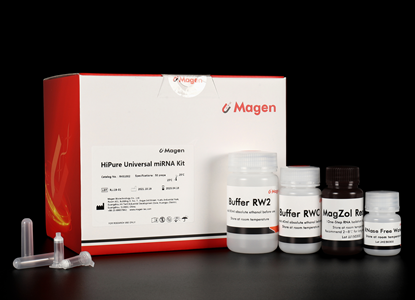
Kit Contents
|
Contents
|
R431002
|
R431003
|
|
Purification Times
|
50 Preps
|
250 Preps
|
|
HiPure RNA Mini Columns
|
100
|
2 x 250
|
2ml Collection Tubes
|
100
|
2 x 250
|
MagZol Reagent
|
60 ml
|
270 ml
|
|
Buffer RWC
|
20 ml
|
80 ml
|
Buffer RW2*
|
20 ml
|
2 x 50 ml
|
RNase Free Water
|
10 ml
|
30 ml
|
Storage and Stability
MagZol Reagent should be stored at 2-8°C upon arrival. However, short-term storage (up to 24 weeks) at room temperature (15-25°C) does not affect its performance. The remaining kit components can be stored at room temperature (15-25°C) and are stable for at least 18 months under these conditions.