Details
Workflow
 .jpg "Dual-column plant RNA extraction workflow for complex plant and fungal samples showing liquid-nitrogen grinding, PSL lysis with TCEP or β-mercaptoethanol, gDNA removal column, ethanol binding preparation and universal column purification.")
Workflow Overview
The HiPure Plant RNA Plus Kit uses a dual-column silica workflow for purification of total RNA from conventional plant and fungal samples, as well as polyphenol- and polysaccharide-rich samples. After liquid-nitrogen grinding, the sample is lysed with Buffer RLF supplemented with TCEP or β-mercaptoethanol to improve lysis and antioxidant protection. The clarified lysate is passed through a gDNA filter column, allowing RNA to remain in the flow-through while genomic DNA is reduced. The RNA-containing flow-through is then adjusted with 0.4 volume ethanol and loaded onto the RNA column, where RNA is captured, washed, dried and eluted in RNase-free water.
Sample Handling Logic
This workflow is designed for plant and fungal samples where secondary metabolites, polysaccharides or phenolic compounds may interfere with RNA recovery. The RLF-based lysis system, together with TCEP or β-mercaptoethanol, supports rapid sample dispersion and helps protect RNA from oxidation-related degradation. The gDNA filter column provides an upstream DNA-reduction step before RNA binding is established. For applications requiring more complete DNA removal, optional on-column DNase digestion can be incorporated after RNA binding.
Time and Workflow Characteristics
Under typical manual operation, the workflow is usually completed within about 35–45 minutes, depending mainly on sample grinding, lysate viscosity, gDNA filtration and column loading. If optional on-column DNase digestion is included, the workflow time is extended by approximately 15–20 minutes. This route is suitable for laboratories that require a fast dual-column plant RNA workflow with stronger tolerance for complex plant matrices. For detailed step-by-step conditions, workflow guidance and estimated processing times, please refer to the Workflow Note in the Download section.
Extraction Principle
Plant tissues are lysed using a low-guanidine buffer system designed to release RNA while minimizing co-extraction of inhibitory compounds.
An antioxidant component is incorporated during lysis to reduce oxidation effects associated with polyphenol-rich samples. Genomic DNA is removed using a dedicated DNA removal column prior to RNA purification.
RNA is then captured on a silica membrane under selective binding conditions and purified through sequential washing steps. Purified RNA is eluted for downstream molecular applications.
Engineering Features
Low-guanidine lysis with antioxidant protection
Reduces oxidation-related RNA degradation in polyphenol-containing samples, supporting improved RNA integrity.
Odorless reducing system
Incorporates an alternative reducing agent to replace β-mercaptoethanol, avoiding strong odor during RNA extraction workflows and improving laboratory handling conditions.
Dual-column DNA removal strategy
Removes genomic DNA prior to RNA purification without requiring DNase digestion.
Broad sample compatibility
Designed for plant samples with variable composition, reducing the need for protocol selection.
Optimized column loading conditions
Recommended sample input range supports stable column performance and reproducible RNA recovery.
Technical Validation
HiPure Plant RNA Plus Kit was evaluated as a broad-compatibility plant RNA extraction system for conventional plant samples, polysaccharide-rich samples and polyphenol-rich samples. The validation used 100 mg plant leaf input and a two-column workflow consisting of a gDNA Filter Column followed by a HiPure RNA Mini Column. RNA yield, purity and integrity were assessed by Nanodrop and agarose gel electrophoresis.
Across the tested plant matrices, the kit produced measurable RNA from both routine and difficult samples, including Ficus, mango, eucalyptus, tea, loquat, grape, rose, sweet potato, paper mulberry, pepper and tomato leaves. Under the tested conditions, From 100 mg plant leaf input, RNA yields ranged from approximately 12.1 µg in tea leaves to 51.5 µg in sweet potato leaves, with higher-yielding samples such as mango, paper mulberry, sweet potato, pepper and tomato producing approximately 29.6–51.5 µg RNA.
The kit was also evaluated with TCEP as an odorless reducing agent in comparison with 2-mercaptoethanol. In multiple tested samples, TCEP-supported extraction produced similar or higher RNA yield and improved A260/230 values compared with 2-mercaptoethanol under the tested conditions. For example, mango leaves showed an increase from 36.42 µg to 45.35 µg RNA, while A260/230 improved from 1.23 to 2.10; grape leaves increased from 21.17 µg to 22.74 µg, with A260/230 improving from 1.31 to 2.05.
A comparative test against a reference polysaccharide / polyphenol plant RNA kit showed that HiPure Plant RNA Plus Kit produced comparable RNA integrity and DNA background control, while generally providing higher A260/230 values across difficult plant samples. Without DNase digestion, electrophoresis analysis showed no obvious genomic DNA contamination in the tested samples, supporting the effectiveness of the gDNA Filter Column for routine DNA reduction. These results support R4150 as a first-choice RNA extraction workflow for unknown, variable or inhibitor-rich plant samples where sample composition may not be predictable.
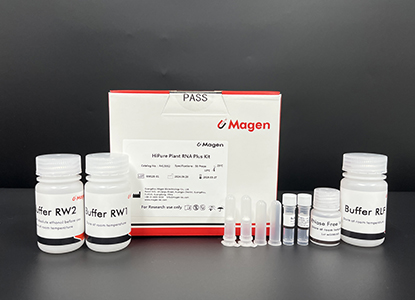
Kit Contents
|
Contents
|
R415002
|
D415003
|
|
Purification Times
|
50 Preps
|
250 Preps
|
|
HiPure RNA Mini Columns
|
50
|
250
|
gDNA Filter Columns
|
50
|
250
|
|
2ml Collection Tubes
|
100
|
500
|
TCEP (1M)
|
0.29 g
|
5 x 0.29 g
|
Buffer EP
|
1.0 ml
|
5.0 ml
|
Buffer RLF
|
50 ml
|
250 ml
|
|
Buffer RW1
|
50 ml
|
250 ml
|
Buffer RW2*
|
20 ml
|
2 x 50 ml
|
RNase Free Water
|
10 ml
|
30 ml
|
Storage and Stability
Except TCEP, the kit components can be stored dry at room temperature (15–25°C) and are stable for at least 18 months under these conditions. After receiving the product, it is recommended to store TCEP (dry powder) at -20-8°C. At low temperatures, Buffer RLF may form precipitates, dissolve it completely by 55°C water bath.