Details
Workflow
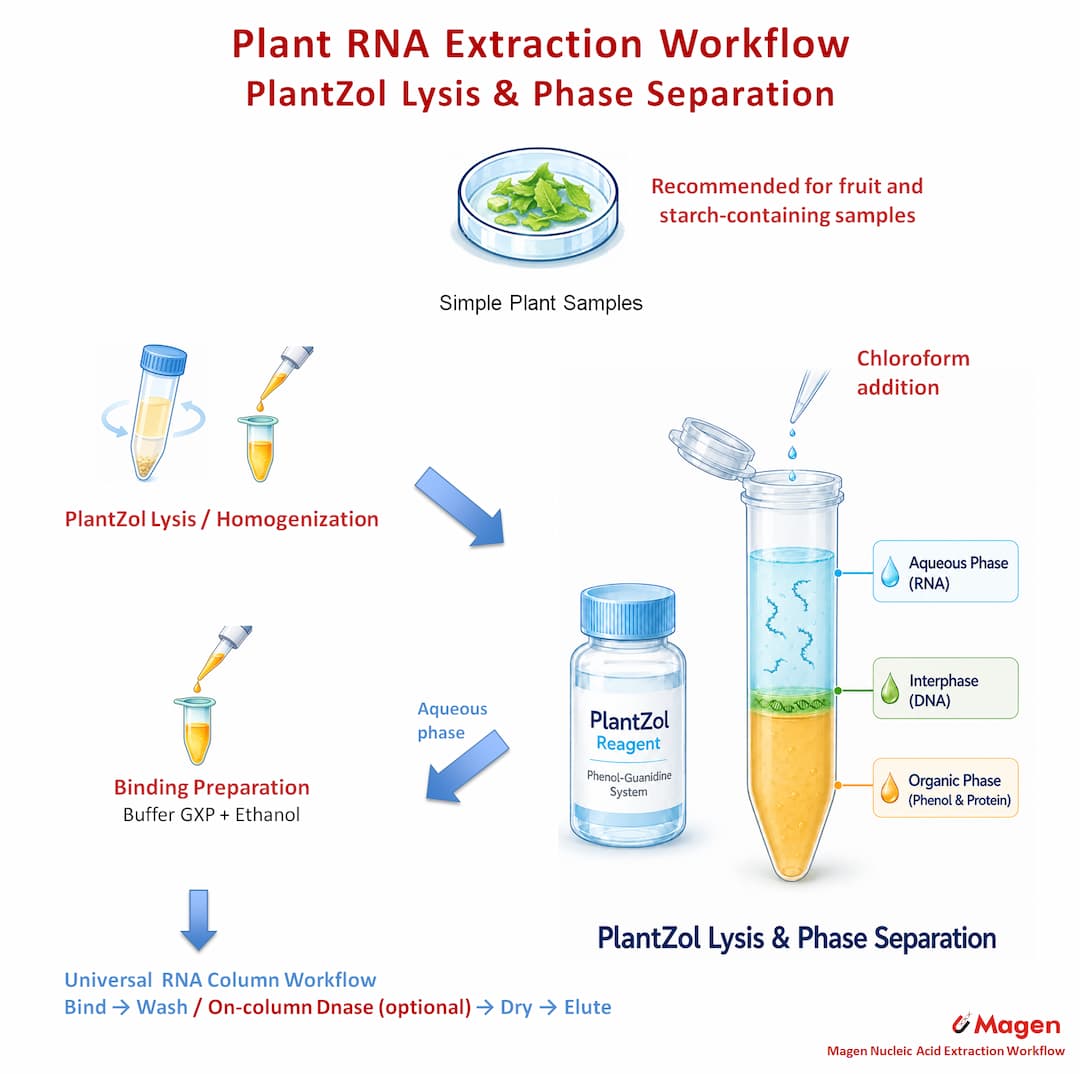
Workflow Overview
The HiPure Fruit RNA Kit uses a PlantZol-based phase-separation workflow followed by silica column RNA purification. Fruit or starch-containing plant tissue is first ground under liquid nitrogen and homogenized in PlantZol Reagent to disrupt the sample and release RNA. After chloroform addition and centrifugation, RNA is recovered from the upper aqueous phase, while DNA, proteins and organic contaminants are partitioned away from the RNA-containing fraction. The aqueous phase is then adjusted with Buffer GXP and ethanol and loaded onto the RNA column, where RNA is bound, washed, dried and eluted in RNase-free water.
Sample Handling Logic
This workflow is designed for fruit and starch-rich plant samples where direct column lysis may be affected by viscosity, carbohydrates or tissue-specific contaminants. PlantZol lysis provides strong chemical disruption, while chloroform phase separation helps separate RNA from DNA- and protein-rich fractions before column binding. The most important sample-dependent factors are input control, complete homogenization in PlantZol, clean phase separation and careful transfer of the aqueous phase. Optional on-column DNase digestion can be added when downstream applications require additional DNA reduction.
Time and Workflow Characteristics
Under typical manual operation, the workflow is usually completed within about 40–50 minutes, depending mainly on sample grinding, PlantZol homogenization, chloroform phase separation, aqueous-phase transfer and column loading. Optional on-column DNase digestion extends the workflow when higher DNA control is required. This route is suitable for fruit RNA extraction workflows where phase separation before silica column purification provides better control of sample-derived contaminants. For detailed step-by-step conditions, workflow guidance and estimated processing times, please refer to the Workflow Note in the Download section.
Specifications
|
Features
|
Specifications
|
|
Main Functions
|
Isolation total RNA from <150 mg fruit or seed using chloroform and Plantzol reagent
|
|
Applications
|
RT-PCR, qPCR, Northern hybridization, Poly A purification, nucleic acid protection and in vitro translation translation
|
|
Purification method
|
Mini spin column
|
|
Purification technology
|
Silica technology
|
|
Process method
|
Manual (centrifugation or vacuum)
|
|
Sample type
|
Simple plant, petal, peel, seed
|
Sample amount
|
50-150mg
|
|
Time per run
|
40~50 minutes
|
|
Liquid carrying volume per column
|
800µl
|
|
Binding yield of column
|
100µg
|
Technical Validation
HiPure Fruit RNA Kit was evaluated using fruit and complex plant tissue samples to assess RNA extraction performance from matrices that may contain starch, polysaccharides, polyphenols, pigments and other plant-derived inhibitors. The validation compared the PlantZol-based R4014 workflow with a MagZol / Trizol-type reference workflow, followed by silica column purification, Nanodrop measurement and agarose gel electrophoresis analysis.
In fruit sample testing, R4014 was evaluated with orange, pear, guava, tomato, melon, dragon fruit and grape samples using 100 mg input. Under the tested conditions, From 100 mg fruit tissue input, R4014 produced measurable RNA from all tested fruit samples, including 3.62–4.78 µg from orange, 2.08–2.42 µg from pear, 3.10–3.44 µg from guava, 2.39–2.50 µg from tomato, 2.25–4.60 µg from melon, 8.48–10.40 µg from dragon fruit and 0.84–2.15 µg from grape. In several fruit matrices, especially guava and dragon fruit, the PlantZol-based workflow showed better recovery behavior than the MagZol / Trizol-type reference workflow.
The kit was further tested with plant leaf samples, including Pachira macrocarpa, Ficus, mulberry, Alocasia, bamboo, pepper and banana leaves. From 100 mg plant leaf input, R4014 produced RNA yields of 59.76–60.50 µg from Pachira macrocarpa leaves, 25.48–26.33 µg from Ficus leaves. In Ficus, mulberry and Alocasia leaf samples, R4014 showed higher or more consistent RNA recovery than the reference MagZol workflow under the tested conditions.
Electrophoresis analysis supported RNA recovery from both fruit and leaf samples, while the PlantZol lysis and column purification workflow provided a structured route for processing inhibitor-rich plant materials. The purified RNA is suitable for routine downstream applications such as RT-PCR, Northern blotting, poly(A)+ RNA purification, nuclease protection and in vitro translation. For highly variable plant tissues, sample input and homogenization should be optimized to maintain stable RNA yield and purity.
Kit Contents
|
Contents
|
R401402
|
D401403
|
|
Purification Times
|
50 Preps
|
250 Preps
|
|
HiPure RNA Mini Columns
|
50
|
250
|
|
2ml Collection Tubes
|
50
|
250
|
PlantZol Reagent
|
60 ml
|
200 ml
|
Buffer GXP
|
30 ml
|
150 ml
|
|
Buffer RW1
|
50 ml
|
200 ml
|
Buffer RW2*
|
20 ml
|
2 x 50 ml
|
RNase Free Water
|
10 ml
|
30 ml
|
Storage and Stability
PlantZol Reagent should be store at 2–8°C after received. The remaining components of the kit can be stored dry at room temperature (15–25°C) and are stable for at least 24 months under these conditions.