Details
Extraction Principle
Bone samples contain highly mineralized matrices and protein-rich structural components that limit DNA accessibility compared with soft tissues. Efficient DNA extraction therefore requires both mechanical disruption and enhanced enzymatic digestion.
In the HiPure Bone DNA workflow, finely ground bone powder is digested using Proteinase K together with a reducing agent (DTT). The reducing conditions disrupt disulfide bonds in bone matrix proteins, improving protein digestion and facilitating release of DNA molecules embedded in the mineralized tissue structure.
Following digestion, released DNA binds to the silica membrane of the purification column under chaotropic conditions. Contaminants are removed through washing steps, and purified DNA is eluted in low-salt buffer suitable for downstream molecular analysis
Engineering Characteristics
Optimized bone digestion chemistry
Bone samples require efficient decalcification and enzymatic digestion to release genomic DNA trapped within mineralized tissue matrices. The kit combines digestion buffers and Proteinase K treatment to facilitate efficient DNA release from bone fragments.
Silica membrane genomic DNA purification
Following digestion, genomic DNA binds to the silica membrane under optimized binding conditions. Proteins, lipids and digestion byproducts are removed during washing steps to obtain purified DNA.
Recovery from challenging samples
The extraction workflow is optimized for biological materials where DNA may be partially degraded or present at low abundance, a situation commonly encountered in forensic or historical samples.
Spin-column workflow
The purification procedure uses standard laboratory centrifuges and does not require specialized automated extraction instruments.
Technical Validation
Validation experiments using difficult biological samples demonstrated that the silica membrane purification chemistry enables stable recovery of genomic DNA suitable for PCR amplification and downstream genetic analysis.
The purification workflow is optimized for trace and degraded DNA sources, which are frequently encountered in forensic samples such as bone fragments, aged tissues or other challenging biological materials.
Recovered genomic DNA produced clear amplification results in PCR-based assays, demonstrating compatibility with genotyping workflows commonly used in forensic DNA laboratories.
Typical Applications
Genomic DNA purified using the HiPure Bone DNA Kit is commonly used in workflows involving difficult or degraded biological samples, including:
• Forensic DNA analysis
• Identification of human remains
• Genotyping of degraded biological samples
• PCR amplification of trace DNA samples
• Anthropological and archaeological DNA studies
Related Products
Laboratories performing forensic or degraded DNA analysis often combine bone DNA purification with additional DNA extraction systems for different biological samples.
• MagPure Forensic DNA Kit (D6359D) – magnetic bead purification of trace DNA from forensic samples including hair, nails, blood stains and bone fragments
• HiPure Universal DNA Kit (D3018) – purification of genomic DNA from mixed biological samples including tissue, blood and body fluids
• MagPure Universal DNA Kit (IVD3102) – magnetic bead-based purification of genomic DNA from diverse biological samples for automated extraction workflows
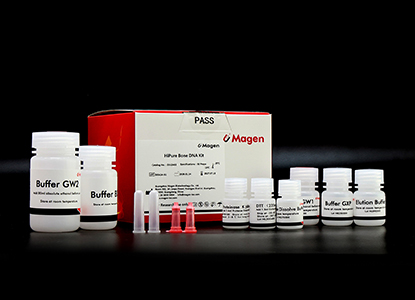
Kit Contents
|
Contents
|
D312402
|
D312403
|
|
Purification Times
|
50
|
250
|
|
HiPure DNA Mini Columns I
|
50
|
250
|
|
2ml Collection Tubes
|
50
|
250
|
|
Buffer BGL
|
40 ml
|
180 ml
|
|
Buffer GXP
|
30 ml
|
150 ml
|
|
Buffer GW1*
|
13 ml
|
53 ml
|
|
Buffer GW2*
|
20 ml
|
2 x 50 ml
|
|
DTT Powder
|
235 mg
|
2 x 235 mg
|
|
Proteinase K
|
48 mg
|
240 mg
|
|
Protease Dissolve Buffer
|
5 ml
|
15 ml
|
|
Elution Buffer
|
15 ml
|
60 ml
|
Storage and Stability
This product can be stored at room temperature (15~25°C) for 18 months. Proteinase K/DTT dry powder can be transported and stored at room temperature. For long-term storage (>6 months), it is recommended to store at -20~8°C. Dissolved Proteinase K should be stored at -20~8°C. The dissolved DTT should be stored at -20°C.