Introduction
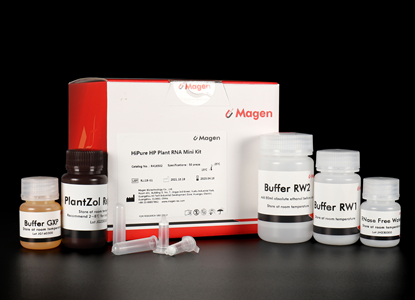
The HiPure HP Plant RNA Mini Kit (R4165) is designed for RNA extraction from plant samples with high inhibitor content, where standard column-based or guanidine-based workflows often result in low yield or reduced purity.
The workflow integrates CTAB-based lysis, organic extraction and on-column DNase digestion to improve RNA recovery from difficult plant tissues such as woody plants, mature leaves and inhibitor-rich samples.
In addition to total RNA purification, the system supports recovery of small RNA fractions, enabling applications such as microRNA analysis from complex plant matrices.
Within the Magen plant RNA portfolio, R4165 functions as the dedicated solution for challenging plant samples, complementing R4150 for routine and unknown sample types.
Details
Workflow
Workflow Overview
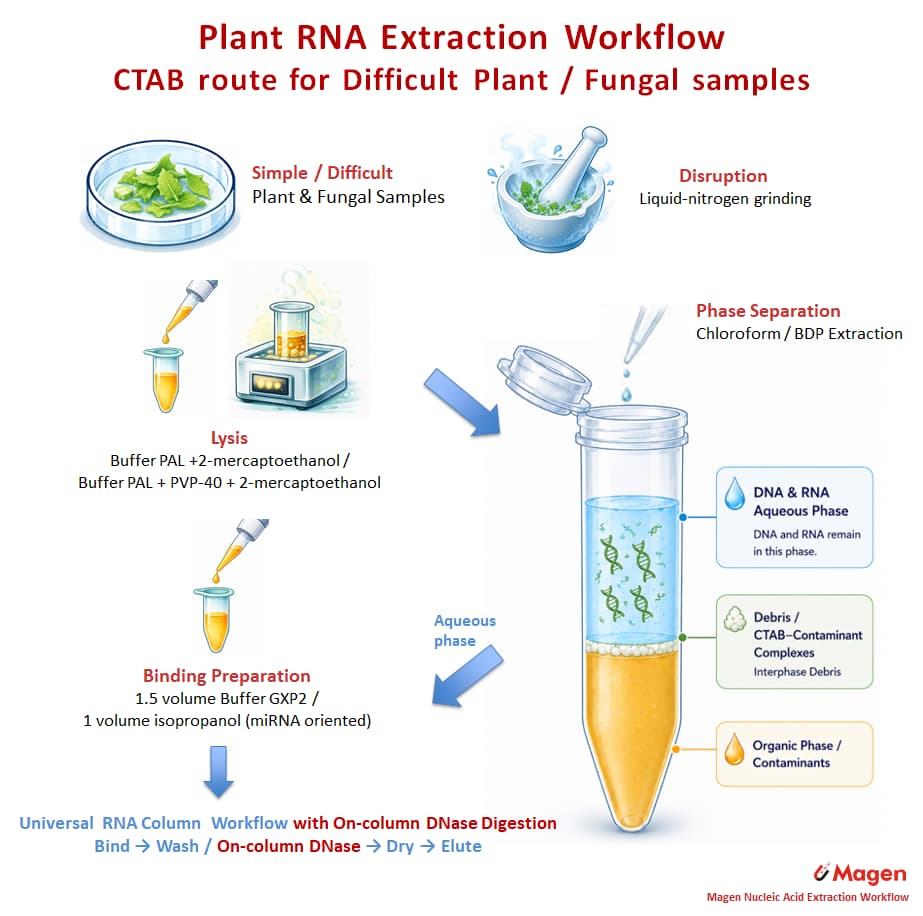
The HiPure HP Plant RNA Mini Kit uses a CTAB-based column workflow for purification of total RNA, including miRNA, from difficult plant and fungal samples. After liquid-nitrogen grinding, the sample is lysed with Buffer PAL in the presence of 2-mercaptoethanol, with PVP-40 available for complex polyphenol-rich samples. Buffer BDP or chloroform extraction is then used to partition plant debris, proteins, CTAB-contaminant complexes and other interfering materials away from the nucleic-acid-containing aqueous phase. The aqueous phase is adjusted with Buffer GXP2, or with isopropanol for miRNA-inclusive recovery, and then loaded onto the RNA column. Bound RNA is washed, treated by on-column DNase digestion, dried and eluted in RNase-free water.
Sample Handling Logic
This workflow is designed for plant and fungal samples where polysaccharides, polyphenols, pigments or other plant-derived contaminants may interfere with direct RNA purification. The CTAB/PAL lysis and BDP or chloroform phase-separation step provides an upstream contaminant-partitioning route before RNA binding is established. Sample amount, grinding efficiency, lysate viscosity and the amount of flocculent material formed after binding preparation should be controlled carefully, especially for difficult tissues. After the aqueous phase has been transferred and the binding condition has been adjusted, the downstream purification follows the universal column workflow with integrated on-column DNase digestion.
Time and Workflow Characteristics
Under typical manual operation, the workflow is usually completed within about 70–80 minutes, depending mainly on sample disruption, lysis behavior, phase separation, lysate viscosity and the 20-minute on-column DNase digestion step. This route is suitable for laboratories that require a CTAB-based plant RNA workflow with stronger contaminant control and optional miRNA-inclusive recovery. For detailed step-by-step conditions, workflow guidance and estimated processing times, please refer to the Workflow Note in the Download section.
Specifications
|
Features
|
Specifications
|
|
Main Functions
|
Isolation total RNA (include miRNA) from <200mg difficult-to-extract plant samples (use low toxicity chloroform substitutes)
|
|
Applications
|
RT-PCR, qPCR, Northern hybridization, second generation sequencing, nucleic acid protection, in vitro translation
|
|
Purification method
|
Mini spin column
|
|
Purification technology
|
Silica technology
|
|
Process method
|
Manual (centrifugation or vacuum)
|
|
Sample type
|
Hard-to-extraction plant samples such as fruit and seed, grape leaves, tea
|
Sample amount
|
≤200 mg
|
|
Elution volume
|
≥30μl
|
|
Time per run
|
~70-80 minutes
|
|
Liquid carrying volume per column
|
800µl
|
|
Binding yield of column
|
100µg
|
Engineering Features
CTAB-based lysis for inhibitor-rich plant tissues
Improves RNA release and reduces co-extraction of polysaccharides and polyphenols in difficult plant samples.
Flexible organic extraction strategy
Supports use of chloroform or proprietary BDP reagent with comparable RNA yield and purity, providing an alternative to traditional organic solvent workflows
Small RNA compatibility under optimized conditions
Binding chemistry can be adjusted to retain low-molecular-weight RNA species, enabling recovery of both total RNA and miRNA from complex plant samples.
On-column DNase digestion
Ensures removal of genomic DNA contamination in inhibitor-rich samples.
Enhanced impurity tolerance
Adapted for plant matrices where standard workflows show reduced performance.
Technical Validation
HiPure HP Plant RNA Mini Kit was evaluated as a CTAB-based RNA extraction workflow for difficult plant samples that are not well handled by routine plant RNA kits. The workflow combines CTAB-type plant lysis, Buffer BDP cleanup, silica column purification and on-column DNase I digestion, and is designed for plant samples containing high levels of polysaccharides, polyphenols, pigments, proteins or other extraction inhibitors.
Buffer BDP was evaluated as a chloroform-replacement cleanup buffer using soybean leaf lysate aliquots prepared from 300 mg leaf input. Under the tested conditions, BDP-treated samples showed comparable nucleic acid recovery and purity to chloroform-treated samples. Chloroform treatment produced nucleic acid yields of 13.38–14.93 µg per processed lysate aliquot, while four tested BDP batches produced yields of 12.81–15.03 µg. The BDP-treated samples maintained A260/280 values of approximately 2.14–2.15 and A260/230 values of 2.23–2.31, with no obvious batch-related difference observed in the tested range.
Electrophoresis analysis showed no obvious difference between chloroform-treated and BDP-treated samples. The BDP-treated lysates also produced clear supernatants without visible pigment carryover, supporting effective removal of pigments, proteins and other lysis-derived impurities. These results indicate that Buffer BDP can provide chloroform-like cleanup performance while reducing reliance on highly toxic chloroform handling in CTAB-based plant RNA extraction.
The kit was further tested with difficult plant materials, including birch leaves, apple callus tissue and Bashan bamboo leaves. From 50–100 mg difficult plant tissue input, RNA recovery was successful for these challenging samples, with representative RIN values around 4.9–8.6 depending on sample type and tissue condition. Additional comparison testing using cassava, pumpkin, tomato and pepper leaves showed that the CTAB-type PAL / BDP workflow produced measurable RNA with A260/280 values generally around 1.93–2.18 and A260/230 values around 1.92–2.21 under the tested conditions.
Together, these results support R4165 as a specialized CTAB-based solution for difficult plant RNA extraction, especially when conventional plant RNA kits show poor yield, column clogging, pigment carryover or inhibitor contamination. The inclusion of DNase I digestion further supports use in downstream applications that are sensitive to genomic DNA background, while the BDP-based cleanup step provides a reduced-toxicity alternative to chloroform-dependent extraction for complex plant samples.
Kit Contents
|
Contents
|
R416502
|
R416503
|
|
Purification Times
|
50 Preps
|
250 Preps
|
|
HiPure RNA Mini Columns
|
50
|
250
|
|
2ml Collection Tubes
|
50
|
250
|
DNase I
|
600 μl
|
5 x 600 μl
|
DNase Buffer
|
6 ml
|
30 ml
|
Buffer PAL
|
60 ml
|
270 ml
|
Buffer GXP2*
|
20 ml
|
100 ml
|
Buffer BDP
|
60 ml
|
270 ml
|
|
Buffer RWC*
|
20 ml
|
75 ml
|
Buffer RW2*
|
20 ml
|
2 x 50 ml
|
RNase Free Water
|
10 ml
|
30 ml
|
Storage and Stability
DNase I should be stored at -20°C upon arrival. However, short-term storage (up to 12 weeks) at room temperature (15–25°C) does not affect their performance. The remaining kit components can be stored dry at room temperature (15–25°C) and are stable for at least 18 months under these conditions. The entire kit can be stored at 2–8°C, but in this case buffers should be redissolved before use. Make sure that all buffers are at room temperature when used.