Introduction
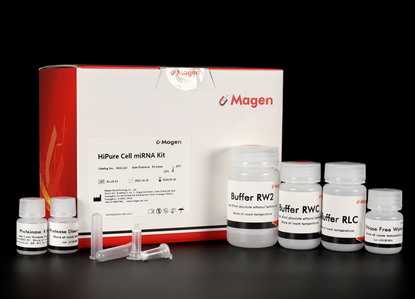
The HiPure Cell miRNA Kit provides a column-based workflow for purification of total RNA including microRNA from cultured cells and various animal and human tissues, including difficult-to-lyse tissues samples.
RNA molecules including small RNA species are captured by the silica membrane and purified through sequential washing and elution steps. The workflow supports microRNA expression profiling and RT-PCR analysis.
For workflows requiring enrichment and separation of miRNA and large RNA fractions laboratories may use the HiPure Universal miRNA Kit (R4310).
Details
Workflow
Workflow Overview
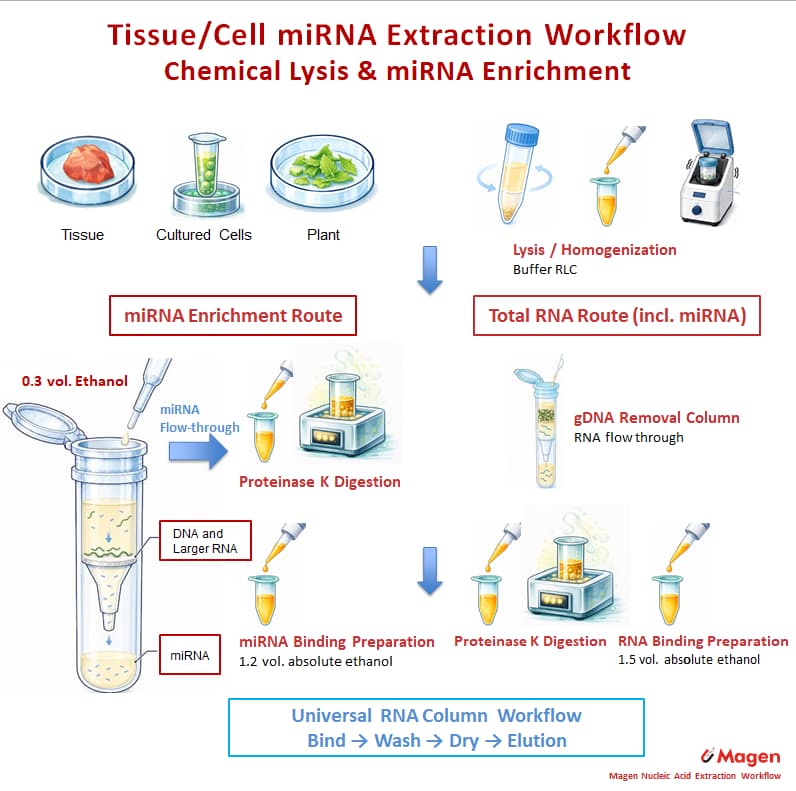
The HiPure Cell miRNA Kit uses a chemical lysis and silica-column workflow for recovery of total RNA including miRNA, or enrichment of miRNA from cell and tissue samples without MagZol phase separation. After lysis and homogenization in a denaturing buffer, the workflow can be directed into a total RNA route or a miRNA enrichment route. In the enrichment route, larger RNA and DNA are retained in an early column step while the miRNA-containing flow-through is further treated and adjusted for high-alcohol binding on a second RNA column.
Sample Handling Logic
This workflow is designed for laboratories that need miRNA-inclusive or miRNA-enriched RNA recovery while avoiding organic phase separation. The main sample-dependent variation occurs during lysis and homogenization, especially for tissue and plant inputs. The total RNA route is used when large RNA and small RNA are recovered together, while the miRNA enrichment route is used when the small RNA fraction is the main analytical target.
Time and Workflow Characteristics
Under typical manual operation, the workflow is usually completed within about 45–65 minutes, depending on sample disruption, Proteinase K digestion and whether the total RNA or miRNA enrichment route is selected. Compared with a MagZol-based workflow, this route provides a more direct column-based approach for miRNA-inclusive extraction, while still supporting size-selective recovery through sequential binding conditions. For detailed step-by-step conditions, workflow guidance and estimated processing times, please refer to the Workflow Note in the Download section.
Specifications
|
Features
|
Specifications
|
|
Main Functions
|
Isolation total RNA and miRNA from cell and tissue without MagZol reagent
|
|
Applications
|
RT-PCR, Northern Blot, poly A+purification, nucleic acid protection and in vitro translation
|
|
Purification method
|
Mini spin column
|
|
Purification technology
|
Silica technology
|
|
Process method
|
Manual (centrifugation or vacuum)
|
|
Sample type
|
Cell, Animal tissue, Plant tissue
|
|
Sample amount
|
Cells: ≤ 5 x 10^6, Animal tissue:<10mg
|
|
Elution volume
|
≥30μl
|
|
Time per run
|
~45-65 minutes
|
|
Liquid carrying volume per column
|
800µl
|
|
Binding yield of column
|
100µg
|
Principle
Biological samples are first lysed and homogenized in a highly denaturing guanidine isothiocyanate-containing buffer, which immediately inactivates DNases and RNases to ensure isolation of intact DNA and RNA. The lysate is then passed through a Mini spin column. This column, in combination with the high-salt buffer, allows selective and efficient binding of genomic DNA. Flow-through from the column is digested by Proteinase K in the presence of ethanol. This optimized digestion, together with the subsequent addition of further ethanol, allows appropriate binding of total RNA, including miRNA, to the column. Contaminants are efficiently washed away and high-quality RNA is eluted.
Kit Contents
|
Contents
|
R431102
|
R431103
|
|
Purification Times
|
50 Preps
|
250 Preps
|
|
HiPure RNA Mini Columns
|
100
|
2 x 250
|
2ml Collection Tubes
|
100
|
2 x 250
|
Proteinase K
|
48 mg
|
240 mg
|
Protease Dissolve Buffer
|
5 ml
|
15 ml
|
Buffer RLC
|
40 ml
|
200 ml
|
Buffer RWC
|
20 ml
|
80 ml
|
Buffer RW2*
|
20 ml
|
2 x 50 ml
|
RNase Free Water
|
10 ml
|
60 ml
|
Storage and Stability
Proteinase K should be stored at 2-8°C upon arrival. However, short-term storage (up to 12 weeks) at room temperature (15-25°C) does not affect their performance. The remaining kit components can be stored at room temperature (15-25°C) and are stable for at least 18 months under these conditions.