


How phase separation, gDNA removal and alcohol-controlled silica binding separate genomic DNA, large RNA and small RNA
Technical mechanism note for Magen tissue/cell RNA and miRNA extraction workflows
Overview
RNA extraction workflows are often described by their visible format: a spin column, magnetic bead, direct chemical lysis route or MagZol-style phase separation route. In practical workflow design, the more important question is how the protocol separates molecular populations before the final RNA eluate is obtained. Genomic DNA, large RNA and small RNA do not behave identically under the same salt, alcohol, pH and phase conditions. A well-designed workflow uses these differences deliberately.
This article focuses on four representative Magen tissue/cell RNA workflows: a routine dual-column RNA route, a DNase-assisted dual-column route, a MagZol phase-separation miRNA route and a chemical-lysis miRNA enrichment route. The purpose is not to compare catalog numbers, but to explain how lysis chemistry, gDNA removal, phase partitioning, alcohol ratio and wash conditions define whether larger RNA, total RNA including miRNA, or a separated small-RNA fraction is recovered.
1. Separation Is Created by Chemistry Before Purification Format
The column does not actively choose genomic DNA, large RNA or miRNA. The membrane provides an adsorptive surface, but the selection is created by the chemical microenvironment established before and during loading. Chaotropic salt concentration, pH, ionic strength, alcohol ratio and the remaining sample matrix decide which molecules enter a binding or partitioning window and which remain in solution.
Nucleic acids in aqueous solution are strongly hydrated polyanions. Their phosphate backbone carries negative charge, and both nucleic acid surfaces and silica surfaces are surrounded by structured water. Under these conditions, RNA and DNA are generally favored to remain soluble rather than bind strongly to silica.
Chaotropic salts such as guanidine salts weaken ordered water structure, denature proteins and rapidly inactivate RNases. They also contribute to charge shielding around the phosphate backbone. Alcohol then lowers the dielectric constant of the solution. As the dielectric environment becomes less water-like, electrostatic repulsion is reduced, the hydration layer is weakened and nucleic acid interaction with silica becomes more favorable.
There is also a thermodynamic contribution from water release. When ordered water molecules are displaced from nucleic acid and silica surfaces, the system gains configurational freedom. This dehydration-associated entropy gain contributes to a lower free-energy state for adsorption. Entropy is not the only driving force, but it helps explain why the same membrane can show different retention behavior when the salt and alcohol environment is changed.
In this sense, RNA extraction is not only a purification step. It is a controlled sequence of chemical separations: first through lysis and phase behavior, then through selective solid-phase binding, washing, drying and elution.
2. Two Separation Strategies in RNA Extraction
RNA workflows generally use one of two separation strategies, or a combination of both. The first strategy is phase-based partitioning, where pH and organic/aqueous phase behavior are used to move DNA, protein and RNA into different physical compartments. The second strategy is selective solid-phase binding, where salt, alcohol and wash chemistry determine which nucleic acid population remains retained on silica.
2.1 Phase Separation: Front-End Partitioning of RNA from DNA, Protein and Matrix Background
Phase separation is a front-end separation strategy rather than a final purification format. In phenol/guanidine systems such as MagZol-based workflows, the sample is lysed under strongly denaturing conditions, endogenous RNases are rapidly inactivated, and much of the protein and hydrophobic sample background is destabilized before any solid-phase binding step begins.
After chloroform or BCP addition and centrifugation, acidic phenol/guanidine systems separate the lysate into an upper aqueous phase, an interphase and an organic phase. RNA remains preferentially in the aqueous phase, while much of the genomic DNA, denatured protein and lipid-rich background partitions toward the interphase or organic phase. The recovered aqueous phase is therefore not simply a clarified lysate; it is an RNA-enriched liquid fraction with a reduced DNA, protein and matrix burden.
This front-end strategy is particularly valuable for difficult tissues, fibrous or lipid-rich samples, fungal or yeast cultures, and viscous lysates where direct column chemistry may have less tolerance for incomplete disruption or heavy sample background. Its strength lies in sample release and early matrix reduction.
2.2 Selective Solid-Phase Binding: Controlled Retention on Silica
Selective solid-phase binding addresses a different part of the workflow. Silica membranes or silica-coated magnetic particles do not actively “choose” genomic DNA, large RNA or miRNA by themselves. Selection is created by the chemical environment established before and during loading: chaotropic salt concentration, alcohol ratio, pH, ionic strength, sample viscosity and wash-buffer composition.
Under these conditions, nucleic acid binding depends on dehydration of the nucleic acid and silica surface, reduction of the solution dielectric constant, charge shielding around the phosphate backbone and the release of ordered water molecules from hydrated surfaces. In practical terms, the workflow defines which nucleic acid population enters the binding window and which population remains in the flow-through.
This is why similar-looking columns can produce different RNA fractions. A gDNA removal column, a larger-RNA binding column and a miRNA-inclusive binding step may all use silica as the solid phase, but they operate under different chemical windows. The solid phase provides the retention surface; the buffer system defines the selectivity.
2.3 Integrated Workflow Architecture: Phase Separation Followed by Selective Solid-Phase Binding
Modern RNA extraction workflows increasingly combine phase separation and selective solid-phase binding rather than treating them as competing methods. Each mechanism is assigned to the stage where it performs best. Phase separation is used for aggressive lysis, broad RNA release and early reduction of DNA, protein and complex sample background. Solid-phase binding is then used to standardize RNA retention, washing, drying, optional fractionation and elution.
This integrated architecture is especially useful when the workflow must handle difficult sample types while still delivering controlled downstream recovery. The phase-separation front end can accommodate challenging matrices and recover the RNA population into an aqueous phase. The downstream silica column or magnetic solid phase then converts that RNA-enriched phase into a defined purification format, avoiding the dependence on manual alcohol precipitation and an often invisible RNA pellet.
The practical advantage is not simply higher lysis strength or cleaner column purification alone, but the combination of both. After phase separation, defined binding chemistry can be used to further reduce residual DNA and carryover contaminants, separate larger RNA from small RNA when required, and elute RNA in a small, controlled volume for higher concentration. In this design, phase separation performs the heavy upstream release and matrix reduction, while selective solid-phase binding provides controlled RNA recovery.
3. Three Solid-Phase Binding Windows After Lysis or Phase Separation
After the sample has been lysed, clarified or phase-separated, the downstream solid-phase portion of the workflow can be understood through three binding windows. These windows are not universal recipes, and the exact ratio depends on route-specific buffer chemistry. Their value is to explain how the same RNA-containing sample can be directed toward gDNA removal, larger RNA recovery, total RNA including miRNA, or fractionated small RNA recovery.
In the four Magen workflow diagrams, these windows are represented by three practical alcohol checkpoints: no added alcohol or only minimal alcohol before RNA binding; 1 vol. 70% ethanol, annotated in the workflow diagrams as approximately 0.5 vol. absolute ethanol equivalent, for the intermediate larger-RNA binding window; and 1.5 vol. absolute ethanol for total RNA including miRNA or high-alcohol small-RNA recovery. These checkpoints should be read as workflow-specific operating states rather than universal conversion formulas.
| Binding window | Main separation logic | Workflow diagram checkpoint |
|---|---|---|
| No- or very-low-alcohol window | High-molecular-weight DNA is preferentially retained, depleted or removed before RNA enters full binding conditions. | No added alcohol or minimal alcohol before RNA binding; used for gDNA removal or low-alcohol first-column logic. |
| Intermediate-alcohol window | Larger RNA species enter the silica-binding range more readily than small RNA. | 1 vol. 70% ethanol; shown in the workflow diagrams as approximately 0.5 vol. absolute ethanol equivalent. |
| High-alcohol window | Small RNA and miRNA require stronger dehydration and matched wash chemistry to remain retained. | 1.5 vol. absolute ethanol for total RNA including miRNA, or high-alcohol recovery of the small-RNA fraction. |
3.1 No- or very-low-alcohol window: DNA behavior is addressed first
Many RNA workflows remove or reduce genomic DNA before RNA binding is fully established. In dual-column routes, the lysate passes through a DNA removal column under a no- or very-low-alcohol upstream condition in which RNA remains in the flow-through. In low-alcohol miRNA enrichment routes, a related principle is used differently: DNA and larger RNA are retained preferentially, while miRNA remains in the flow-through for later recovery.
3.2 Intermediate-alcohol window: larger RNA enters the binding range
When the RNA-containing flow-through is adjusted to a moderate alcohol condition, larger RNA species enter a favorable silica-binding range. In the Magen workflow diagrams, this window is represented by 1 vol. 70% ethanol, annotated as approximately 0.5 vol. absolute ethanol equivalent. This label is intended to align the visual workflow with the operational binding state: a mid-alcohol condition for larger-RNA-oriented recovery, not a general-purpose mathematical conversion across all lysate systems.
3.3 High-alcohol window: small RNA requires stronger dehydration
Small RNA molecules are more difficult to retain under conditions optimized for larger RNA. A miRNA-inclusive route moves the lysate into a stronger dehydration condition, represented in these workflows by 1.5 vol. absolute ethanol for total RNA including miRNA, or by a high-alcohol second binding step after the small-RNA-containing flow-through has been collected. This window is meaningful only when salt strength, membrane behavior and wash stringency are matched.
4. How the Four Magen Workflows Apply These Separation Principles
The following workflow positions should be read as operational applications of the separation logic described above. The diagrams may be inserted in this section when the article is prepared for website layout or download publication.
4.1 R4111: dual-column tissue/cell RNA workflow
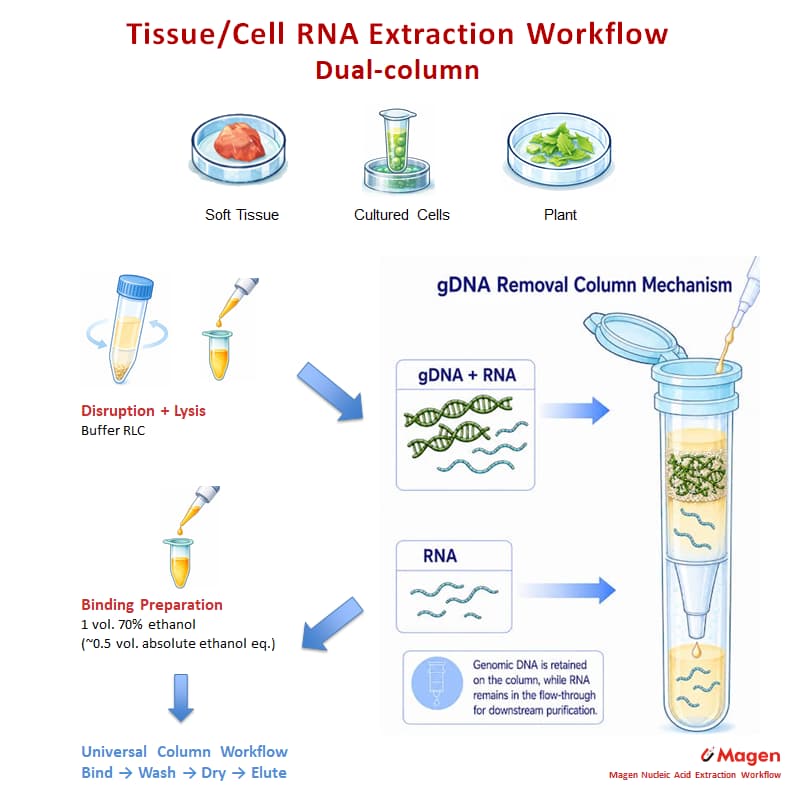
R4111 HiPure Total RNA Plus Kit represents the classic dual-column route for routine total RNA / larger-RNA-oriented recovery. Tissue, cultured cells or plant material is disrupted and lysed in Buffer RLC. The lysate passes through a gDNA removal column before ethanol-mediated RNA binding is established. The RNA-containing flow-through is then mixed with 1 vol. 70% ethanol, corresponding to the intermediate alcohol checkpoint shown in the workflow diagram, and loaded onto the RNA column for washing, drying and elution.
The technical strength of this design is the separation of gDNA removal from RNA binding. gDNA is addressed before RNA is loaded onto the final RNA membrane. The downstream RNA column can then focus on recovering the RNA fraction under a controlled mid-alcohol condition rather than carrying the full lysate burden directly into the final purification step.
4.2 IVD4121: dual-column route with DNase-supported RNA purification
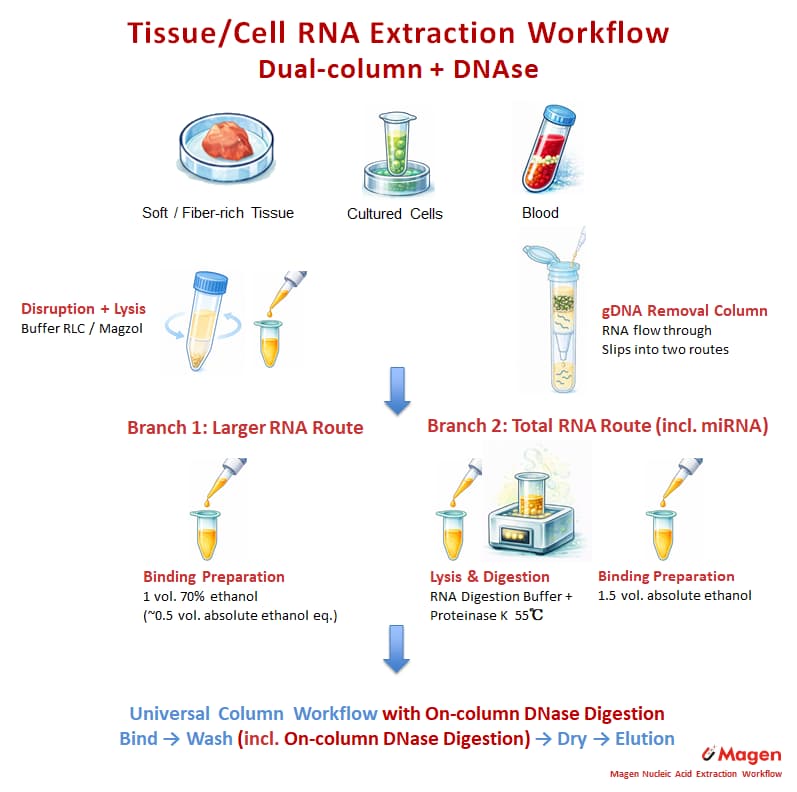
IVD4121 HiPure Total RNA Kit extends the upstream gDNA removal logic by adding route branching and on-column DNase support. After disruption and lysis, the lysate passes through a gDNA removal column under the no- or very-low-alcohol checkpoint. The RNA-containing flow-through can then be directed into a larger RNA route or a total RNA route including miRNA.
In the larger RNA branch, 1 vol. 70% ethanol creates the intermediate binding condition shown in the workflow diagram, where larger RNA is recovered. In the total RNA including miRNA branch, additional digestion with RNA Digestion Buffer and Proteinase K is followed by 1.5 vol. absolute ethanol, moving the sample into a small-RNA-inclusive binding condition. On-column DNase digestion adds a second level of DNA background control after the upstream gDNA removal step.
4.3 R4310: MagZol lysis, phase separation and silica fractionation
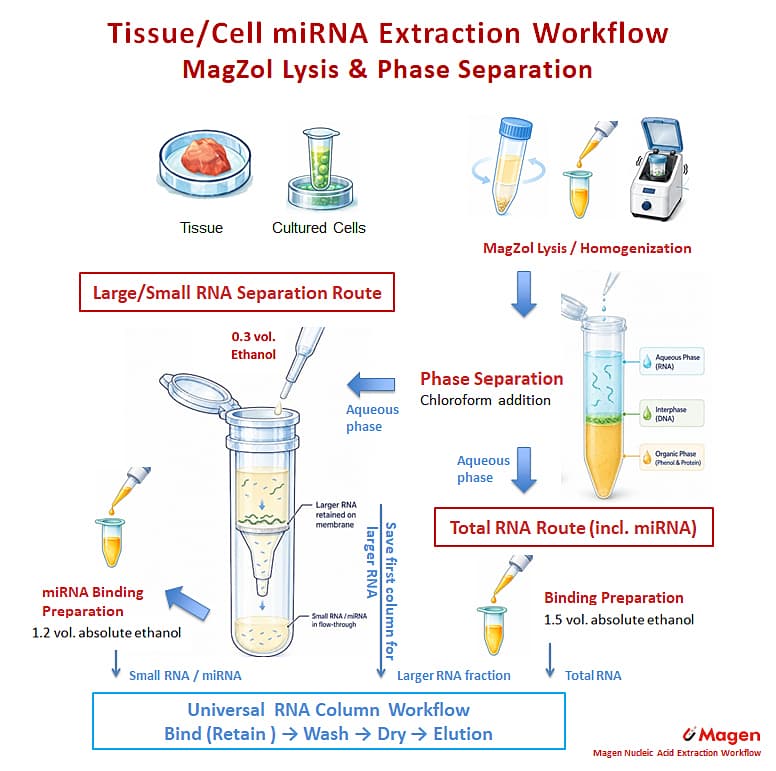
R4310 HiPure Universal miRNA Kit uses a MagZol front end for phenol/guanidine-based lysis, strong RNase inactivation and efficient disruption of tissue or cultured cells. After chloroform addition and centrifugation, the aqueous RNA phase is recovered and directed into a silica-column workflow.
From this point, the downstream binding preparation determines the recovered RNA fraction. For total RNA including miRNA, the aqueous phase is prepared with 1.5 vol. absolute ethanol and loaded for broad RNA binding. For large/small RNA separation, the workflow first uses a lower-alcohol condition to retain the large RNA fraction while small RNA remains in the flow-through; the small-RNA-containing flow-through is then adjusted into a high-alcohol binding condition and loaded onto a second column. This is where the MagZol route changes from liquid extraction into controlled solid-phase fractionation.
4.4 R4311: chemical lysis and miRNA enrichment without phase separation
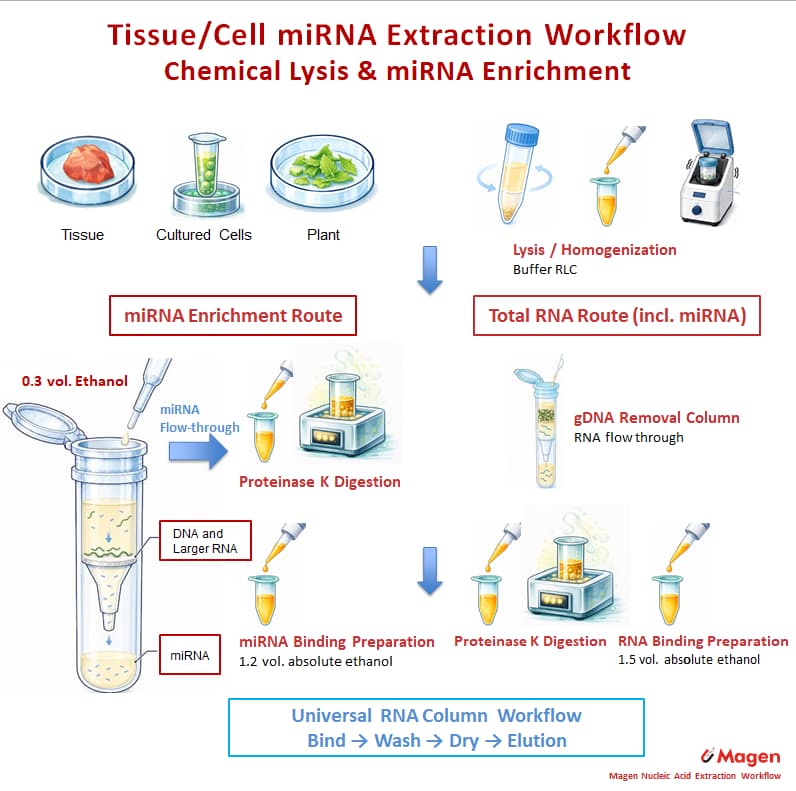
R4311 HiPure Cell miRNA Kit applies size-selective recovery using a chemical lysis format rather than MagZol phase separation. Samples are lysed and homogenized in Buffer RLC. In the total RNA route, the lysate first passes through a gDNA removal column, and the RNA-containing flow-through is treated with Proteinase K and adjusted with ethanol for total RNA including miRNA binding.
In the miRNA enrichment route, the first column is used differently. A lower-alcohol condition allows DNA and larger RNA to be retained while miRNA remains in the flow-through. After Proteinase K digestion and high-alcohol binding preparation, the miRNA-containing flow-through is loaded onto a second RNA column. This makes R4311 a useful example of chemical lysis plus column-based fractionation, without relying on organic phase separation.
5. Why Small RNA Recovery Requires More Than Adding Ethanol
A routine RNA kit cannot be converted into a validated total RNA including miRNA workflow by increasing only the ethanol volume during binding. That approach changes one variable, while small RNA recovery depends on an integrated chemical and physical system.
5.1 Salt strength and charge shielding
Small RNA binding requires a strong dehydration environment, but alcohol alone is not enough. Chaotropic salt and overall ionic strength help shield the negative phosphate backbone and support ion-mediated contacts between nucleic acid and silica. If large volumes of ethanol are added without preserving the appropriate salt environment, the apparent alcohol ratio may increase while the charge-shielding condition becomes weaker. This single-variable addition may dilute the chaotropic guanidine salts and weaken the charge-shielded binding environment. As a result, small RNA molecules may not adsorb efficiently to the silica surface despite the higher volumetric alcohol ratio.
5.2 RNA size and alcohol threshold
RNA length changes the binding threshold. Larger RNA molecules enter the silica-binding range under moderate dehydration conditions. Short RNA molecules, including miRNA, remain more soluble and require a stronger reduction in water activity and dielectric constant. A validated miRNA workflow moves the lysate into that window while maintaining compatible salt and wash chemistry.
5.3 Membrane structure and surface chemistry
A silica membrane optimized for routine RNA purification is usually balanced for loading capacity, flow rate, contaminant tolerance and larger RNA retention. That balance does not automatically provide efficient retention of 18-200 nt RNA species. Small RNA retention also depends on pore structure, membrane surface behavior and how the wash system preserves the dehydrated binding state.
5.4 Wash buffer stringency and leaching
Small RNA can be captured during binding and still be lost during washing if the wash environment becomes too aqueous. In many small-RNA workflows, the effective wash environment is maintained in a strongly ethanolic range, commonly around 80% ethanol or higher, so that short RNA remains dehydrated and retained during washing. Because miRNA and other short RNA species have limited contact length on the silica surface, their retention is more sensitive to changes in alcohol strength, ionic conditions and wash-buffer composition than larger RNA molecules. If the wash condition becomes too aqueous, the small-RNA fraction is more prone to partial desorption and leaching. The exact formulation is workflow-specific, but the principle is consistent: small RNA must remain retained through binding, washing and the transition to final elution.
5.5 Drying and downstream inhibition
High-alcohol binding and washing improve small RNA retention, but they also increase the risk of residual ethanol. Ethanol held in the membrane or carried into the eluate can inhibit reverse transcription, PCR, qPCR and library preparation. For miRNA-inclusive workflows, drying is therefore not a minor housekeeping step. It is part of the recovery chemistry.
6. Practical Interpretation for Workflow Design
For a laboratory, the useful technical question is which separation window the workflow must create for the intended assay.
If the downstream assay focuses on mRNA, rRNA, RT-PCR or routine expression analysis, the workflow should prioritize efficient lysis, low DNA background and robust larger RNA recovery. A dual-column route with gDNA removal may be sufficient, and DNase support can be added when the assay is highly DNA-sensitive.
If the assay requires miRNA, small RNA-seq, circulating small RNA analysis or any interpretation in which short RNA composition matters, the workflow must be small-RNA-inclusive from binding through washing and drying. It is not enough for a protocol to recover total absorbance at A260; the short RNA fraction must remain retained throughout the process.
If large RNA and small RNA must be analyzed separately, the workflow should be designed as a fractionation route rather than as a single total RNA extraction. The first binding window should retain larger RNA while leaving miRNA in the flow-through. The second binding window should then move the small RNA fraction into a stronger dehydration and binding condition.
If the sample is difficult to lyse or carries substantial protein, lipid or extracellular matrix burden, the front-end decision becomes important. A MagZol-based phase-separation route may improve release and reduce sample-derived interference before silica binding. A chemical lysis route may be preferred when operational simplicity and avoidance of organic phase transfer are more important.
For non-standard samples or downstream assays, workflow development should treat lysis, pH, salt strength, alcohol ratio, membrane behavior, wash stringency and drying as one integrated system. Magen workflow customization is most useful in this setting: the question is not only how to extract RNA, but which molecular population must be separated, retained and delivered to the downstream assay.
Conclusion
In a well-designed RNA extraction workflow, performance is built from details that are easy to overlook: phase behavior, dehydration, dielectric constant, salt-mediated charge shielding, pH, membrane retention, wash alcohol strength and final drying. These details explain why workflows that share a similar final column step can produce different RNA fractions, and why separation of gDNA, large RNA and small RNA must be designed as a complete workflow rather than as a single ethanol adjustment.
Related Resources
- Tissue & Cell RNA Extraction – Purchase Guide
- Tissue RNA and miRNA Extraction Workflows Explained
- Tissue / Cell RNA Extraction Systems
- Tissue / Cell miRNA Extraction Systems
Representative Workflow Notes
-
Routine tissue and cell total RNA extraction using direct lysis, silica column binding, washing, drying and elution.
-
Total RNA extraction with upstream gDNA removal before RNA column purification.
-
RNA extraction with gDNA removal, DNase digestion and route options for larger RNA or total RNA including miRNA.
-
Column-based total RNA including miRNA recovery or miRNA enrichment without organic phase separation.
-
MagZol lysis, phase separation and silica column recovery for total RNA including miRNA or large / small RNA fractionation.
-
MagZol lysis and phase separation followed by column or magnetic purification for difficult and heterogeneous samples.
-
Magnetic total RNA extraction with DNase treatment, washing, drying and elution for manual or automated processing.