Introduction
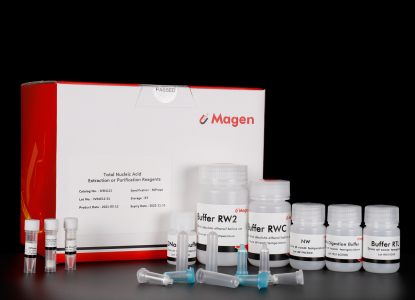
The HiPure Total RNA Plus Kit is designed for RNA purification workflows requiring stringent removal of genomic DNA contamination. The system integrates a DNA removal column with DNase digestion to ensure efficient elimination of residual genomic DNA during RNA purification.
The workflow supports purification of total RNA including small RNA species from tissue samples and cultured cells. The protocol is commonly used in RNA-seq experiments, RT-PCR analysis and other applications where trace genomic DNA contamination may affect downstream results.
For routine RNA extraction workflows laboratories may refer to the HiPure Total RNA Plus Kit (R4111), while automated RNA purification systems can be implemented using the MagPure Universal RNA Kit (IVD3020).
Details
Workflow
Workflow Overview
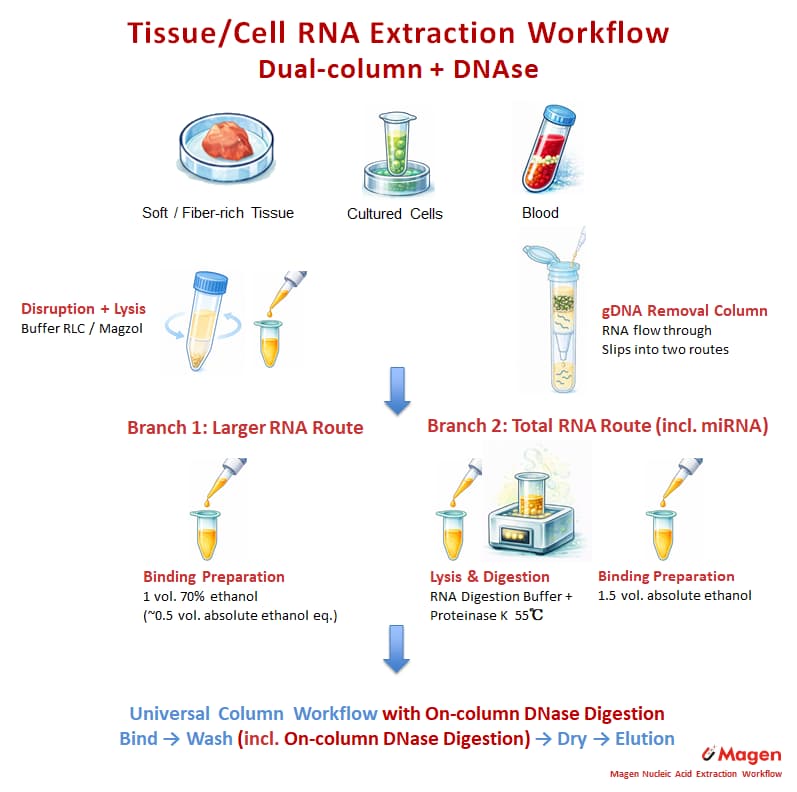
The HiPure Total RNA Kit with DNase I uses a dual-column workflow with additional DNase-supported RNA purification. After disruption and lysis, genomic DNA is first reduced by passing the lysate through a gDNA removal column. The RNA-containing flow-through can then be directed into either a larger RNA route or a total RNA route including miRNA. Following RNA binding on the silica column, on-column DNase digestion provides an additional level of DNA background control before washing, drying and elution.
Sample Handling Logic
This workflow is designed for samples where RNA recovery and DNA background control are both important. Soft tissues, fiber-rich tissues, cultured cells and blood-derived cell pellets may require different front-end handling before the shared downstream column workflow. The route selection is determined by the analytical target: the larger RNA route is used when recovery of RNA above approximately 200 nt is sufficient, while the total RNA route including miRNA applies stronger binding preparation to retain small RNA species as well.
Time and Workflow Characteristics
Under typical manual operation, the workflow is usually completed within about 45–75 minutes, depending on sample pretreatment, route selection and the DNase digestion step. The workflow is slightly longer than a routine dual-column RNA protocol, but provides more structured DNA background control and broader route flexibility. For detailed step-by-step conditions, workflow guidance and estimated processing times, please refer to the Workflow Note in the Download section.
Specifications
|
Features
|
Specifications
|
|
Main Functions
|
Isolation total RNA(incl. miRNA or only large RNA)from tissue, cell using two columns and DNase plus reagent
|
|
Applications
|
RT-PCR, cDNA synthesis, second generation sequencing
|
Products
|
RNA, miRNA
|
|
Purification method
|
Mini spin column
|
|
Purification technology
|
Silica technology
|
|
Process method
|
Manual (centrifugation or vacuum)
|
|
Sample type
|
Clinical tissues, cells, lymphocytes
|
|
Sample amount
|
Tissue: <20 mg
Cells: <5 x 10⁶
|
|
Yield
|
2-50μg
|
|
Elution volume
|
≥30μl
|
|
Time per run
|
~45-75 minutes
|
Application Scenario Summary
IVD4121 combines dual-column genomic DNA removal with on-column DNase digestion, providing an additional level of DNA background control for DNA-sensitive RNA applications. This route is especially useful for RT-qPCR, RNA-seq, viral RNA quantification and molecular testing-like workflows where residual genomic DNA may interfere with expression-level interpretation. The research examples below highlight its use in cancer drug-response transcriptomics, melanoma metabolism, mitochondrial pathway analysis and HIV-related immune and viral RNA studies.
|
Application Scenario
|
Sample Source
|
Downstream Research Use
|
|
AML stem cell drug-response and PROTAC-mediated AURKA degradation research
|
AML cell lines, AML stem cell-related models and primary patient blasts treated with AURKA PROTACs
|
Transcriptomic analysis to compare cellular responses to different AURKA degraders, supporting investigation of mitotic AURKA, interphase AURKA, MYC/E2F targets, stemness programs and PROTAC cocktail–mediated AML stem cell suppression.
|
|
Melanosomal glucose metabolism, pigmentation and melanoma metastasis research
|
Slc45a2-deficient primary melanocytes, B16F10 melanoma cells and mouse pigmentation / melanoma metastasis models
|
qPCR-based gene expression analysis together with metabolic flux and biochemical assays, supporting investigation of SLC45A2 as a proton/glucose exporter regulating melanosomal pH, glycolysis, melanin biosynthesis and melanoma metastasis.
|
View more application scenarios
|
Application Scenario
|
Sample Source
|
Downstream Research Use
|
|
Mitotic kinase inhibitor response and oxidative phosphorylation dependency in cancer cells
|
Alisertib-treated breast cancer MDA-MB-231 cells and mitotic kinase inhibitor response models
|
RNA-seq transcriptome analysis after alisertib treatment, combined with genome-wide CRISPR/Cas9 screening, to identify OXPHOS and mitochondrial respiration pathways that enhance the antineoplastic activity of mitotic kinase inhibition.
|
|
HIV-1-specific CD8+ T cell immune function and exhaustion research
|
PBMCs and HIV-1-specific CD11c+ CD8+ T cell populations from HIV-1-infected individuals
|
RNA-based immune analysis in combination with flow cytometry and functional killing assays, supporting evaluation of CD11c+ CD8+ T cells with low PD-1 expression, strong cytotoxicity and anti-HIV-1 activity.
|
|
Chronic HIV-1 infection, inflammatory proteins and T cell immune recovery research
|
PBMCs from treatment-naïve HIV-1 patients, immunological responders and immunological non-responders under ART
|
Total cellular RNA extraction for HIV-1 RNA quantification, supporting analysis of HIV-1 reservoir activity together with inflammation-related proteomics and T cell exhaustion / activation / differentiation profiling.
|
Kit Contents
|
Contents
|
IVD4121
|
|
Purification Times
|
50 Preps
|
HiPure DNA Mini Column Ⅱ
|
50
|
|
HiPure RNA Mini Columns
|
50
|
|
2ml Collection Tubes
|
150
|
Proteinase K
|
24 mg
|
Protease Dissolve Buffer
|
1.8 ml
|
DNase I
|
600 μl
|
DNase Buffer
|
6 ml
|
Buffer RTL
|
40 ml
|
RNA Digestion Buffer
|
15 ml
|
|
Buffer RWC*
|
20 ml
|
Buffer RW2*
|
20 ml
|
Nuclease Free Water
|
10 ml
|
Storage and Stability
Proteinase K should be stored at 2–8°C upon arrival. DNase I should be stored at -20°C. However, short-term storage (DNase I up to 1 weeks, Proteinase K up to 8 weeks) at room temperature (15–25°C) does not affect their performance. The remaining kit components can be stored at room temperature (15–25°C) and are stable for at least 18 months under these conditions.