


Operational workflow logic for total RNA, gDNA control, miRNA enrichment, MagZol phase separation and magnetic automation
Overview
Tissue and cell RNA extraction workflows often look similar at the final purification stage. Most of them end with binding, washing, drying and elution. The practical differences are usually created earlier: how the sample is disrupted, how genomic DNA is controlled, whether small RNA must be retained, and whether the workflow is designed for manual columns, manual magnetic handling or automated extraction.
The workflow diagrams are read here as process architectures: where the sample enters, where DNA control is introduced, how RNA binding conditions are prepared, and which routes support routine total RNA, miRNA-inclusive recovery, size fractionation or magnetic automation.
The related resources at the end of this article provide the companion selection table, protocol-level workflow notes and a deeper discussion of molecular separation chemistry.
1. How to Read the Workflow Family
The workflow family can be understood through four practical decisions. First, the sample must be disrupted well enough for RNA to enter solution before purification begins. Soft tissues and cultured cells usually tolerate a direct lysis route, while fibrous tissue, plant material, fungal or bacterial samples and viscous lysates may need stronger mechanical disruption or a MagZol front end.
Second, the RNA target must be defined. Routine mRNA or total RNA analysis usually requires consistent larger RNA recovery. miRNA or small RNA analysis requires a route that deliberately retains or enriches short RNA species; this should not be assumed from every routine total RNA protocol.
Third, the acceptable DNA background must be decided. Some assays tolerate low residual DNA, while RT-qPCR, viral RNA quantification and RNA-based molecular testing often require more deliberate gDNA control.
Finally, the handling format matters. A column workflow is straightforward and familiar, while magnetic workflows are easier to scale across multiple samples and automated instruments.
2. Direct Chemical Lysis Routes
Direct lysis routes are the shortest path from sample disruption to solid-phase RNA purification. They avoid organic phase transfer and are generally easier to standardize for routine tissue and cell work. The main variation lies in how much DNA control and route branching are built into the workflow.
2.1 Single-column total RNA workflow: R4011 HiPure Total RNA Kit
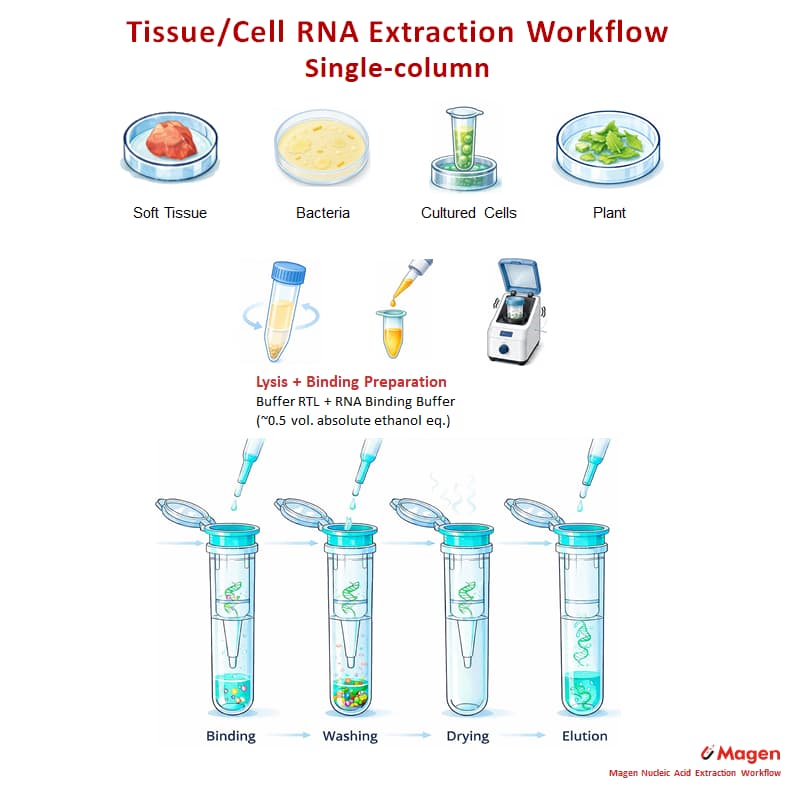
R4011 represents the simplest direct route. The sample is disrupted and lysed, RNA binding conditions are established, and the lysate is loaded directly onto a silica RNA column. The column then carries the common downstream path: binding, washing, drying and elution.
This workflow is best understood as a routine total RNA format for samples that can be lysed cleanly and do not require a dedicated gDNA-removal column or miRNA-enrichment branch. Its value is operational simplicity. Its boundary is equally important: when residual DNA control, difficult lysis or small RNA recovery becomes the main requirement, a more specialized route should be used.
2.2 Dual-column gDNA removal workflow: R4111 HiPure Total RNA Plus Kit
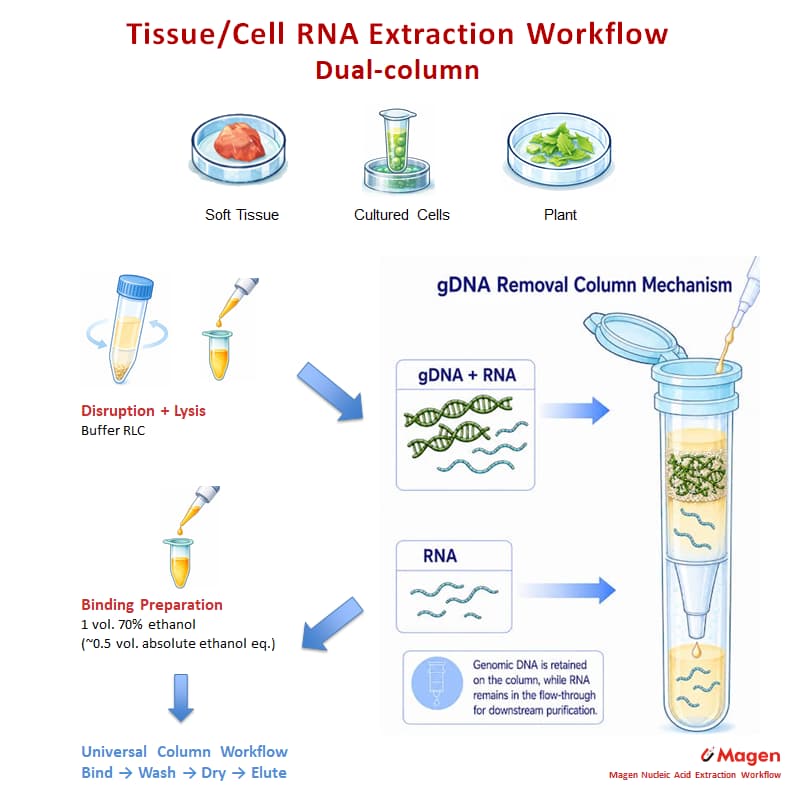
R4111 adds an upstream gDNA removal step before RNA binding. After lysis and homogenization, the lysate passes through a DNA removal column. Genomic DNA is reduced at the front end, while RNA remains in the flow-through for downstream binding on the RNA column.
The important feature is workflow order. DNA is addressed before RNA reaches the final RNA column. This lowers the DNA burden entering the RNA purification step and provides a more suitable route for routine RT-PCR or qPCR workflows where reduced genomic DNA background is useful, but where a full DNase-supported workflow may not be necessary.
2.3 Dual-column plus DNase workflow with route branching: IVD4121 HiPure Total RNA Kit
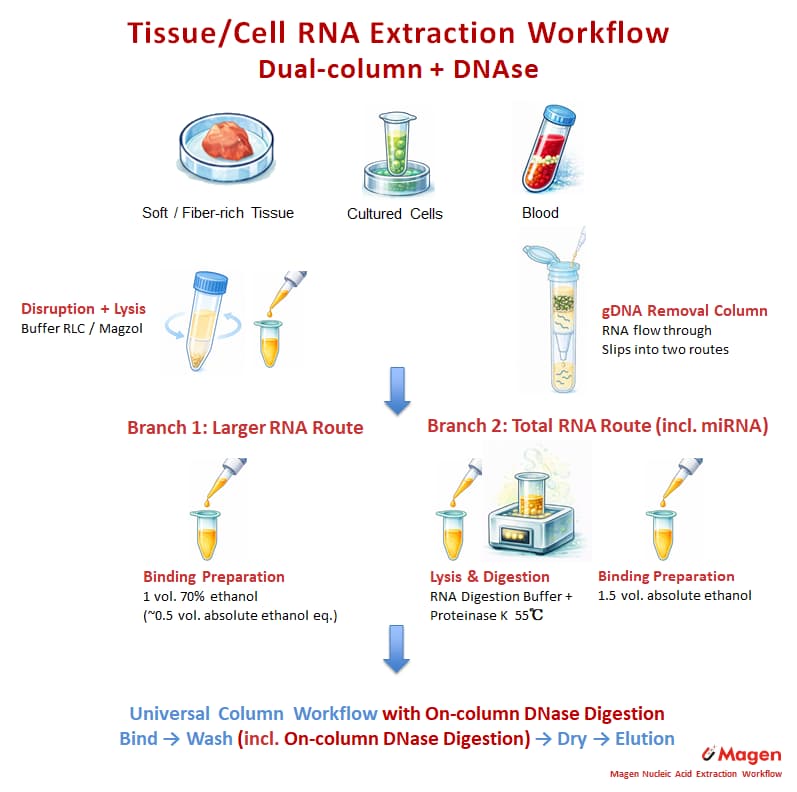
IVD4121 combines upstream gDNA removal with on-column DNase support. The lysate first passes through a gDNA removal column, and the RNA-containing flow-through then enters one of two downstream branches. One branch is directed toward larger RNA recovery; the other is directed toward total RNA including miRNA.
This design is useful when both route flexibility and DNA background control matter. The workflow separates DNA control into two stages: front-end removal before RNA binding and DNase digestion after RNA capture. The additional time reflects an added control layer, supporting applications where DNA carryover may influence interpretation.
3. miRNA and RNA Size-Fractionation Routes
miRNA workflows should be read as size-directed workflows rather than routine total RNA workflows with one extra step. The goal is to either recover total RNA including short RNA species or deliberately separate larger RNA from the small RNA / miRNA fraction.
3.1 Chemical lysis miRNA enrichment workflow: R4311 HiPure Cell miRNA Kit
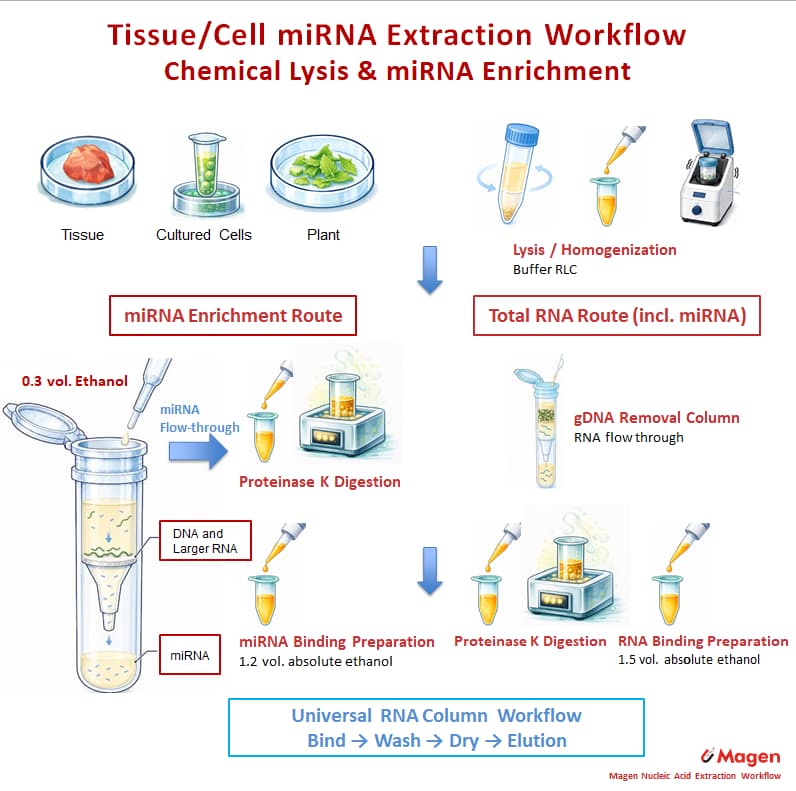
R4311 uses chemical lysis rather than MagZol phase separation. In the total RNA route, the workflow proceeds through gDNA removal, Proteinase K treatment and high-alcohol binding preparation so that total RNA including miRNA can be recovered together.
In the miRNA enrichment route, the first column is used to retain DNA and larger RNA under a lower-alcohol condition, while miRNA remains in the flow-through. The miRNA-containing flow-through is then treated and moved into a stronger binding condition for recovery on a second RNA column. This route is suitable when small RNA recovery is the main workflow objective, but the laboratory wants to avoid organic phase separation.
3.2 MagZol miRNA and large/small RNA separation workflow: R4310 HiPure Universal miRNA Kit
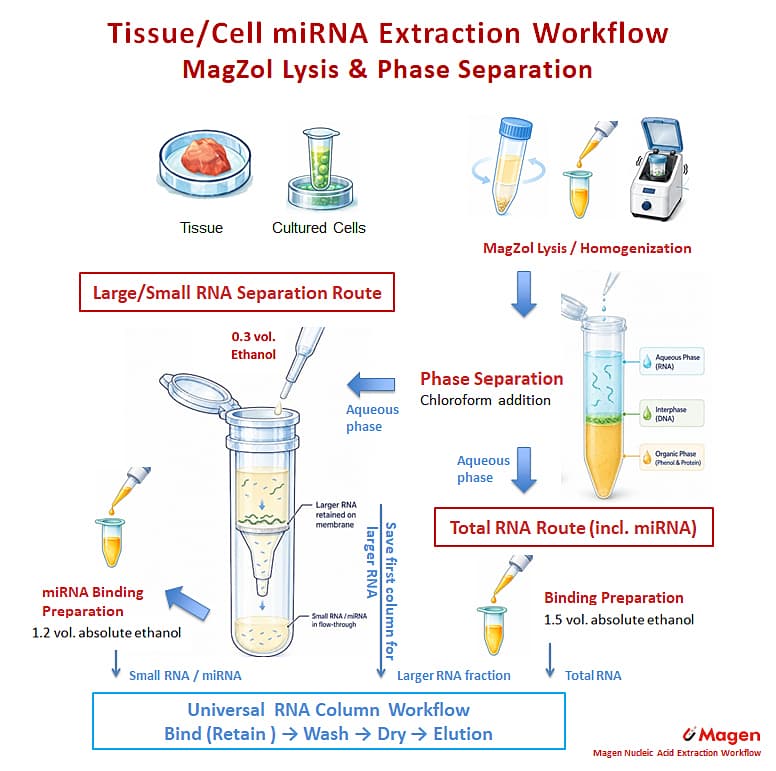
R4310 begins with MagZol lysis and chloroform phase separation. The aqueous RNA phase is recovered after front-end separation, and the downstream column route then determines whether total RNA including miRNA is collected together or larger and small RNA fractions are collected separately.
This workflow combines two practical advantages. MagZol provides strong lysis and early matrix reduction, which is useful for difficult tissue and cell samples. The downstream silica columns then provide controlled retention and optional fractionation. For total RNA including miRNA, the aqueous phase is prepared for broad RNA binding. For large/small RNA separation, the first column retains larger RNA while the miRNA-containing flow-through is recovered in a second binding step.
4. MagZol Universal RNA Workflows: Shared Front End, Different Recovery Format
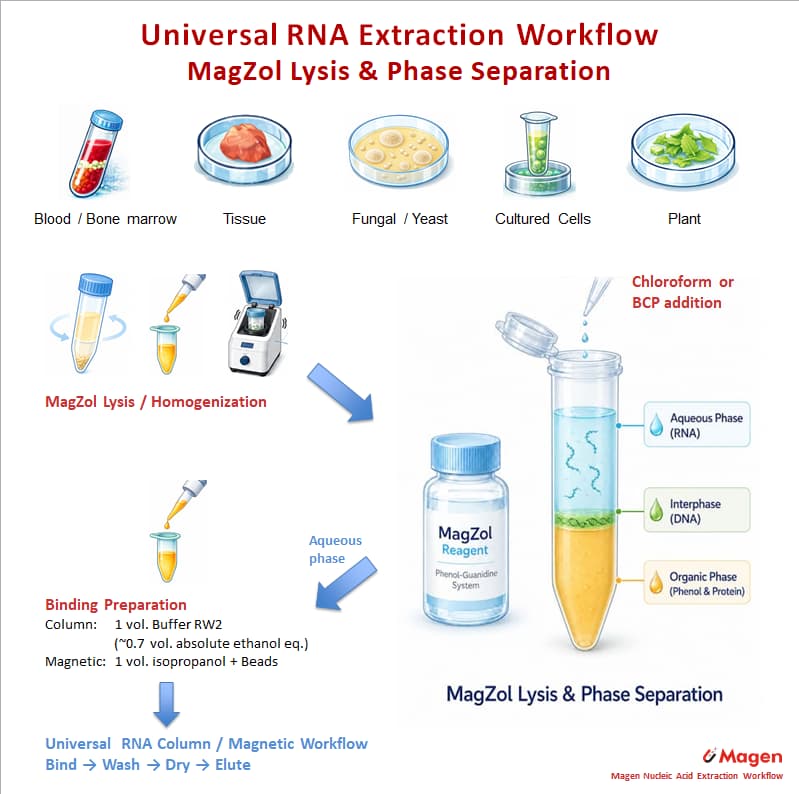
R4130 HiPure Universal RNA Kit and R6623 MagPure Universal RNA Kit II share the same front-end concept: MagZol lysis followed by phase separation. The sample is disrupted in a phenol / guanidine system, and after chloroform or BCP addition and centrifugation, RNA is recovered in the aqueous phase. This step reduces much of the DNA, protein and matrix background before the final purification format begins.
The difference is the downstream recovery format. R4130 connects the aqueous RNA phase to a silica spin column workflow. R6623 connects the same front-end logic to magnetic-particle purification, using isopropanol and MagPure Particles to bind RNA before magnetic washing and elution. The shared diagram should therefore be read as a common sample-release and phase-separation architecture, with the final recovery path selected according to preferred handling format.
These routes are useful when direct chemical lysis may be less tolerant of sample complexity. Fibrous tissue, plant material, fungal or bacterial samples, blood-derived cell pellets and heterogeneous biological materials can benefit from the stronger front-end cleanup, while the downstream column or magnetic step standardizes RNA recovery.
5. Magnetic Bead RNA Workflows and Automation
Magnetic RNA workflows replace repeated centrifugation with magnetic particle capture and release. The RNA still binds to a silica-based surface under defined chemical conditions, but the handling format is magnetic. This makes the route easier to adapt to multi-sample work and automated platforms.
5.1 Magnetic beads workflow with DNase support: IVD3020 MagPure Universal RNA Kit and R6622
MagPure Total RNA Kit
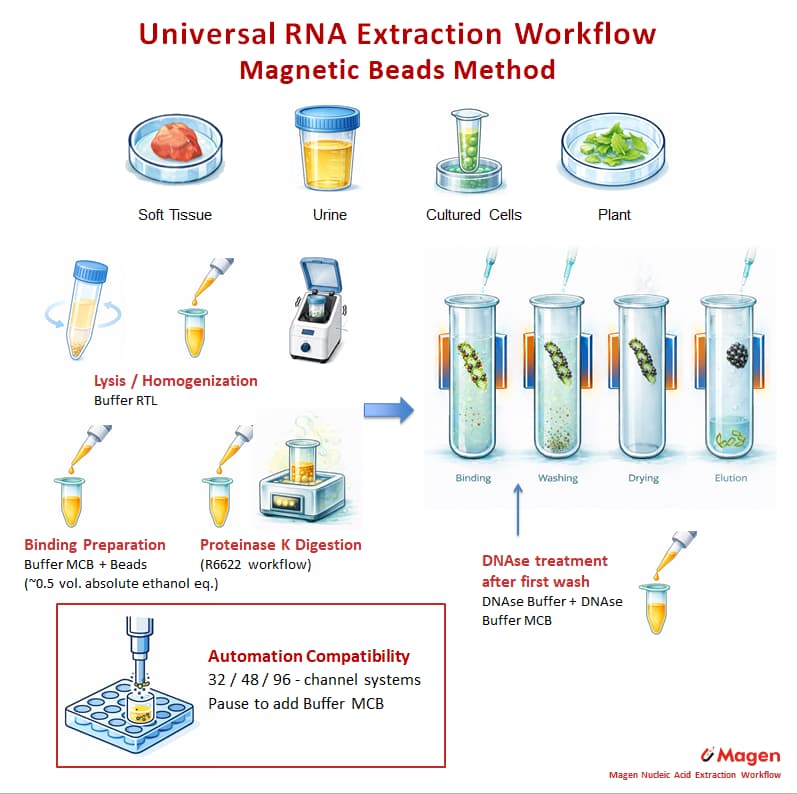
IVD3020 and R6622 follow a related magnetic route: sample lysis, Buffer MCB-mediated RNA binding to magnetic particles, first wash, DNase treatment, restoration of binding conditions, final washes, drying and elution. The shared workflow diagram emphasizes the magnetic process rather than a specific catalog-number distinction.
This route is appropriate when laboratories need DNA background control and scalable magnetic handling. IVD3020 is commonly positioned as a universal magnetic RNA workflow with DNase support, including manual and automated processing. R6622 follows the same general magnetic purification logic and includes Proteinase K-assisted sample processing, which can support lysates where additional digestion improves handling.
5.2 Automated magnetic workflow without pause: IVD3020B MagPure Universal RNA Kit B
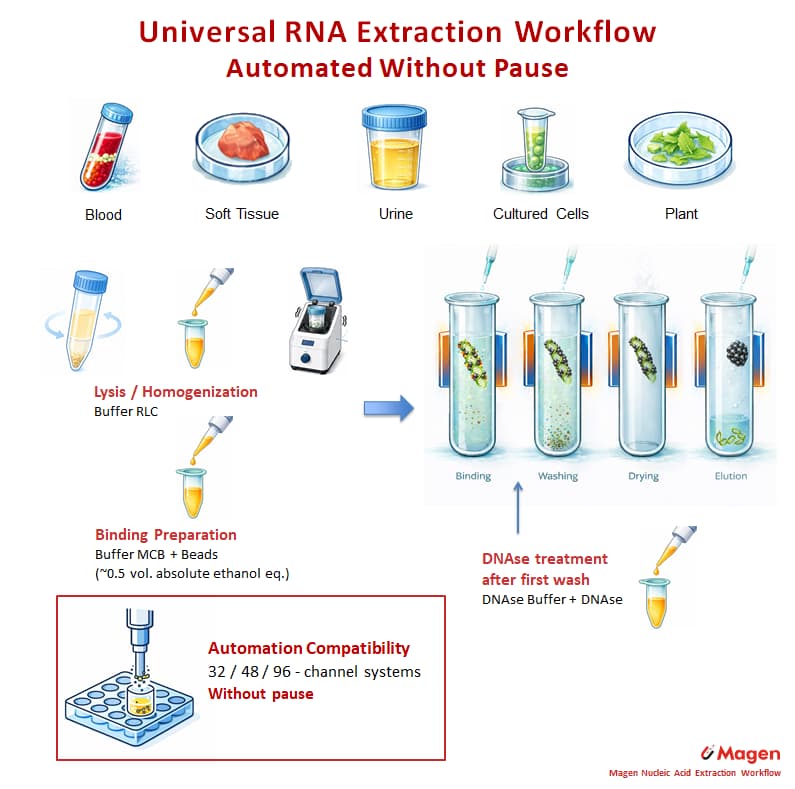
IVD3020B is designed around automation continuity. It uses the same general magnetic principle of lysis, particle binding, DNase treatment, washing and elution, but the automated program is organized so that the run can proceed without a mid-process manual pause.
This is most relevant for low-RNA-yield or low-input samples, including small tissue input, cultured cells, blood or bone marrow cell fractions and related clinical samples. The practical value is not a different RNA chemistry, but a more automation-friendly workflow architecture that reduces manual interruption and improves consistency across plates and operators.
6. Compact Workflow Map
The table below condenses the workflow family into the main operational question behind each route.
| Workflow Route | Main Workflow Question | Operational Logic | Representative Kits |
|---|---|---|---|
| Single-column RNA | Is routine total RNA recovery enough? | Direct lysis followed by one RNA column. | R4011 |
| Dual-column RNA | Should gDNA be reduced before RNA binding? | Front-end gDNA removal column followed by RNA column purification. | R4111 |
| Dual-column + DNase | Is stronger DNA background control needed? | gDNA removal before RNA binding plus on-column DNase support. | IVD4121 |
| Chemical lysis miRNA | Is small RNA enrichment required without phase separation? | Chemical lysis with sequential column conditions for miRNA recovery. | R4311 |
| MagZol miRNA / fractionation | Is strong lysis and large/small RNA separation needed? | MagZol phase separation followed by total RNA or fractionated column binding. | R4310 |
| MagZol universal RNA | Does the sample need phase separation before final purification? | MagZol front end with either column or magnetic recovery. | R4130 / R6623 |
| Magnetic beads RNA | Is scalable magnetic handling preferred? | Magnetic particle binding with DNase-compatible washing and elution. | IVD3020 / R6622 |
| Automated without pause | Is uninterrupted automation the priority? | Automation-oriented magnetic workflow for low-input or clinical-style samples. | IVD3020B |
7. Selected Publication-Informed Application Contexts
Published-use records for Magen tissue and cell RNA extraction kits show how workflow choice follows the sample matrix, RNA target and downstream readout. The contexts below are selected at the workflow-route level, with publication links reserved for the corresponding product pages or reference list.
| Research Context | Representative Workflow Route | Published-Use Context |
|---|---|---|
| Metabolic gene expression and liver disease models | Single-column total RNA workflow | R4011-format total RNA extraction has been used with mouse liver tissues and primary hepatocyte-related metabolic models in fructose diet, high-fat diet, leptin-deficient and TK-related studies. Downstream qRT-PCR was combined with isotope tracing and triglyceride analysis to examine fructose-driven hepatic lipogenesis, NAFLD-related metabolism and dietary fructose tolerance. |
| Macrophage inflammation, mechanosensing and antibacterial response | Single-column total RNA workflow | R4011-format total RNA extraction has been used in murine macrophage models, including BMDMs, LPS stimulation, infection systems and Piezo1-related mechanosensing studies. qPCR readouts supported analysis of TLR4 signaling, calcium influx, actin remodeling, phagocytosis, ROS production and bacterial clearance. |
| Viral RNA quantification and host antiviral response | Dual-column RNA workflow with gDNA reduction | R4111-format workflows have been used in ZIKV-infected Huh7, U87MG and Vero cells and related host-response models. Total RNA extraction supported qRT-PCR analysis of viral RNA, antiviral restriction factors, STING-dependent TBK1 / IRF3 activation, cytokine signaling and interferon-stimulated gene expression. |
| Stem cell differentiation and transcriptional regulation | Dual-column RNA workflow with gDNA reduction | R4111-format RNA extraction has been used in human pluripotent stem cell studies involving PCGF6 / SOX2 regulation, endogenous retroviral elements and TFAM-dependent mitochondrial dysfunction. RNA-seq and qRT-PCR were used to evaluate lineage markers, mitochondrial gene expression, cell-cycle genes and pluripotency-related transcriptional programs. |
| DNA-sensitive cancer and immune-cell RNA analysis | Dual-column + DNase workflow | IVD4121-format workflows have been used in AML stem-cell drug-response studies, melanoma pigmentation and metastasis models, breast cancer mitotic kinase inhibitor response studies and HIV-1 immune-cell analysis. RNA-seq, qPCR and RNA-based immune analysis supported investigation of AURKA degradation, melanosomal metabolism, oxidative phosphorylation dependency and HIV-related immune function. |
| Tumor tissue, immune microenvironment and cancer therapy studies | MagZol + column universal RNA workflow | R4130-format MagZol + column workflows have been used with residual colorectal tumor tissues after ablation, TNBC tumor tissues, breast cancer bone metastasis models and vemurafenib-resistant colorectal cancer cells. RNA-seq and qRT-PCR supported analysis of tumor immune suppression, cytokine / chemokine expression, immune checkpoint glycosylation, inflammasome signaling, metastasis and drug resistance. |
| Plant floral transcriptomics and developmental regulation | MagZol + column universal RNA workflow | R4130-format workflows have been used for transcriptome sequencing of Gelsemium elegans floral organs, including styles and filaments from different floral morphs and developmental stages. The workflow supported identification of differentially expressed genes and candidate S-locus supergene components involved in heterostyly and floral morphology. |
| miRNA, lncRNA and non-coding RNA biomarker studies | MagZol-based miRNA / total RNA workflow | R4310-format workflows have been used in follicular lymphoma transformation, hepatocellular carcinoma promoter activity analysis and bladder urothelial carcinoma lncRNA validation. Downstream analysis included miRNA RT-qPCR, RNA-seq validation and RT-qPCR assessment of prognostic lncRNA markers. |
These examples connect workflow structure with experimental use. Single-column routes support controlled tissue and cell gene-expression studies; dual-column and DNase-supported routes are useful when DNA background matters; MagZol-based routes appear frequently in tumor, plant and difficult-matrix contexts; and miRNA-oriented workflows are selected when small RNA or non-coding RNA is part of the analytical target.
8. Practical Use of the Workflow Diagrams
The workflow diagrams are most useful when they are read as process maps. They show where sample preparation ends, where RNA binding begins, where DNA control is introduced, and whether the route is designed for one RNA output or separated RNA fractions. Protocol details such as sample input, centrifugation or magnetic handling, DNase setup and elution volume should still be checked against the individual product workflow note or manual.
In routine soft tissue or cultured cell work, the direct routes are usually the first workflows to consider. When genomic DNA background matters, the dual-column or DNase-assisted routes provide more structured control. When the target is miRNA or small RNA, a dedicated miRNA-inclusive or miRNA-enrichment workflow should be selected. When the sample is difficult or heterogeneous, MagZol phase separation can improve the front-end condition before column or magnetic recovery. When throughput and standardization are priorities, magnetic and automation-oriented formats become more practical.
In practice, workflow performance comes from the full route rather than a single step. Disruption, lysis chemistry, DNA control, binding preparation, washing, drying and elution must be matched to the sample and assay. That is why Magen provides parallel column, MagZol, miRNA and magnetic workflow formats instead of forcing all tissue and cell RNA samples into one extraction route.