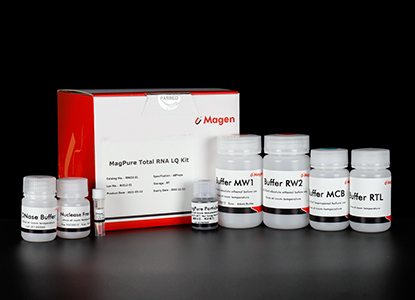
Introduction
The MagPure Total RNA Kit uses magnetic particle purification combined with Proteinase K digestion for RNA extraction from cells and tissue samples with high protein content or complex lysates. Proteinase K digestion helps degrade protein components and reduce lysate complexity, improving RNA binding efficiency to magnetic particles and supporting stable RNA purification from protein-rich samples.
After sample lysis, RNA binds to magnetic particles under optimized binding conditions while Proteinase K digestion reduces residual protein interference. The captured RNA is purified through a series of washing steps and finally eluted in RNase-free water. The workflow is compatible with both automated nucleic acid extraction platforms and routine laboratory RNA purification.
Within the Magen RNA extraction systems, automated universal RNA purification workflows are supported by the MagPure Universal RNA Kit (IVD3020), while column-based RNA purification can be performed using the HiPure Total RNA Plus Kit (R4111).
Details
Workflow
Workflow Overview
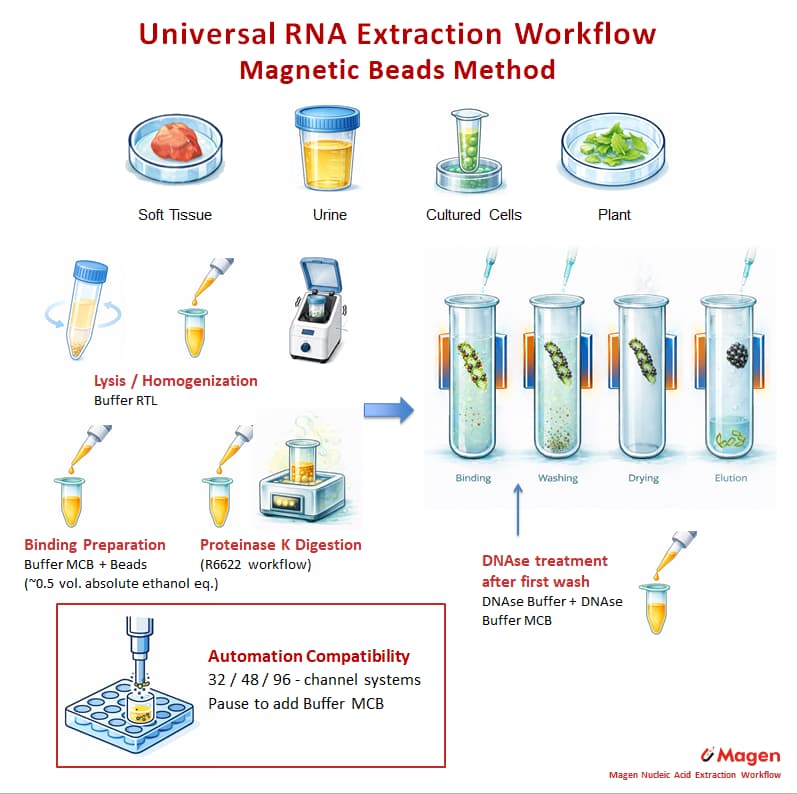
The MagPure Total RNA Kit with DNase I uses a magnetic bead–based workflow for routine total RNA extraction from tissue, cultured cells and compatible biological samples. Following disruption and lysis in RTL Lysis Buffer, RNA binding conditions are established with Buffer MCB, MagPure RNA Particles and Proteinase K. RNA is captured on the magnetic particles, separated by magnetic handling and purified through washing, DNase I treatment, re-binding, final washes, drying and elution in RNase-free water. This workflow combines silica-based RNA binding chemistry with magnetic particle handling, without phenol / chloroform extraction or alcohol precipitation.
Sample Handling Logic
This workflow is designed for laboratories that need a direct magnetic RNA purification route with built-in DNA background control. The main sample-dependent variation occurs during front-end disruption and lysis: tissue and plant samples require sufficient homogenization or grinding, while yeast and bacterial samples require mechanical disruption before entering the magnetic purification step. Once the lysate is prepared, the downstream workflow follows a consistent magnetic format, using particle binding, DNase treatment and wash chemistry to recover purified total RNA.
Time and Workflow Characteristics
Under typical manual operation, the workflow is usually completed within about 75–105 minutes, depending mainly on sample disruption, Proteinase K-assisted binding, DNase incubation and magnetic drying time. The workflow is also compatible with automated magnetic extraction, including KingFisher Flex–type systems, where the same binding, DNase treatment, washing and elution logic is transferred into a plate-based magnetic workflow. This route is suitable for laboratories that require reproducible total RNA extraction with DNase support and scalable magnetic handling. For detailed step-by-step conditions, workflow guidance and estimated processing times, please refer to the Workflow Note in the Download section.
Specifications
|
Features
|
Specifications
|
|
Main Functions
|
Isolation total RNA from tissue and cells and plant
|
|
Applications
|
RT-PCR, cDNA synthesis, second generation sequencing
|
|
Purification method
|
Polydisperse magnetic beads
|
|
Purification technology
|
Magnetic beads technology
|
|
Process method
|
Manual or automatic
|
Adaptive instrument
|
Nucleic acid extractor, pipetting workstation
|
|
Sample type
|
Animal tissue, human tissue, cultured cells, lymphocytes, ordinary plant tissue
|
|
Sample amount
|
Cells: 1 x 10⁷
Animal tissue: ≤20mg
Plant tissue: ≤100mg
Yeast cell: ≤5 x 10⁶
|
|
Yield
|
5-100μg
|
Technical Validation
MagPure Total RNA Kit was evaluated as a magnetic bead-based total RNA extraction workflow for diverse biological sample types. The workflow combines RTL lysis, magnetic particle RNA binding, DNase I digestion, magnetic washing and RNase-free water elution, and can be performed manually or adapted to automated magnetic extraction platforms such as KingFisher Flex. The validation focused on RNA recovery, RNA integrity and genomic DNA removal from representative animal tissue, plant tissue and bacterial samples.
RNA recovery from fresh animal tissue was evaluated using 5 mg and 20 mg chicken liver inputs. From 5 mg chicken liver input, RNA yields were 29.55–30.36 µg, with A260/280 values of 2.11–2.14 and A260/230 values of 1.86–2.03. From 20 mg chicken liver input, RNA yields were 66.38–68.84 µg, with A260/280 values of 2.10–2.12 and A260/230 values of 1.95–2.06. Agarose gel electrophoresis showed clear RNA band patterns across both input levels, supporting efficient RNA recovery from low and moderate tissue inputs under the tested conditions.
Genomic DNA removal was evaluated using 100 mg Epipremnum aureum leaf input, 20 mg muscle input and 1 mL bacterial culture input. In plant leaf samples, recovered nucleic acid yields decreased from 12.11–13.10 µg without DNase I treatment to 8.29–8.88 µg after DNase I treatment, with post-treatment A260/280 values of 2.04–2.10. In muscle samples, yields decreased from 4.70–4.71 µg without DNase I treatment to 3.92–4.02 µg after DNase I treatment, with A260/280 values of 2.08–2.10. This reduction in total nucleic acid signal is consistent with removal of genomic DNA during the integrated DNase I step.
Bacterial RNA extraction was tested using 1 mL bacterial culture input. Without DNase I treatment, recovered nucleic acid yields were 5.45–7.57 µg. After DNase I treatment, RNA yields were 5.19–5.36 µg, with A260/280 values of 2.03–2.05 and A260/230 values of 1.77–1.94. Electrophoresis analysis showed visible DNA background before DNase I digestion and clear RNA bands after DNase I treatment, supporting effective genomic DNA reduction and RNA recovery from bacterial samples.
Together, these results support R6622 as a magnetic total RNA extraction workflow for laboratories processing animal tissue, plant tissue, bacterial samples and related biological materials. The integrated DNase I digestion step provides effective genomic DNA reduction, while the magnetic bead format supports scalable manual or automated RNA purification for downstream RNA analysis workflows such as RT-PCR, gene expression analysis and sequencing-oriented library preparation.
Kit Contents
|
Contents
|
R662201
|
R662202
|
R662203
|
|
Purification Times
|
48 Preps
|
96 Preps
|
5 x 96 Preps
|
|
MagPure RNA Particles
|
1.7 ml
|
4.0 ml
|
18 ml
|
Proteinase K
|
24 mg
|
50 mg
|
240 mg
|
Protease Dissolve Buffer
|
1.8 ml
|
5 ml
|
15 ml
|
|
DNase I
|
600 μl
|
2 x 600 μl
|
10 x 600 μl
|
DNase Buffer
|
30 ml
|
40 ml
|
200 ml
|
RTL Lysis Buffer
|
40 ml
|
80 ml
|
400 ml
|
|
Buffer MCB*
|
18 ml
|
30 ml
|
150 ml
|
Buffer MW1*
|
44 ml
|
66 ml
|
2 x 220 ml
|
Buffer RW2*
|
20 ml
|
50 ml
|
2 x 100 ml
|
RNase Free Water
|
10 ml
|
30 ml
|
120 ml
|
Storage and Stability
MagPure RNA Particles and Proteinase K should be stored at 2–8°C upon arrival. DNase I shouldbe stored at -20°C. However, short-term storage (DNase I up to 1 weeks, MagPure RNA Particles and Proteinase K up to 8 weeks) at room temperature (15–25°C) does not affect their performance. The remaining kit components can be stored at room temperature (15–25°C) and are stable for atleast 18 months under these conditions.