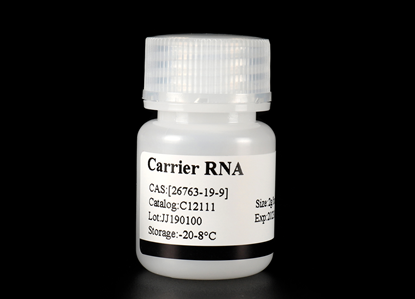
Introduction
Poly A, polyadenylate, is a mixture of 100-10000 polyadenylates, which is polymerized by polynucleotide phosphorylasein vitro. In vivo, poly (a) is added to the 3-terminal of mRNA by enzyme to improve the stability of mRNA. In the application of nucleic acid extraction, adding poly A to the lysate or binding solution can improve the yield of DNA and RNA. The mechanism of poly A improving the yield of nucleic acid is as follows:
1. Saturated contact with the surface adsorption of articles. Most polypropylene articles have static electricity on the surface, which will adsorb nucleic acids. Carrier RNA can saturate these adsorption effects and reduce the loss of target nucleic acids.
2. Inactivate trace nucleases: There are various nucleases in biological samples and environment. Poly A can inactivate trace nucleases in the extraction or preservation steps to improve the yield and stability of target nucleic acids.
3. Coprecipitation: In the nucleic acid purification step of alcohol mediated precipitation or binding, poly A can coprecipitate with the target nucleic acid or form polymerparticles to improve the recovery.
For low-input nucleic acid workflows where carrier RNA is used to improve recovery, see Magen circulating DNA and viral nucleic acid extraction systems.
Details
Specifications
|
Features
|
Specifications
|
|
Appearance
|
White lyophilized powder
|
|
Purity
|
99%
|
|
Molecular Weight
|
700-3500 KDa
|
|
Transportation conditions
|
Room Temperature
|
|
Storage conditions
|
-20-8°C, dry storage, long-term storage should be placed at -20°C.
|
Usage method
|
Take an appropriate amount of lyophilized powder, add DEPC treated water or guanidine salt solution to dissolve it into 0.1-1μg/μl, and then subpack it and store it at -20°C.
|
Application
|
1. Virus DNA/RNA extraction: adding 1-5μg Carrier RNA to the lysate can improve the yield of RNA/DNA, stabilize the target nucleic acid and avoid the degradation of the purified nucleic acid during storage.
2. In the micro DNA/RNA extraction by column membrane method (<1μg), adding carrier RNA to 1-5μg is conducive to improve the yield of nucleic acid.
3. In the alcohol mediated nucleic acid precipitation and concentration step, the addition of 1-2μg carrier RNA is helpful to improve the recovery of short segment RNA.
4. In the quantitative probe PCR reaction solution, adding 10-100ng carrier RNA to the reaction solution is helpful to improve the sensitivity and reduce the CT value.
|
Advantages
-
No pollution - no DNase and RNase pollution
-
High purity - no PCR/ RT-PCR inhibition
-
High degree of polymerization - 80% polymer is 100-2000nt
-
No human - source DNA, no novel coronavirus pollution
Technical Validation
Magen Poly A Carrier RNA was evaluated for concentration consistency, spectrophotometric purity and functional compatibility with RT-qPCR. When dissolved to 500 ng/µL, Magen Carrier RNA showed NanoDrop concentration close to the calculated weight-based concentration, with A260/280 around 2.96 and A260/230 around 4.62, comparable to tested reference carrier RNA products.
RT-qPCR compatibility was tested by adding 2 µg Carrier RNA into a purified RNA template reaction. The Ct value obtained with Magen Carrier RNA was 25.09, comparable to the no-carrier control at 25.36 and other tested carrier RNA sources, indicating that the product did not inhibit fluorescence-based RT-qPCR under the tested conditions.
Functional extraction testing showed that Carrier RNA improved RNA virus recovery in column-based viral nucleic acid extraction workflows. In a Newcastle disease virus RNA model, adding 4 µg Magen Carrier RNA reduced the average Ct value from 27.87 without carrier RNA to 23.05. In plasma dilution tests using the R4173 column workflow, Carrier RNA addition improved detection at higher dilution levels, including conditions where the no-carrier group produced no Ct signal.
Additional testing confirmed that Carrier RNA can be efficiently recovered during nucleic acid extraction and may affect NanoDrop readings, especially in low-input or cell-free samples. Because Poly A Carrier RNA has naturally high A260/280 and A260/230 values, OD-based concentration and purity ratios may mainly reflect carrier RNA rather than target nucleic acid when sample nucleic acid input is very low. For viral extraction or other low-input workflows, qPCR, RT-qPCR or fluorescence-based quantification should be used for more accurate performance evaluation.
Ordering information
|
Contents
|
C12110
|
C12111
|
C12112
|
|
Poly A, Lyophilizate
|
310μg/Tube
|
2g/Bottle
|
100-1000μg/Tube, customized
|