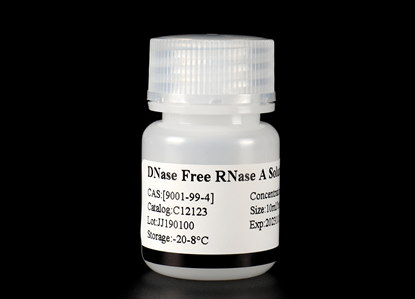
Introduction
RNase A is an endoribonuclease that specifically degrades single-stranded RNA at C and U residues. It cleaves the phosphodiester bond between the 5'-ribose of a nucleotide and the phosphategroup attached to the 3'-ribose of an adjacent pyrimidine nucleotide. The resulting 2',3'-cyclic phosphate is hydrolyzed to the corresponding 3'-nucleoside phosphate. The highest activity is exhibited with single-stranded RNA. RNase A is a single chain polypeptide containing 4 disulfide bridges.
A major application for RNase A is the removal of RNA from preparations of plasmid DNA. The enzyme is active under a wide range of reaction conditions. At low salt concentrations (0 to 100 mM NaCl), RNase A cleaves single-stranded and double-stranded RNA as well as the RNA strand in RNA-DNA hybrids. However, at NaCl concentrations of 0.3 M or higher, RNase A specifically cleaves single-stranded RNA.
For DNA purification workflows where RNA removal is required, explore Magen genomic DNA and plasmid DNA extraction systems using column or magnetic bead purification.
Details
Specifications
|
Features
|
Specifications
|
|
Purity
|
≥60% RNase A basis (SDS-PAGE)
|
|
Enzymatic activity
|
>50 Kunitz units/mg protein
|
Optimum reaction temperature
|
60°C (effective active temperature is 15-70°C)
|
Transportation conditions
|
Normal temperature transportation
|
|
Preservation conditions
|
-20-8°C, dry storage, long-term storage should be placed at -20°C.
|
|
Application 1: adding in the extraction process
|
1. Plasmid Extraction: add RNase A (25mg/ml) to buffer P1 with a final concentration of 100-300μg/ml.
2. DNA extraction: add RNase A (25mg/ml) to the digestion solution with a final concentration is 100-400μg/ml, mix well and place at room temperature for 10-15 minutes. when SDS/CTAB in lysate exceeds 2%, RNase activity will be significantly inhibited; Guanidine salt(>4M guanidine hydrochloride or >3M guanidine isothiocyanate) also significantly inhibited RNase A. When RNase A is added to the lysate, the RNase digestion effect can be extracted by appropriately diluting to reduce the concentration of SDS, CTAB and guanidine salt.
|
Application 2:
|
1. Remove RNA contamination from crude genomic DNA products: add DNase free RNase A (10mg/ml) to crude DNA products with a final concentration of 10-100μg/ml. After mixing, place at room temperature for 10 minutes.
2. Remove RNA contamination from plasmid DNA products: add DNase free RNase A (10mg/ml) to crude DNA products with a final concentration of 10μg/ml. After mixing, it can be directly used for sequencing at room temperature for 10 minutes.
|
Technical Validation
Magen RNase A was validated for DNase-free performance using purified plasmid DNA. After incubation with RNase A at final concentrations of 100 µg/mL and 250 µg/mL for 30 minutes at room temperature, agarose gel electrophoresis showed clear plasmid DNA bands without visible degradation, indicating no detectable DNase contamination under the tested conditions.
Functional RNA removal was evaluated in plasmid DNA extraction using fresh bacterial culture and the P1001 plasmid miniprep workflow. Magen RNase A showed RNA digestion performance comparable to Sigma RNase A. At 100 µg/mL, RNA contamination was effectively removed from plasmid DNA preparations, while lower concentrations showed residual RNA under the tested conditions.
RNase A performance was also tested in tissue DNA extraction using fresh pig liver samples and the D3121 column workflow. After tissue digestion with Proteinase K, addition of RNase A efficiently removed RNA contamination in the SDS-containing digestion system. Effective RNA removal was observed at 100 µg/mL, and the extracted DNA showed clear bands by agarose gel electrophoresis.
Long-term stability testing showed that RNase A solution stored at room temperature for one to two months maintained RNA digestion activity in plasmid and tissue DNA extraction workflows. Additional testing showed that RNase A addition did not reduce DNA recovery or cause visible DNA degradation, supporting its use for RNA removal during plasmid DNA and genomic DNA purification.
Ordering information
|
Contents
|
C12123
|
C12124
|
C12128
|
C12129
|
|
RNase A Solution (25mg/ml)
|
10 ml
|
100 ml
|
|
|
DNase Free RNase A Solution (10mg/ml)
|
|
|
10 ml
|
100 ml
|