Details
Specifications
|
Features
|
Specifications
|
|
Main Functions
|
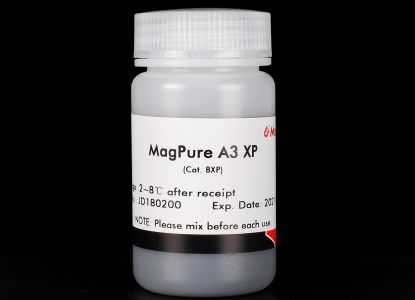
Selectively recover DNA from PCR products and enzymatic reaction solution (Replace Beckmen or agencourt AmPure)
|
|
Applications
|
Sequencing, gene chip and qPCR, etc.
|
|
Purification technology
|
Magnetic beads technology
|
|
Process method
|
Manual (centrifugation or vacuum)
|
|
Sample type
|
PCR products, enzymatic reaction solution
|
Sample amount
|
Appropriate
|
|
Elution volume
|
≥10μl
|
Operation time
|
≤50 minutes
|
Principle
This product is based on the purification method of high binding magnetic particles. PCR amplicons mix with MagPure A3, 100bp and larger DNA binds to magnetic beads. Excessprimes, nucleotides, salts and enzymes can be removed using a simple washing procedure and finally DNA was eluted by Elution Buffer or Water.
Advantages
-
Wide application - DNA products, enzyme digestion system, PCR reaction
-
High recovery - suitable for 100bp-20kb fragments
-
High purity - effectively remove dNTP, primer, primer dimer, salt ion and other impurities
-
Strong applicability - manual operation or automatic workstation
Technical Validation
MagPure A3 was evaluated using internal quality-control testing for DNA fragment size selection, microscale DNA marker recovery and background nucleic acid assessment. The tested A3XP batch was compared with a standard control batch under multiple bead-to-sample ratios.
In macro-scale DNA marker size selection testing, MagPure A3 showed ratio-dependent fragment recovery patterns from 0.6× to 1.8× bead volume. The tested batch showed no obvious difference from the control batch by agarose gel electrophoresis, supporting consistent size selection behavior across the tested ratios.
Microscale DNA marker recovery was further evaluated at 0.6×, 0.9×, 1.2× and 1.8× bead ratios. The tested batch showed average recovery rates of approximately 37.9%, 69.2%, 82.6% and 97.0%, respectively. Recovery at 0.6×, 0.9× and 1.2× was comparable to the control batch, while the higher value observed at 1.8× was attributed to small elution-volume variation under the 50 µL elution condition.
Background nucleic acid testing showed Qubit readings below the detectable range for the tested A3XP bead batch, indicating no detectable nucleic acid background under the tested conditions.
In addition, MagPure A3 was evaluated against AMPure XP in library preparation cleanup and size selection workflows. In double size selection testing using a total 1.5× bead volume, MagPure A3 showed a size selection pattern comparable to AMPure XP across 0.9×, 0.8×, 0.7× and 0.6× first-bind ratios. Agarose gel analysis showed similar first-bind and second-bind fragment distribution patterns between the two bead systems under the tested conditions.
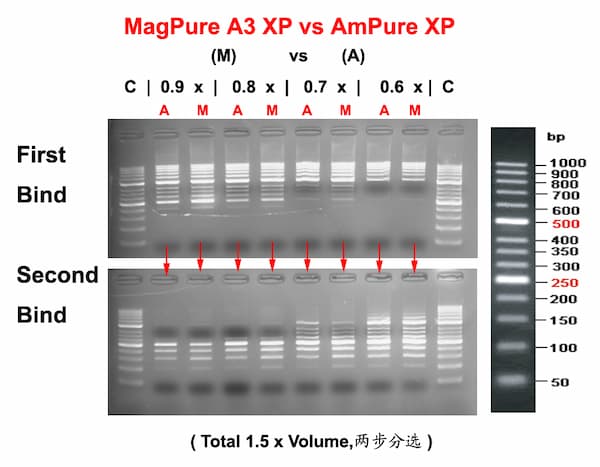
These results support the use of MagPure A3 for PCR product purification, library cleanup and NGS size selection workflows requiring AMPure XP-like handling and size selection behavior.
Kit Contents
|
Contents
|
BXP-5
|
BXP-50
|
BXP-500
|
|
MagPure A3
|
5 ml
|
50 ml
|
500 ml
|
Storage and Stability
MagPure A3 should be stored at 2-8°C upon arrival and is stable up to 18 months under the condition. However, short-term storage (up to 12 weeks) at room temperature (15-25°C) does not affect its performance. Shake the reagent well before use. It should appear homogenous and consistent in color.
DO NOT FREEZE.