Introduction
Soil DNA extraction is challenged by complex sample composition, including diverse microbial populations, variable biomass distribution and high levels of co-extracted inhibitors. Direct extraction methods are widely used to maximize recovery of total microbial DNA, but often face difficulties related to cell disruption efficiency, humic acid contamination and inconsistent DNA yield.
HiPure Soil DNA Kit is developed to address these challenges through a combination of mechanical disruption and optimized purification chemistry. The workflow enables effective lysis of bacteria and fungi while reducing co-extracted inhibitors such as humic substances and soluble metal ions, supporting reliable DNA recovery from diverse soil types.
Within the Magen microbial DNA extraction systems, this kit serves as the standard column-based solution for soil microbiome studies. For high-throughput processing, laboratories may refer to HiPure Soil DNA 96 Kit, while automated workflows can be supported using MagPure Soil DNA Kit.
Details
Specifications
|
Features
|
Specifications
|
|
Main Functions
|
Isolation DNA from 200-500mg soil sample
|
|
Applications
|
PCR, southern blot and enzyme digestion, etc.
|
|
Purification method
|
Mini spin column
|
|
Purification technology
|
Silica technology
|
|
Process method
|
Manual (centrifugation or vacuum)
|
|
Sample type
|
Soil
|
Sample amount
|
200-500mg
|
|
Elution volume
|
≥30μl
|
|
Time per run
|
60~70 minutes
|
|
Liquid carrying volume per column
|
800μl
|
|
Binding yield of column
|
100μg
|
Extraction Principle
Soil samples are first subjected to bead-assisted mechanical disruption combined with chemical lysis to release microbial DNA from complex matrices. Following lysis, insoluble debris and inhibitory substances are reduced using an adsorbent-based cleanup step designed to remove humic acids and other contaminants.
Under optimized binding conditions, DNA is selectively adsorbed onto a silica membrane and purified through sequential washing steps to remove residual inhibitors and soluble impurities. Purified genomic DNA is then eluted for downstream molecular analysis.
Engineering Features
Bead-assisted lysis for complex microbial populations
Mechanical disruption with bead tubes, combined with SDS-based chemical lysis and heat treatment, supports DNA release from bacteria, fungi and other microorganisms present in soil and environmental samples.
Adsorbent-based inhibitor removal
The workflow includes an Absorber Solution designed to reduce humic substances, pigments and other soil-derived inhibitors that may interfere with PCR, enzyme digestion and sequencing-related applications.
Optimized column purification system
After inhibitor removal and binding-condition adjustment, DNA is purified through a silica column workflow with dedicated wash steps to reduce residual salts, humic compounds and soluble environmental contaminants.
Flexible disruption options
Sample disruption can be performed by high-speed vortexing or bead-beating instruments, allowing laboratories to choose a practical workflow based on sample difficulty, throughput and available equipment.
Technical Validation
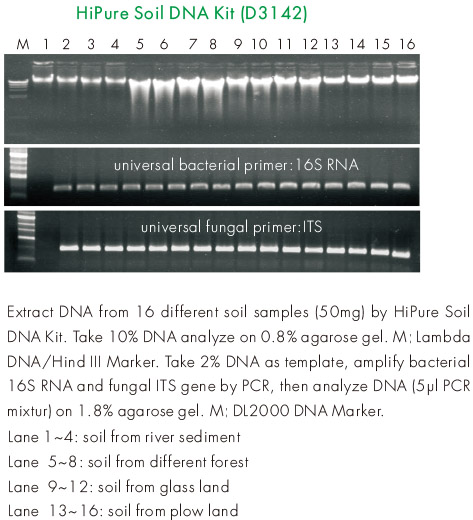
The HiPure Soil DNA Kit was validated using multiple soil types, including mangrove soil, forest soil, agricultural soil, mining-area soil, sewage sediment and waste-site soil. Extracted DNA showed recoverable yield across these different matrices, reflecting the expected variability of microbial biomass and inhibitor background among soil samples.
Purified soil DNA was tested by bacterial 16S PCR amplification. Clear amplification products were obtained from the tested soil samples, supporting effective removal of humic acid and other PCR-inhibitory substances during the extraction workflow.
Additional adsorbent evaluation showed that the inhibitor-removal step did not cause obvious loss of soil DNA under the tested conditions. DNA marker recovery and soil extraction comparisons showed similar recovery profiles between the tested adsorbent batches and control workflows, supporting stable cleanup performance while maintaining DNA recovery.
Kit Contents - D3142
|
Contents
|
D314202
|
D314203
|
|
Purification Times
|
50 Preps
|
250 Preps
|
|
Hipure DNA Mini Columns II
|
50
|
250
|
|
2ml Collection Tubes
|
50
|
250
|
2ml Bead Tubes
|
50
|
250
|
Buffer SOL
|
60 ml
|
250 ml
|
|
Buffer SDS
|
5 ml
|
20 ml
|
Buffer PS
|
10 ml
|
50 ml
|
Absorber Solution
|
10 ml
|
50 ml
|
|
Buffer GWP
|
40 ml
|
220 ml
|
Buffer DW1
|
30 ml
|
150 ml
|
|
Buffer GW2*
|
20 ml
|
2 x 50 ml
|
|
Buffer AE
|
15 ml
|
30 ml
|
Kit Contents - D3142C (Update of D3142)
|
Contents
|
D314202C
|
D314203C
|
|
Purification Times
|
50 Preps
|
250 Preps
|
|
Hipure DNA Mini Columns II
|
50
|
250
|
|
2ml Collection Tubes
|
50
|
250
|
2ml Bead Tubes
|
50
|
250
|
Buffer STL
|
50 ml
|
250 ml
|
|
Buffer SL
|
15 ml
|
60 ml
|
|
Buffer GWP
|
80 ml
|
2 x 180 ml
|
|
Buffer GW2*
|
20 ml
|
2 x 50 ml
|
|
Buffer AE
|
15 ml
|
60 ml
|
Storage and Stability
Absorber Solution should be stored at 2-8°C upon arrival. However, short-term storage (up to 24 weeks) at room temperature (15-25°C) does not affect their performance. The remaining kit components can be stored dry at room temperature (15-25°C) and are stable for at least 18 months under these conditions.
Experiment Data