Introduction
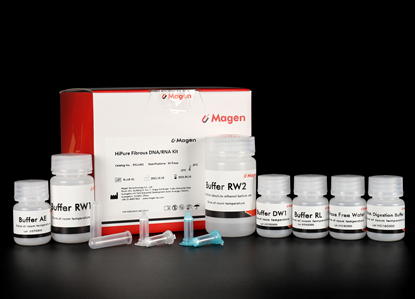
This Kit is designed to purify genomic DNA and total RNA simultaneously from a single biological sample. Lysate is first passed through a DNA spin column to selectively isolate DNA and then through an RNA column to selectively isolate RNA. Pure DNA and RNA are purified from the entire sample, in contrast to other procedures where either the biological sample or the purified total nucleic acids is divided into two before being processed separately. The kit is compatible with small amounts of a wide range of animal cells and tissues.
Details
Specifications
|
Features
|
Specifications
|
|
Main Functions
|
Co-isolation DNA and RNA from skin, muscle, connective tissue, fibrous tissue samples
|
|
Applications
|
PCR and southern blot, etc.
|
|
Purification method
|
Mini spin column
|
|
Purification technology
|
Silica technology
|
|
Process method
|
Manual (centrifugation or vacuum)
|
|
Sample type
|
Cultured cells and tissue samples
|
Sample amount
|
Tissue: < 20mg
|
Principle
The Kits are designed to purify both genomic DNA and total RNA from the same cellor tissue sample. Samples are first lysed and homogenized. The lysate is passed through a DNA Mini column and bind DNA. Ethanol is added to the flow-through and the sample is applied to an RNA column. DNA/RNA binds to the membrane and contaminants are washed away. High-quality RNA is eluted in as little as 30µl water using the Kit. High-quality DNA is eluted in as little as 50µl water using the Kit.
Technical Validation
HiPure Fibrous DNA/RNA Kit was evaluated as a column-based co-isolation workflow for simultaneous recovery of genomic DNA and total RNA from difficult-to-lyse animal tissues. The workflow uses Buffer RL, RNA Digestion Buffer and Proteinase K digestion before sequential column separation, with genomic DNA first captured on a DNA column and total RNA subsequently purified from the flow-through using an RNA column. This design is intended for fibrous or structurally dense samples where routine DNA/RNA co-isolation workflows may show reduced recovery.
Performance testing was performed using 10 mg difficult-to-lyse chicken tissue inputs, including heart, intestine and stomach. From 10 mg heart input, total RNA yields were 9.35–10.62 µg, with A260/280 values of 2.13 and A260/230 values of 1.72–1.95. From 10 mg intestine and stomach inputs, total RNA yields were 34.85–39.47 µg and 28.85–28.96 µg, respectively, with A260/280 values of 2.14 and A260/230 values of 2.23–2.28. These results support RNA recovery from fibrous and digestion-resistant tissue matrices under the tested conditions.
The corresponding genomic DNA fractions were recovered from the same tissue inputs. From 10 mg heart input, genomic DNA yields were 2.06–2.91 µg. From 10 mg intestine and stomach inputs, genomic DNA yields were 12.29–12.99 µg and 6.25–6.85 µg, respectively. A260/280 values were generally around 1.87–1.96 for intestine and stomach DNA fractions, while one heart DNA replicate showed a higher A260/280 value, indicating sample-dependent variation in low-yield fibrous tissue extraction.
Electrophoresis analysis showed visible total RNA bands from heart, intestine and stomach samples, supporting RNA integrity after fibrous tissue digestion and column purification. Genomic DNA electrophoresis showed detectable DNA bands from the same sample types, supporting paired recovery of DNA and RNA from a single fibrous tissue input. Together, these data support R5114 as a specialized DNA/RNA co-isolation workflow for fibrous or difficult-to-lyse animal tissues where both genomic and transcriptomic information are needed from limited sample material.
Kit Contents
|
Contents
|
R511402
|
R511403
|
|
Purification Times
|
50 Preps
|
250 Preps
|
|
HiPure DNA Mini Columns
|
50
|
250
|
|
HiPure RNA Mini Columns
|
50
|
250
|
2ml Collection Tubes
|
100
|
2 x 250
|
Buffer RL
|
30 ml
|
150 ml
|
RNA Digestion Buffer
|
15 ml
|
80 ml
|
Buffer DW1
|
30 ml
|
150 ml
|
|
Buffer RW1
|
50 ml
|
200 ml
|
|
Buffer RW2*
|
20 ml
|
2 x 50 ml
|
|
RNase Free Water
|
10 ml
|
30 ml
|
|
Buffer AE
|
10 ml
|
50 ml
|
Storage and Stability
HiPure DNA/RNA Kit can be stored dry at room temperature (15-25°C) and are stable for at least 18 months under these conditions. Make sure that all buffers are at room temperature when used. During shipment, crystals or precipitation may form in the Buffer RLC. Dissolve by warming buffer to 37°C.