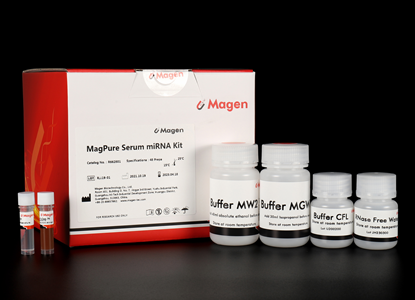
Introduction
The MagPure Serum miRNA Kit uses magnetic particle adsorption technology to enable automated purification of cell-free total RNA, primarily miRNA and other small RNA from serum and plasma samples. RNA molecules are captured by magnetic particles and purified through sequential washing steps prior to elution.
The workflow supports automated extraction systems and is suitable for laboratories performing high-throughput microRNA purification from liquid samples.
For column-based serum microRNA extraction workflows laboratories may refer to the HiPure Serum miRNA Kit (R4314).
Details
Specifications
|
Features
|
Specifications
|
|
Main Functions
|
Isolation cell-free total RNA, primarily miRNA and other small RNA from 0.3mL cell-free body fluids such as serum, plasma and urine using magnetic particles
|
|
Applications
|
RT-PCR, Northern blot, polyA+ RNA (mRNA) purification, nuclease protection, in vitro translation, ect.
|
|
Purification method
|
Polydisperse magnetic beads
|
|
Purification technology
|
Magnetic beads technology
|
|
Process method
|
Manual or automatic
|
Adaptive instrument
|
Nucleic acid extractor, pipetting workstation
|
|
Sample type
|
Serum, plasma, urine and other cell-free samples
|
|
Sample amount
|
300μl
|
Technical Validation
The recovery performance of the MagPure Serum/Plasma miRNA Kit (R6628) was evaluated using nucleic acid spike-in models prepared with porcine plasma or RNase-free water. All samples were processed using the magnetic particle workflow with a 50 µL elution volume and an extraction time of approximately 35 minutes.
Small RNA recovery was evaluated by adding 10 µg of a tissue-derived RNA fraction below 200 nt to 400 µL samples. Recovery from porcine plasma ranged from 82% to 94%, with a mean recovery of 89.7%. Recovery from RNase-free water ranged from 89% to 96%, with a mean recovery of 91.7%. The recovered RNA showed A260/A280 values of 1.86–1.92 in plasma samples and 2.01–2.03 in water samples. Electrophoresis confirmed recovery of the principal small RNA fraction at approximately 50–75 nt.
Short-fragment nucleic acid recovery was further assessed using DNA marker spike-ins. Recovery of 200 ng DL2000 DNA marker from 400 µL porcine plasma ranged from 83% to 86% by Qubit measurement. In a separate experiment using approximately 3 µg of 50 bp DNA marker, recovery ranged from 81% to 88%, with A260/A280 values of 1.80–1.89. Electrophoresis confirmed retention of the 50 bp DNA fragments.
Compatibility with RT-qPCR was evaluated using an RNA virus spike-in model. Eluates obtained from porcine plasma and water samples produced Ct values ranging from 21.40 to 21.93, compared with 21.60–21.68 for the reference viral nucleic acid extraction workflow. The closely aligned amplification profiles indicate effective removal of plasma-derived inhibitors and compatibility of the purified RNA with RT-qPCR under the tested conditions.
Under the tested spike-in conditions, R6628 achieved greater than 80% recovery across the small RNA and short-fragment nucleic acid models while providing eluates suitable for downstream RT-qPCR analysis.
Kit Contents
|
Contents
|
R662801
|
R662802
|
R662803
|
|
Purification Times
|
48 Preps
|
96 Preps
|
5 x 96 Preps
|
|
MagPure Particles N
|
2.5 ml
|
3.5 ml
|
17 ml
|
Buffer CFL
|
10 ml
|
20 ml
|
60 ml
|
Buffer CFP
|
2.5 ml
|
5 ml
|
20 ml
|
|
Buffer MGW1*
|
30 ml
|
60 ml
|
270 ml
|
Buffer MW2*
|
25 ml
|
50 ml
|
3 x 50 ml
|
RNase Free Water
|
20 ml
|
30 ml
|
60 ml
|
Storage and Stability
MagPure Particle N should be stored at 2–8°C upon arrival. However, short-term storage (up to 8 weeks) at room temperature (15–25°C) does not affect their performance. The remaining kit components can be stored at room temperature (15–25°C) and are stable for at least 24 months under these conditions.
Purchase Guide
Choosing the appropriate RNA extraction system depends on sample type, RNA species and workflow requirements.
For detailed selection guidance across blood and liquid RNA workflows, refer to the Blood RNA Kits Selection Guide.