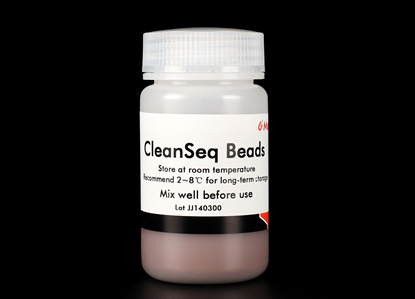
Introduction
A rapid, high performance dye-terminator removal process based on the paramagnetic bead technology. The paramagnetic bead format requires no centrifugation or filtration and is easily performedmanually or fully automated for high throughput dye-terminator removal. Compared to similar systems, this product produces sequences with longer Phred 20 read lengths and higher signal intensities than any other purification technology.
Details
Specifications
|
Features
|
Specifications
|
Main Functions
|
Removal of free fluorescent dye from sequencingsolution (Replace Beckmen or agencourt CleanSeq)
|
|
Applications
|
Automated sequences
|
|
Purification technology
|
Magnetic beads technology
|
|
Process method
|
Manual or automatic
|
|
Sample type
|
DNA doped with fluorescentdye
|
Sample amount
|
5μl
|
|
Recovery
|
90%
|
Elution volume
|
≥25μl
|
Operation time
|
≤50 minutes
|
Principle
The CleanSeq method contains magnetic particles in an optimized binding buffer to selectively capture sequencing extension products. The protocol can be performed directly in the thermal cycling plate. Unincorporated dyes, nucleotides, salts and contaminants are removed using a simple washing procedure. The purification procedure is amenable to a variety of automation platforms since it requires no centrifugation or vacuum filtration.
Technical Validation
CleanSeq Beads were evaluated as magnetic bead reagents for dye-terminator removal and sequencing reaction cleanup. The workflow uses magnetic particles in an optimized binding system to capture sequencing extension products while removing unincorporated dyes, nucleotides, salts and other reaction contaminants through ethanol washing.
Macro-scale DNA marker recovery testing showed that the DTR bead workflow could recover DNA marker fragments after binding, ethanol washing and water elution. Agarose gel electrophoresis indicated effective marker recovery, with recovery efficiency around 80% under the tested conditions.
Microscale marker recovery was further evaluated using 20 ng DNA marker input. Room-temperature drying before elution supported higher recovery, with recovery values reaching approximately 85% and up to 98.4% in the tested samples. In contrast, drying at 65°C for 3 minutes reduced recovery to approximately 69–79%, indicating that excessive drying can reduce elution efficiency.
These results support the use of CleanSeq Beads for Sanger sequencing cleanup workflows requiring dye-terminator removal, magnetic bead handling and compatibility with manual or automated high-throughput processing. For best recovery, room-temperature drying is recommended, and over-drying should be avoided before elution.
Kit Contents
|
Contents
|
BCS-5
|
BCS-50
|
BCS-500
|
|
CleanSeq Beads
|
5 ml
|
50 ml
|
500 ml
|
Storage and Stability
CleanSeq Beads should be stored at 2-8°C upon arrival and is stable up to 6 months under the condition. However, short-term storage (up to 12 weeks) at room temperature (15-25°C) does not affect its performance. Mix CleanSeq Beads well before using. The reagent should appear homogenous and consistent in color.
DO NOT FREEZE.