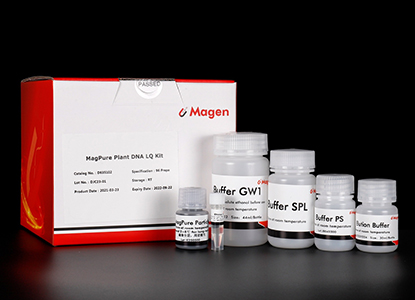
Introduction
The MagPure Plant DNA Kit (D6351) provides a magnetic bead–based workflow for genomic DNA extraction from routine plant samples with low levels of polysaccharides and polyphenols.
Compared to column-based workflows, magnetic bead purification enables scalable processing and reduces manual handling steps, making it suitable for high-throughput plant genomics and screening applications.
Within the Magen system, D6351 functions as the automation-oriented core solution, complementing D3187 for complex samples.
Details
Workflow
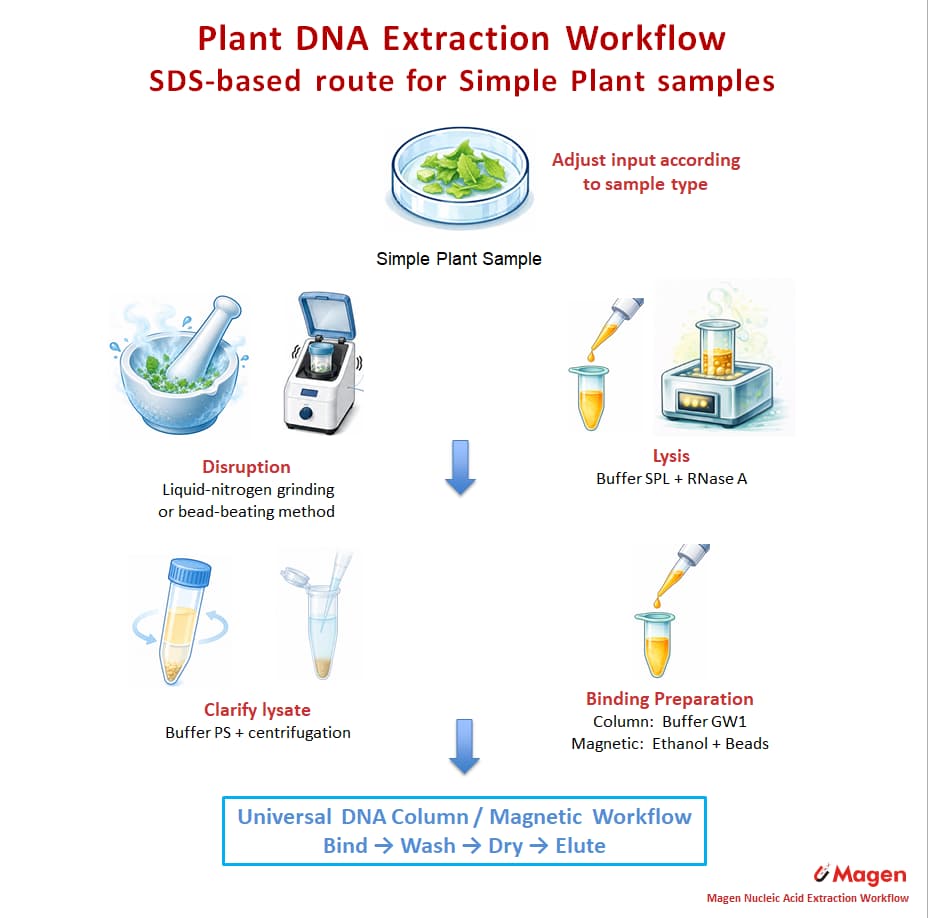
Workflow Overview
The MagPure Plant DNA Kit uses an SDS-based magnetic-particle workflow for purification of genomic DNA from simple plant and fungal samples. Following mechanical disruption by liquid-nitrogen grinding or bead-beating, the sample is chemically lysed with Buffer SPL and RNase Solution. Buffer PS is used to clarify the lysate by removing cell debris, precipitated proteins and polysaccharide-associated contaminants. The clarified supernatant is then combined with MagPure Particles and ethanol, allowing DNA to bind to the magnetic particles before magnetic separation, washing, drying and elution.
Sample Handling Logic
This workflow is designed for laboratories that prefer magnetic-particle handling for plant DNA purification. The upstream lysis and clarification logic is similar to the SDS-based column route, but DNA capture is performed on MagPure Particles instead of a silica membrane. Sample amount, disruption efficiency and lysate clarity are the main factors affecting workflow performance. After the clarified supernatant is transferred, the downstream magnetic workflow follows a consistent bind, magnetic separation, wash, dry and elute structure.
Time and Workflow Characteristics
Under typical manual operation, the workflow is usually completed within about 70–85 minutes, depending mainly on sample disruption, bead resuspension, magnetic separation efficiency and drying control. This route is suitable for plant DNA extraction workflows that require magnetic-particle purification and potential adaptation to automated handling. For detailed step-by-step conditions, workflow guidance and estimated processing times, please refer to the Workflow Note in the Download section.
Specifications
|
Features
|
Specifications
|
|
Main Functions
|
Isolation total DNA from 50-100 mg plant, fungal tissue
|
|
Applications
|
PCR, transgene detection, fluorescence quantitative PCR, southern blot, SNP site analysis, etc.
|
|
Purification technology
|
Magnetic beads technology
|
|
Process method
|
Manual or automatic
|
|
Sample type
|
Conventional economic plant samples
|
|
Sample amount
|
Fresh / frozen plant samples:≤ 100mg
Dried plant / seed samples:≤ 20mg
|
|
Elution volume
|
≥50μl
|
|
Time per run
|
70-85 minutes
|
Engineering Features
Magnetic bead–based DNA binding
Supports automated workflows and parallel sample processing without centrifugation.
Detergent-based lysis for routine samples
Provides efficient DNA release for plant tissues with lower inhibitor content.
Salt-mediated impurity control
Reduces carryover of proteins and pigments during washing steps.
Workflow scalability
Adapted for multi-sample processing and laboratory automation systems.
Kit Contents
|
Contents
|
D635101
|
D635102
|
D635103
|
|
Purification Times
|
48 Preps
|
96 Preps
|
5 x 96 Preps
|
MagPure Particles
|
1.7 ml
|
4 ml
|
18 ml
|
RNase Solution
|
0.6 ml
|
1.2 ml
|
6 ml
|
|
Buffer SPL
|
30 ml
|
60 ml
|
300 ml
|
|
Buffer PS
|
10 ml
|
20 ml
|
100 ml
|
|
Buffer GW1*
|
26 ml
|
53 ml
|
220 ml
|
Elution Buffer
|
10 ml
|
30 ml
|
120 ml
|
Storage and Stability
RNase Solution and MagPure Particles should be stored at 2-8°C upon arrival. However, short-term storage (up to 24 weeks) at room temperature (15-25°C) does not affect their performance. The remaining kit components can be stored dry at room temperature (15-25°C) and are stable for at least 18 months under these conditions.
Purchase Guide
MagPure Plant DNA Kit (D6351) is suitable for routine plant samples and laboratories requiring automated or high-throughput workflows.
For plant samples with high polysaccharide or polyphenol content, CTAB-based systems such as HiPure HP Plant DNA Kit (D3187) may provide improved DNA purity.
For seed or storage tissues, dedicated workflows such as MagPure Seed DNA Kit (D6352) can be considered.
For a complete selection guide:
👉 Plant DNA and RNA Extraction Selection Guide