Details
Extraction Principle
Forensic samples such as hair, nails and bone often contain highly cross-linked proteins and extremely limited DNA quantities. Efficient DNA extraction therefore requires intensive enzymatic digestion and optimized adsorption chemistry.
In the MagPure Forensic DNA workflow, samples are digested using Proteinase K together with reducing agents such as DTT. Proteinase K breaks down structural proteins and histones, while DTT reduces disulfide bonds in keratinized tissues, enabling efficient release of DNA from highly cross-linked matrices. Extended incubation allows gradual digestion of difficult materials and improves recovery of trace DNA.
Following digestion, DNA molecules bind to magnetic silica particles under chaotropic conditions. The high surface area of the magnetic particles enables efficient capture of DNA even at very low concentrations. Impurities and PCR inhibitors are removed during washing steps, and purified DNA is eluted in a small volume of buffer suitable for downstream PCR amplification and STR analysis.
Engineering Characteristics
Magnetic bead DNA adsorption
High-affinity magnetic particles provide efficient adsorption of genomic DNA under optimized binding conditions, allowing effective enrichment of DNA molecules from dilute forensic lysates.
Trace DNA recovery
The extraction chemistry and binding buffers are optimized for recovery of low-template DNA commonly encountered in forensic samples.
Compatibility with degraded samples
The purification workflow supports recovery of fragmented DNA while minimizing additional degradation during the extraction process.
Automation-ready workflow
The system is compatible with automated nucleic acid extraction instruments and multi-channel purification platforms used in forensic laboratories.
Reduced sample handling
Magnetic separation eliminates repeated centrifugation steps, reducing manual handling and improving workflow reproducibility.
Technical Validation
MagPure Forensic DNA Kit was evaluated as a magnetic bead-based DNA extraction workflow for difficult forensic sample materials, including tooth, bone, animal tissue, fingernail material and DNA marker model samples. The validation focused on DNA recovery, qPCR amplifiability, STR compatibility, automated magnetic handling and analytical marker recovery under the tested conditions.
Human tooth DNA extraction was tested using 100 mg, 50 mg and 25 mg tooth inputs, followed by magnetic purification and 60 µL elution. DNA yields increased with sample input, reaching 4.54–4.83 µg from 100 mg tooth material, 2.60–2.98 µg from 50 mg input and 1.13–1.39 µg from 25 mg input. All tested tooth DNA extracts produced qPCR amplification, with Ct values of 16.54–19.61, supporting recovery of amplifiable DNA from mineralized forensic material.
Bone DNA extraction was evaluated using aged bone material with an 80 µL elution volume. Single-well binding produced 4.00–4.90 µg DNA, while the dual-well binding configuration produced 8.04–9.01 µg DNA under the tested conditions. A260/A280 values remained within 1.82–1.94. Electrophoresis showed detectable DNA signal with slight smearing, consistent with the aged nature of the tested bone sample.
Automated extraction performance was further tested using representative animal tissue samples on an S16 magnetic extraction platform. Single-well and dual-well binding configurations produced comparable DNA yields of 6.54–6.90 µg, with A260/A280 values of 1.82–1.89. Electrophoresis showed clear genomic DNA bands without obvious degradation smearing, supporting consistent automated magnetic handling and elution performance.
STR workflow compatibility was evaluated using difficult forensic sample types. Complete 25-locus detection was observed from both fresh and aged fingernail materials, while selected fresh tooth materials produced near-complete STR profiles with 23–24 detected loci. Aged tooth materials produced partial STR profiles under the tested 25-locus workflow. These results show that D6359D can recover amplifiable DNA from difficult forensic matrices, while STR interpretation for aged mineralized materials should consider preservation history, sampling position, grinding quality and available template amount.
Analytical DL2000 marker recovery was tested using approximately 50 ng input under automated magnetic extraction conditions. Single-well binding showed recovery rates of 92.35–94.51%, while dual-well binding showed recovery rates of 81.76–84.90%. Macroscopic DL2000 electrophoresis showed complete marker band patterns without obvious diffusion or degradation, supporting the magnetic binding, washing and elution design of the D6359D workflow.
Together, these results support D6359D as a magnetic bead-based forensic DNA extraction workflow for difficult sample matrices. The kit demonstrated amplifiable DNA recovery from mineralized samples, compatible STR profile generation from selected forensic materials, consistent automated extraction performance and above-80% analytical marker recovery under the tested conditions.
Typical Applications
Genomic DNA purified using the MagPure Forensic DNA Kit is commonly used in forensic and trace DNA analysis workflows, including:
• Forensic DNA identification
• Trace DNA purification from biological evidence
• DNA recovery from hair roots and fingernails
• Blood stain and semen stain DNA extraction
• PCR-based genotyping analysis
• STR profiling workflows
• Human identification studies
• Forensic genetics research
Related Products
Forensic laboratories often process a wide range of biological samples in addition to trace evidence. The following nucleic acid extraction systems are frequently used together with the MagPure Forensic DNA Kit.
• HiPure Bone DNA Kit (D3124) – genomic DNA purification from bone fragments used in forensic identification and anthropological studies
• HiPure Universal DNA Kit (D3018) – genomic DNA purification from mixed biological samples including tissue, blood and body fluids
• MagPure Universal DNA Kit (IVD3102) – magnetic bead purification of genomic DNA from diverse biological samples using automated extraction instruments
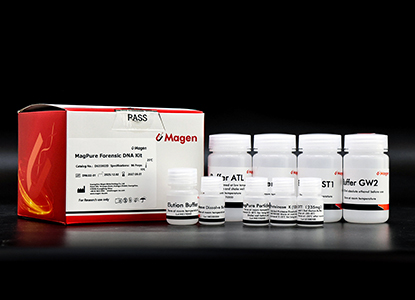
Kit Contents
|
Contents
|
D635901D
|
D635902D
|
D635903D
|
|
Purification Times
|
48
|
96
|
480
|
|
MagPure Particles N
|
1.1 ml
|
2.2 ml
|
11 ml
|
|
Buffer ATL
|
40 ml
|
80 ml
|
2 x 200 ml
|
|
Buffer BGL
|
40 ml
|
80 ml
|
2 x 200 ml
|
|
Buffer BST1
|
60 ml
|
120 ml
|
550 ml
|
|
Buffer GW2*
|
20 ml
|
25 ml
|
2 x 50 ml
|
|
Proteinase K
|
50 mg
|
120 mg
|
2 x 220 mg
|
|
Protease Dissolve Buffer
|
5 ml
|
10 ml
|
30 ml
|
|
DTT
|
235 mg
|
235 mg
|
3 x 235 mg
|
|
Elution Buffer
|
10 ml
|
10 ml
|
30 ml
|
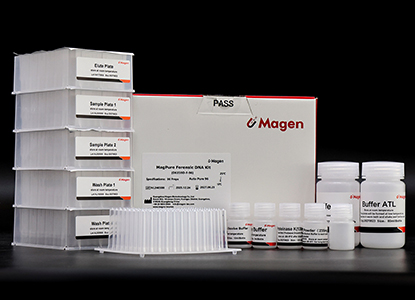
Prefilled Kit Contents
32/48 channel machine
|
Product
|
Contents and volume
|
D6359D-TL-06
|
|
Buffer BGL
|
|
80 ml
|
|
Buffer ATL
|
|
80 ml
|
|
Proteinase K
|
|
120 mg
|
|
Protease Dissolve Buffer
|
|
10 ml
|
|
DTT Powder
|
|
2 x 235 mg
|
|
Elution Buffer
|
|
5 ml
|
|
AS-Tip
|
|
12 pcs
|
2.0ml V
bottom plate
|
Row 1/7:empty
|
6 plates
|
Row 2/8:500μl Buffer BST1
|
Row 3/9:500μl Buffer BST1
|
Row 4/10:20μl MagPure Particles N
500μl Buffer GW2
Row 5/11:500μl Buffer GW2 (ethanol ~350ul)
|
Row 6/12:60μl Elution Buffer
|
96 channel machine
|
Product
|
Contents and volume
|
D6359D-F-96
|
D6359D-F-48
|
|
Buffer BGL
|
|
80 ml
|
40 ml
|
|
Buffer ATL
|
|
80 ml
|
40 ml
|
|
Proteinase K
|
|
120 mg
|
50 mg
|
|
Protease Dissolve Buffer
|
|
10 ml
|
5 ml
|
|
DTT Powder
|
|
235 mg
|
235 mg
|
|
Elution Buffer
|
|
5 ml
|
5 ml
|
|
96-Tip (AS)
|
|
1
|
1
|
Sample Plate 1
|
500μl Buffer BST1
|
1
|
1
|
Sample Plate 2
|
500μl Buffer BST1
|
1
|
1
|
Wash Plate 1
|
20μl MagPure Particles N
500μl Buffer GW2
|
1
|
1
|
Wash Plate 2
|
500μl Buffer GW2
|
1
|
1
|
Elute Plate
|
60μl Elution Buffer
|
1
|
1
|
Storage and Stability
Proteinase K should be stored at 2–8°C upon arrival. However, short-term storage (up to 12 weeks) at room temperature (15–25°C) does not affect their performance. DTT Powder is easily oxidized, should be shipped at -20~8°C and stored at -20°C upon arrival, keep dry. The remaining kit components can be stored at room temperature (15–25°C) and are stable for at least 18 months under these condition.