Introduction
Bacterial genomic DNA extraction is influenced by differences in cell wall structure between Gram-negative and Gram-positive species. While Gram-negative bacteria can be lysed under relatively mild conditions, Gram-positive bacteria and certain strains with reinforced cell walls require more effective disruption strategies to achieve reliable DNA recovery.
Incomplete lysis of bacterial cells can lead to reduced DNA yield and variability between samples, particularly when processing mixed or difficult-to-lyse species. Effective extraction workflows therefore require a combination of enzymatic and mechanical lysis to ensure consistent DNA release across different bacterial types.
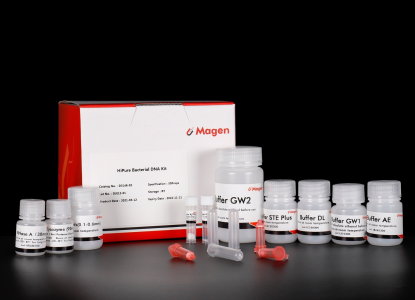
The HiPure Bacterial DNA Kit is developed to address these challenges through an integrated lysis strategy combining enzymatic digestion with mechanical disruption. The system supports genomic DNA recovery from a broad range of bacterial species, including difficult-to-lyse strains.
Within the Magen microbial DNA extraction systems, this kit serves as the standard column-based solution for bacterial genomic DNA preparation. For RNA extraction workflows, laboratories may refer to HiPure Bacterial RNA Kit.
Details
Specifications
|
Features
|
Specifications
|
|
Main Functions
|
Isolation bacterial DNA from cultures, food and other samples
|
|
Applications
|
PCR, southern blot and enzyme digestion, etc.
|
|
Purification method
|
Mini spin column
|
|
Purification technology
|
Silica technology
|
|
Process method
|
Manual (centrifugation or vacuum)
|
|
Sample type
|
Culture medium, swab, parasitic blood, tissue,sputum, etc.
|
|
Sample amount
|
Bacterial culture medium: 0.5-2 ml
Tissue samples: 50-100 mg
Whole blood / cell suspension: 0.5-1 ml
Viscous secretion: 0.1-1 g
|
|
Elution volume
|
≥30μl
|
|
Time per run
|
60~90 minutes
|
|
Liquid carrying volume per column
|
800μl
|
|
Binding yield of column
|
100μg
|
Extraction Principle
Bacterial cells are first subjected to enzymatic digestion to weaken cell wall structures, particularly in Gram-positive species. Mechanical disruption can be applied to further improve lysis efficiency for difficult-to-lyse bacteria.
Following lysis, genomic DNA is released into the solution and selectively adsorbed onto a silica membrane under chaotropic binding conditions. Sequential washing steps remove proteins, enzymes and other impurities, and purified DNA is eluted for downstream molecular analysis.
Engineering Features
Integrated lysis strategy for diverse bacterial types
Combination of enzymatic digestion and optional mechanical disruption supports DNA recovery from both Gram-negative and Gram-positive bacteria
Improved performance for difficult-to-lyse strains
Lysis workflow is optimized to enhance DNA release from bacteria with reinforced cell walls
Stable column-based purification system
Silica membrane adsorption ensures consistent genomic DNA recovery across different bacterial samples
Flexible workflow adaptation
Lysis conditions can be adjusted based on bacterial type and sample complexity
Technical Validation
The HiPure Bacterial DNA Kit was validated using representative bacterial species, including Pseudomonas aeruginosa as a Gram-negative bacterium, Enterococcus faecalis as a difficult-to-lyse Gram-positive bacterium, and Staphylococcus aureus as a highly difficult-to-lyse Gram-positive bacterium. Purified DNA showed A260/280 values of approximately 1.82–1.92 and A260/230 values up to about 2.24, supporting reliable DNA purity across different bacterial cell wall types.
Agarose gel electrophoresis showed clear genomic DNA bands without obvious degradation, indicating good DNA integrity after extraction. Under the tested conditions, DNA yields varied by bacterial species, with higher recovery from easier-to-lyse bacteria and lower recovery from difficult Gram-positive bacteria, reflecting the expected impact of cell wall structure on extraction efficiency.
Different disruption strategies were also compared, including lysozyme treatment, glass bead disruption, and combined lysozyme plus glass bead treatment. The results showed that lysis method selection affects DNA yield, especially for difficult-to-lyse bacteria, supporting the kit’s flexible pretreatment design for routine bacterial DNA extraction workflows.
Kit Contents
|
Contents
|
D314602
|
D314603
|
|
Purification Times
|
50 Preps
|
250 Preps
|
|
Hipure DNA Mini Columns I
|
50
|
2 x 125
|
|
2ml Collection Tubes
|
50
|
2 x 125
|
Glass Beads (0.1~0.2mm)
|
20 g
|
100 g
|
Buffer P1
|
20 ml
|
100 ml
|
|
Buffer DL
|
15 ml
|
80 ml
|
Buffer GW1
|
22 ml
|
88 ml
|
Buffer GW2
|
12 ml
|
50 ml
|
|
Lysozyme
|
60 mg
|
300 mg
|
|
Proteinase K
|
24 mg
|
120 mg
|
|
Protease Dissolve Buffer
|
5 ml
|
15 ml
|
Buffer AE
|
15 ml
|
60 ml
|
Storage and Stability
Lysozyme and Proteinase K should be stored at 2-8°C upon arrival. However, short-term storage (up to 12 weeks) at room temperature (15-25°C) does not affect their performance. The remaining kit components can be stored dry at room temperature (15-25°C) and are stable for at least 18 months under these conditions.
Purchase Guide
For guidance on selecting the most appropriate nucleic acid extraction system based on sample type, input volume and workflow requirements:
👉 Magen Kits Selection Guide