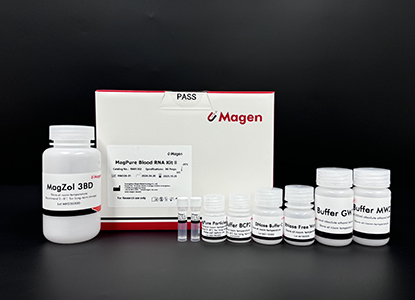
Details
Specifications
|
Features
|
Specifications
|
|
Main Functions
|
Isolation total RNA from 1ml anticoagulant blood (fresh or frozen blood/cryopreservation blood), lymphocytes, buffy coat, bone marrow, cultured cells, etc using Magzol reagents.
|
|
Applications
|
RT-PCR, cDNA synthesis, second generation sequencing
|
|
Purification method
|
Polydisperse magnetic beads
|
|
Purification technology
|
Magnetic beads technology
|
|
Process method
|
Manual or automatic
|
|
Sample type
|
anticoagulant blood, lymphocytes, buffy coat, bone marrow, cultured cells
|
|
Sample amount
|
1ml whole blood (fresh or frozen blood)
|
Principles
This product is based on the purification method of high binding magnetic particles. The sample is lysed and digested by lysis buffer and protease, and RNA/DNA is released into the lysis buffer. Add binding solution and magnetic particles to adsorb RNA/DNA, while proteins are not adsorbed and removed. The particles adsorbed with DNA/RNA are washed with washing buffer to remove proteins and other impurities, then washed with ethanol to remove salt, and finally digested with DNase to remove DNA. RNA is recovered by adding binding solution, and finally the RNA is eluted with low salt buffer. The eluted RNA can be directly used for experiments such as RT-PCR, NGS and virus detection.
Technical Validation
MagPure Blood RNA Kit II was evaluated as a MagZol-based magnetic bead workflow for rapid RNA extraction from whole blood and bone marrow samples. Unlike RBC lysis-based workflows, the R6613 protocol uses direct MagZol 3BD sample lysis, followed by phase clarification, magnetic particle RNA binding, DNase I digestion, magnetic washing and RNase-free water elution. This design simplifies blood RNA sample preparation and supports use with fresh blood, frozen blood, bone marrow and other blood-derived sample types.
Rapid pretreatment testing was performed by mixing 1 mL blood or bone marrow sample with MagZol 3BD, followed by short room-temperature incubation, 60°C incubation and clarification before magnetic extraction. In bone marrow samples, RNA concentrations ranged from 198.5–416.9 ng/µL with total RNA yields of 11.9–25.0 µg under the standard pretreatment conditions. A260/280 values remained around 2.1, and A260/230 values were 1.8–2.1. One bone marrow sample processed without Buffer BCP2 produced a higher RNA yield of 55.3 µg, with A260/280 of 2.2 and A260/230 of 2.1 under the tested conditions.
Whole blood samples showed more sample-dependent RNA recovery, as expected for blood specimens with variable leukocyte content and storage condition. Across tested blood samples, RNA yields ranged from 1.8–8.9 µg for human blood samples and reached 32.7 µg in the tested hog blood sample. A260/280 values were generally 1.8–2.1 for human blood samples and 2.3 for the hog blood sample, while A260/230 values varied from 1.0–1.8 in human blood samples and reached 2.3 in the hog blood sample. These results indicate that R6613 can recover measurable RNA from direct-lysed blood samples, while final yield depends strongly on sample type, leukocyte content and preservation status.
Agarose gel electrophoresis showed visible RNA band patterns from both bone marrow and blood sample extracts, supporting RNA recovery after direct MagZol-based pretreatment and magnetic purification. The workflow includes DNase I digestion to reduce genomic DNA background before elution, supporting use in downstream RNA analysis workflows where residual DNA may interfere with interpretation.
Together, these results support R6613 as a convenient magnetic blood RNA workflow for laboratories that require direct lysis of fresh or frozen blood, bone marrow or related blood-derived samples without a separate RBC lysis step. The MagZol 3BD-based sample handling format also supports blood preservation and transportation workflows, where immediate RNA stabilization before extraction is important. The recovered RNA supports downstream applications such as RT-PCR, gene expression analysis and sequencing-oriented workflows, with final performance depending on sample condition and downstream assay requirements.
Kit Contents
|
Contents
|
R661301
|
R661302
|
R661303
|
|
Purification Times
|
48 Preps
|
96 Preps
|
480 preps
|
|
DNase I
|
600 μl
|
2 x 600 μl
|
10 x 600 µl
|
DNase Buffer C
|
20 ml
|
30 ml
|
150 ml
|
MagPure Particles N
|
2.5 ml
|
5.0 ml
|
28 ml
|
|
MagZol 3BD
|
65 ml
|
140 ml
|
3 x 200 ml
|
Buffer GW1*
|
13 ml
|
44 ml
|
110 ml
|
Buffer BCP2
|
10 ml
|
15 ml
|
80 ml
|
Buffer MW2*
|
20 ml
|
50 ml
|
2 x 100 ml
|
RNase Free Water
|
10 ml
|
20 ml
|
60 ml
|
Kit Contents: Precast kit
|
Cat.No
|
Reagent
|
R6613-TL-06
|
|
DNase I
|
|
2 x 600 μl
|
|
Magzol 3BD
|
|
130 ml
|
|
Buffer BCP2
|
|
15 ml
|
|
AS Tip
|
|
12 PCS
|
|
2.0ml V-bottom plate
|
Row 1/7:350μl Isopropanol
15μl MagPure Particles N
Row 2/8:350μl Isopropanol
15μl MagPure Particles N
Row 3/9: 500μl DNase Buffer C
Row 4/10: 500μl Buffer GW1
Row 5/11: 500μl Buffer MW2
Row 6/12:70μl RNase Free Water
|
6 Plates
|
Storage and Stability
DNase I should be shipped with ice pack or dry ice and stored at -20°C upon arrival. MagPure Particles N, MagZol 3BD and Buffer BCP2 should be stored at 2–8°C upon arrival. However, short-term storage at room temperature (15–25°C) does not affect their performance. The remaining kit components can be stored at room temperature (15–25°C) and are stable for at least 18 months under these conditions.