Introduction
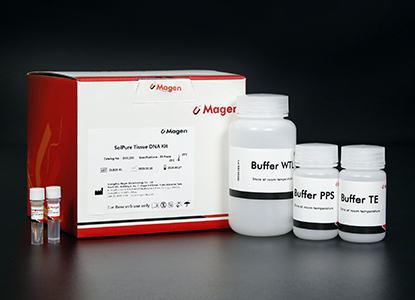
The SolPure Tissue DNA Kit provides a salt precipitation–based workflow for purification of high-molecular-weight genomic DNA from animal tissues and cultured cells. The method uses detergent-mediated cell lysis followed by protein precipitation and alcohol-based DNA recovery, enabling preparation of large DNA fragments suitable for molecular analysis.
Compared with column-based purification systems, the salt-out workflow offers a scalable and economical approach for laboratories processing larger tissue samples.
For silica column purification workflows laboratories may use the HiPure Tissue DNA Kit (D3121) or the HiPure Universal DNA Kit (D3018), while automated extraction can be performed using the MagPure Universal DNA Kit (IVD3102).
Details
Specifications
|
Features
|
Specifications
|
|
Main Functions
|
Isolation total DNA from tissue using economic salt out method
|
|
Applications
|
PCR, enzyme digestion, Southern hybridization,etc.
|
|
Purification technology
|
Salting out method
|
|
Process method
|
Manual (centrifugation or vacuum)
|
|
Sample type
|
Animal tissue
|
|
Sample amount
|
Unlimited
|
|
Elution volume
|
≥100μl
|
|
Time per run
|
Variation with sample amount
|
Principles
Cells are lysed with ananionic detergent in the presence of a DNA stabilizer. The DNA stabilizer limits the activity of intracellular DNases and also DNases found elsewhere in the environment. RNA is then removed by treatment with an RNA digesting enzyme. Other contaminants, such as proteins, are removed by salt precipitation. Finally, the genomic DNA is recovered by precipitation with alcohol and dissolved in Buffer TE. Purified DNA typically has an A260/A280 ratio between 1.7 and 1.9, and is up to 200 kb in size. The DNA can be safely stored at 2-8°C, -20°C, or -80°C.
Advantages
-
Safe - without phenol chloroform extraction
-
Environment friendly - the reagents used are safe, non-toxic and without pollution
-
High molecular weight - the molecular weight of genomic DNA is about 50-150kb
-
High purity - the purified DNA has A260/280=1.8-1.9, A260/230=2.0-2.5
-
Unlimited sample size - solution type operation, sample volume can be adjusted at will
-
Cost performance - the most economical nucleic acid extraction technology
Technical Validation
The SolPure Tissue DNA Kit was validated using multiple animal tissue and biological samples, including porcine liver, chicken lung, chicken brain, frog lung, frog skin, frog liver, fish liver and human saliva. Purified DNA showed A260/280 values of approximately 1.7–2.0, with tissue-dependent yields ranging from about 8–54 µg under the tested conditions.
Agarose gel electrophoresis showed high-molecular-weight genomic DNA bands above 23 kb without obvious smearing, indicating good DNA integrity. The workflow also recovered small-fragment DNA from saliva samples, supporting DNA recovery from samples that may contain both high-molecular-weight genomic DNA and fragmented DNA.
Downstream compatibility was confirmed by PCR amplification using serially diluted DNA templates and by EcoRI restriction digestion. The results support the use of the SolPure Tissue DNA Kit for high-molecular-weight DNA extraction where PCR, restriction digestion and other enzymatic downstream applications are required.
Kit Contents
|
Contents
|
D331201
|
D331202
|
D331203
|
|
Purification Times
|
1 g
|
5 g
|
50 g
|
|
Proteinase K
|
330 µl
|
1.8 ml
|
18 ml
|
|
Buffer WTL
|
33 ml
|
160 ml
|
2 x 800 ml
|
|
Buffer PPS
|
12 ml
|
55 ml
|
500 ml
|
RNase Solution
|
330 µl
|
1.8 ml
|
18 ml
|
|
Buffer TE
|
12 ml
|
60 ml
|
200 ml
|
Storage and Stability
RNase Solution should be stored at 2-8°C upon arrival. However, short-term storage (up to 24 weeks) at room temperature (15-25°C) does not affect their performance. The remaining kit components can be stored dry at room temperature (15-25°C) and are stable for at least 18 months under these conditions. The entire kit can be stored at 2-8°C, but in this case buffers should be redissolved before use. Make sure that all buffers are at room temperature when used.