Introduction
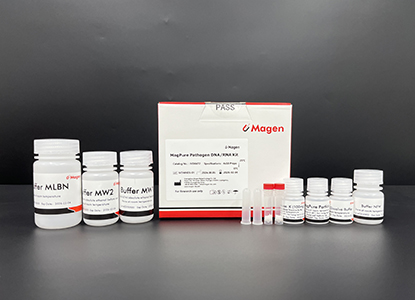
MagPure Pathogen DNA/RNA Kit is a routine magnetic bead–based extraction system for pathogen DNA/RNA preparation from no- or low-cell-content biological samples such as plasma, serum, body fluid, soaking solution, tissue homogenate supernatant and culture medium supernatant. It is designed for PCR, qPCR and routine molecular detection workflows where stable direct extraction and PCR-compatible nucleic acid recovery are required.
The kit combines Proteinase K–assisted lysis with bead-tube disruption before magnetic bead purification, providing a standardized workflow for routine pathogen sample preparation.Within the Magen Viral & Pathogen series, IVD6672 serves as the general direct extraction route. For tNGS-oriented low-background pathogen extraction, laboratories may consider R6672B; for mNGS-oriented host-background reduction and pathogen enrichment, R6672C provides a dedicated enrichment workflow.
Details
Workflow
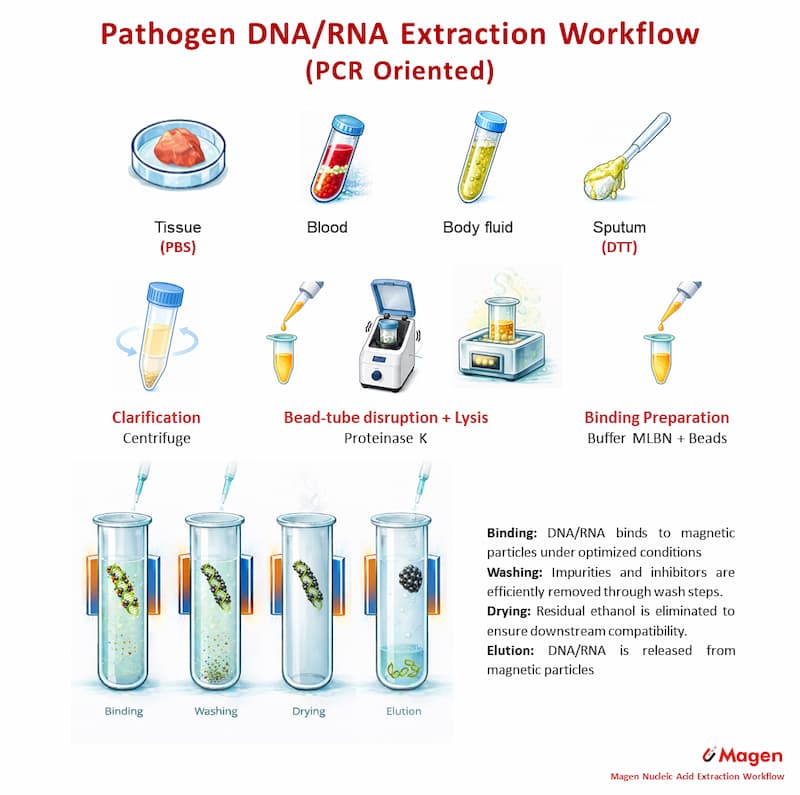
Workflow Overview
The MagPure Pathogen DNA/RNA Kit uses a direct magnetic bead–based workflow for routine pathogen nucleic acid extraction from no- or low-cell-content biological samples. Following sample clarification when required, pathogen DNA/RNA is released through Proteinase K–assisted bead-tube disruption and then captured by magnetic particles under optimized binding conditions. The purified nucleic acids are recovered through washing, drying and elution steps, providing a simple and reproducible workflow for PCR and qPCR-oriented pathogen detection.
Sample Handling Logic
The workflow is designed for routine biological samples such as serum, plasma, body fluid, soaking solution, tissue homogenate supernatant and culture medium supernatant. For cell-rich inputs, a clarification step can be used to reduce excessive somatic cell carryover before extraction. Once the processed sample enters the magnetic bead purification stage, the downstream binding, washing, drying and elution steps remain consistent.
Time and Workflow Characteristics
Under typical manual operation, the workflow is usually completed within about 50–65 minutes, depending mainly on sample clarification needs and whether bead-tube disruption is performed by bead beater or vortexing. For detailed step-by-step conditions, workflow guidance and estimated processing times, please refer to the Workflow Note in the Download section.
Specifications
|
Features
|
Specifications
|
|
Main Functions
|
Extract total pathogen nucleic acid from cell-free/low-content cell biological samples such as body fluids, serums, plasma, tissue homogenate supernatant.
|
|
Applications
|
RT-PCR,PCR
|
|
Products
|
Pathogen DNA / RNA
|
|
Purification method
|
Polydisperse magnetic beads
|
|
Purification technology
|
Magnetic beads technology
|
|
Process method
|
Manual or automatic
|
|
Sample type
|
cell-free/low-content cell biological samples such as body fluids, serums, plasma, tissue homogenate supernatant
|
|
Sample amount
|
200-300μl
|
Adaptive instrument
|
Nucleic acid extractor, pipetting workstation
|
Kit Contents
|
Contents
|
IVD6672-50
|
IVD6672
|
|
Purification Times
|
50 Preps
|
200 Preps
|
|
Bead Tube C
|
50
|
4 x 50
|
MagPure Particle
|
1.6 ml
|
7.0 ml
|
|
Proteinase K
|
24 mg
|
100 mg
|
|
Protease Dissolve Buffer
|
1.8 ml
|
6 ml
|
Buffer MLBN
|
30 ml
|
120 ml
|
Buffer MW1*
|
22 ml
|
53 ml
|
Buffer MW2*
|
20 ml
|
50 ml
|
Buffer NFW
|
10 ml
|
30 ml
|
Storage and Stability
MagPure Particles and Proteinase K should be stored at 2–8°C upon arrival. However, short-term storage (up to 8 weeks) at room temperature (15–25°C) does not affect their performance. The remaining kit components can be stored at room temperature (15–25°C) and are stable for 18 months under these conditions.
Purchase Guide
For guidance on selecting the most appropriate viral or pathogen nucleic acid extraction system based on sample type, target nucleic acid, automation needs and downstream application:
👉 Viral & Pathogen Nucleic Acid Extraction Kit Selection Guide
For a broader technical overview of Magen viral / pathogen workflow routes, background-control logic and PCR, tNGS or mNGS application orientation:
👉 Magen Viral / Pathogen Workflows Explained
For detailed workflow notes covering representative pathogen extraction and enrichment routes:
👉 IVD6672 Pathogen DNA/RNA Extraction Workflow Note
👉 R6672B Low-Background Pathogen DNA/RNA Extraction Workflow Note
👉 R6672C Host-Background Reduction and Pathogen Enrichment Workflow Note
👉 IVD4179 Column-Based Pathogen Enrichment Workflow Note