


1.0 Introduction
Viral and pathogen nucleic acid extraction is often described as one product category, but the workflow requirements are not the same. A routine viral PCR sample, a broader pathogen panel sample and a host-rich blood mNGS sample each present a different preparation problem.
In routine viral PCR, the main requirement is efficient viral lysis and PCR-compatible purification from no- or low-cell-content samples. In broader pathogen detection, the workflow may need stronger disruption of bacterial, fungal or mixed microbial material. In mNGS-oriented preparation, extraction efficiency alone is not enough: host-derived nucleic acids can dominate the sequencing readout while low-abundance pathogen signals remain underrepresented.
For this reason, the Magen viral / pathogen portfolio is best understood as a workflow system. It spans routine viral DNA/RNA extraction, PCR-oriented pathogen extraction, sputum-oriented pathogen RNA extraction, tNGS-oriented low-background pathogen extraction and mNGS-oriented host-background reduction with pathogen enrichment.
2.0 Technical Architecture of the Magen Viral / Pathogen Workflow System
The Magen system can be organized into five related but distinct workflow levels. These levels are application-oriented tendencies rather than rigid product boundaries; final selection still depends on sample condition, pathogen type, expected abundance, downstream sensitivity requirement and automation needs.
| Workflow Level | Representative Products | Core Workflow Problem | Downstream Context |
|---|---|---|---|
| Routine viral extraction | IVD4173, IVD4175, R4171, IVD5412, IVD5412 precast formats | Recover viral nucleic acids from no- or low-cell-content samples using column, magnetic bead or automated formats | Viral PCR / RT-PCR, respiratory virus detection, viral load monitoring, viral surveillance and high-throughput screening |
| PCR-oriented pathogen DNA/RNA extraction | IVD6672 | Improve pathogen release with Proteinase K-assisted bead-tube disruption and magnetic bead purification | Routine pathogen PCR / qPCR, mixed microbial nucleic acid recovery, respiratory and body-fluid pathogen testing |
| Sputum-oriented pathogen RNA extraction | IVD6672C | Support pathogen RNA recovery from sputum-oriented workflows using SDS-assisted disruption, DNase treatment and magnetic bead RNA purification | Sputum pathogen RNA extraction, TB-oriented RNA detection, bacterial RNA analysis and respiratory pathogen research |
| tNGS-oriented low-background pathogen extraction | R6672B | Reduce reagent-derived background while supporting direct pathogen disruption | Targeted pathogen sequencing, pathogen panel workflows, low-biomass microbial detection and low-background nucleic acid preparation |
| mNGS-oriented enrichment | R6672C, IVD4179 | Reduce host-derived background and preserve pathogen signal before downstream purification | mNGS-oriented pathogen detection from host-rich samples, host-background reduction before sequencing and low-abundance pathogen signal recovery |
3.0 Routine Viral Extraction Workflows
Routine viral workflows are used when the main question is not host-background reduction, but stable recovery of viral DNA/RNA from no- or low-cell-content biological samples. Typical inputs include serum, plasma, body fluid, soaking solution, tissue homogenate supernatant and culture supernatant.
3.1 Column-based viral workflows
IVD4173 HiPure Viral DNA/RNA Kit represents a routine silica column workflow for total viral nucleic acid extraction. IVD4175 HiPure Viral DNA/RNA Kit follows a related column-based viral DNA/RNA route, with a rapid extraction positioning. R4171 HiPure Viral RNA Kit focuses on viral RNA preparation for RT-PCR-oriented workflows.
These routes are most useful when the sample matrix is relatively simple and the laboratory prefers a structured spin-column workflow.
3.2 Magnetic bead and precast viral workflows
IVD5412 MagPure Viral DNA/RNA Kit represents the routine magnetic bead viral DNA/RNA route. Its value lies in magnetic bead handling, automation compatibility and standardized recovery from low-cell-content viral samples. The IVD5412 precast formats extend the same chemistry into automated plate-based workflows, reducing reagent setup and improving process standardization.
4.0 PCR-Oriented Pathogen DNA/RNA Extraction
IVD6672 MagPure Pathogen DNA/RNA Kit represents the PCR-oriented direct pathogen extraction level. It is intended for total pathogen nucleic acid extraction from no- or low-cell-content biological samples, including body fluid, serum, plasma, soaking solution, tissue homogenate supernatant and culture medium supernatant.
The workflow can be summarized as: sample conditioning, clarification when needed, Proteinase K-assisted bead-tube disruption, lysis incubation, magnetic bead binding, washing, drying and elution. For cell-rich samples, clarification may reduce excess somatic-cell carryover before extraction. For sputum, DTT liquefaction may be required. For dry swabs or solid tissue samples, the sample can be placed into the bead tube with PBS or normal saline.
Workflow interpretation: The bead-tube step helps improve pathogen release compared with a purely liquid viral workflow. However, IVD6672 should still be interpreted as a routine direct extraction route, not as a dedicated host-background reduction or pathogen enrichment workflow.
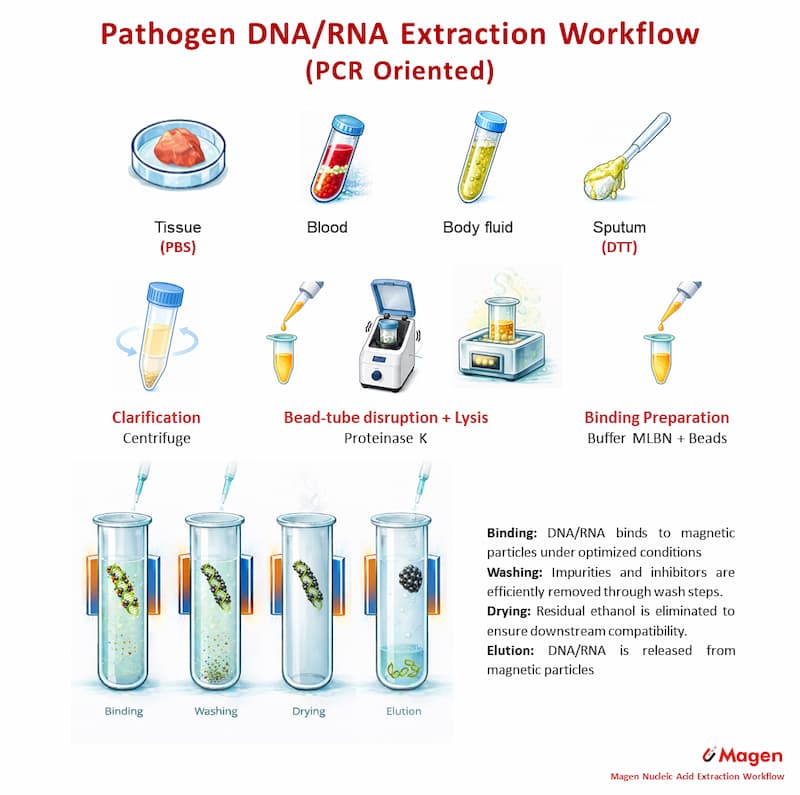
4.1 Sputum-Oriented Pathogen RNA Extraction
IVD6672C MagPure Pathogen RNA Kit fits a more specialized position in the workflow system. Unlike IVD6672, which is positioned for pathogen DNA/RNA recovery, IVD6672C focuses on pathogen RNA purification from sputum and other no- or low-cell-content biological samples where microbial RNA detection is required.
The workflow is built around sputum liquefaction when needed, mechanical / SDS-assisted disruption, Proteinase K digestion, DNase treatment and magnetic bead RNA purification. This makes it suitable for sputum pathogen RNA workflows, including TB-oriented RNA detection, bacterial RNA analysis and respiratory pathogen research.
IVD6672C should be understood as a specialized pathogen RNA workflow rather than a general pathogen DNA/RNA extraction route.
5.0 tNGS-Oriented Low-Background Pathogen Extraction
R6672B MagPure Pathogen DNA/RNA Kit B represents the tNGS-oriented low-background pathogen extraction level. Compared with IVD6672, it places more emphasis on direct disruption and reagent background control.
This distinction matters for targeted NGS and pathogen panel workflows. These applications do not require the same host-background depletion logic as mNGS, because downstream detection is guided by known targets or targeted sequencing design. However, they still benefit from stronger pathogen disruption and lower reagent-derived nucleic acid background, especially in low-biomass pathogen testing.
Workflow interpretation: R6672B is better viewed as a low-background direct pathogen extraction workflow. Its core logic is low-background reagent control, SDS-assisted bead-tube disruption and magnetic bead purification. It should not be confused with the mNGS enrichment route.
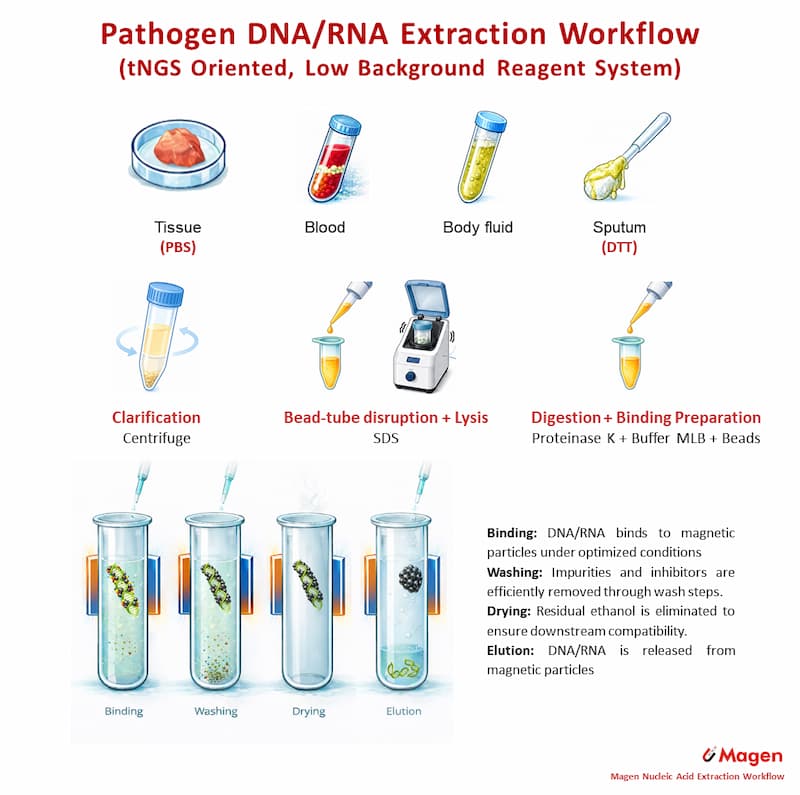
6.0 mNGS-Oriented Host-Background Reduction and Pathogen Enrichment
R6672C is different from direct extraction workflows. In host-rich samples, especially blood-related mNGS samples, the sediment may contain host cells as well as bacteria, fungi, cell-associated microorganisms or pathogen material associated with cell debris. If this sediment is discarded, part of the pathogen signal may be lost. If it is lysed directly without background control, large amounts of human DNA may enter the final extract.
R6672C is designed to address this trade-off. The workflow retains the liquid fraction containing viral or mycoplasma-associated material, processes the sediment fraction through host-background reduction, releases microbial nucleic acids by bead-tube disruption and then recombines the fractions before magnetic bead purification.
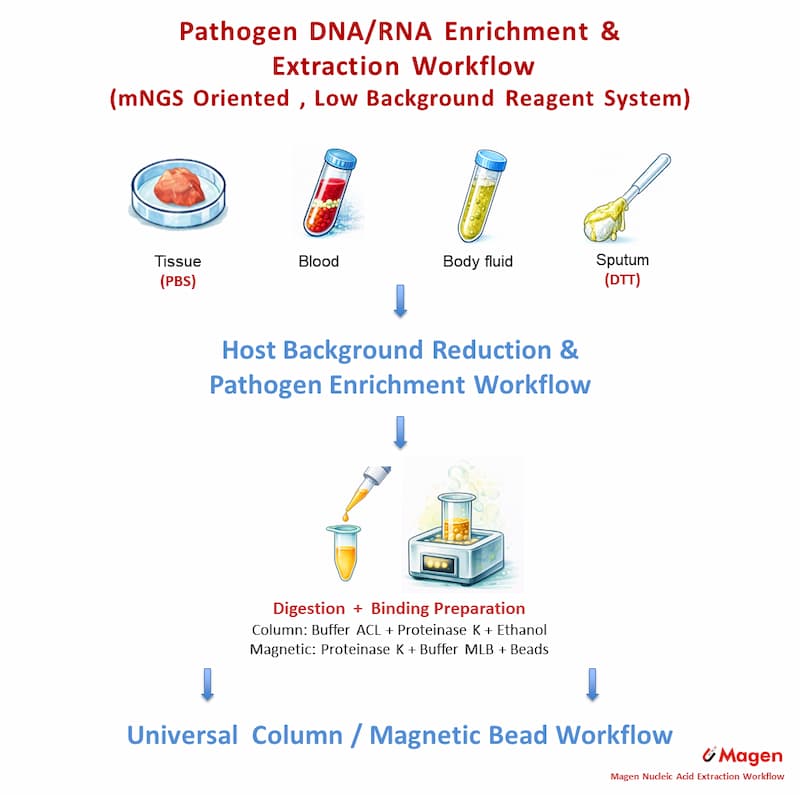
Workflow interpretation: The value of this workflow is reduces pathogen loss from the sediment fraction while controlling sample-derived human DNA background before downstream purification.
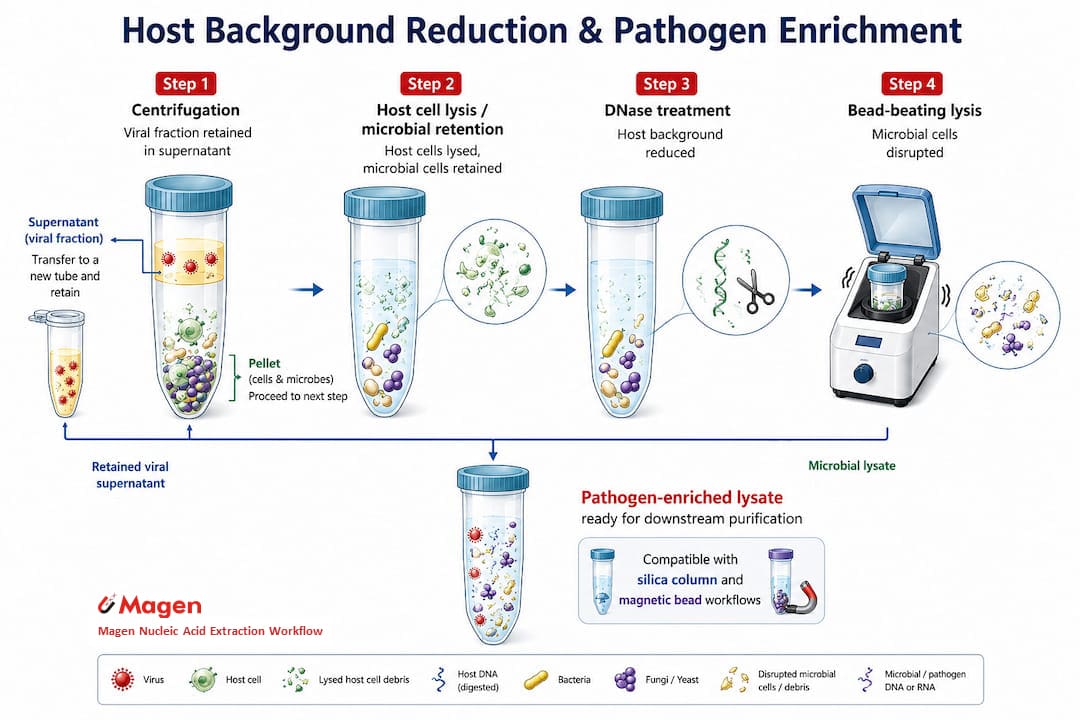
7.0 Column-Based Pathogen Enrichment Route
IVD4179 HiPure Pathogen RNA/DNA Kit fits into the same enrichment logic, but uses a silica column downstream purification platform. It should not be confused with ordinary viral column extraction.
The useful distinction is simple: R6672C represents enrichment followed by magnetic bead purification, while IVD4179 represents enrichment followed by silica column purification. In both cases, the upstream logic is built around host-background control and pathogen enrichment; the downstream platform determines how DNA/RNA is finally recovered.
8.0 Two Types of Background in Pathogen Nucleic Acid Preparation
8.1 Reagent-derived nucleic acid background
Reagent-derived background refers to nucleic acids introduced by reagents, consumables or production processes. It is especially important in low-biomass pathogen testing, targeted NGS and pathogen panel workflows, where background nucleic acids can increase noise or interfere with interpretation.
R6672B is positioned around this problem through a low-background reagent system combined with direct pathogen disruption. In this type of workflow, the sample is still processed mainly as a direct extraction route, but the reagent system is controlled to reduce the risk of introducing nucleic acid background into low-biomass pathogen analysis.
8.2 Sample-derived host nucleic acid background
Sample-derived background refers to human or host nucleic acids already present in the sample. It is especially important in mNGS, where sequencing reads can be dominated by host-derived DNA/RNA rather than pathogen sequences.
R6672C and IVD4179 address this problem at a higher workflow level. These workflows are not only built on low-background extraction requirements; they also add sample-processing steps for host-background reduction and pathogen enrichment before downstream purification. In host-rich samples, this process-level background control is critical because the main interference comes from the sample itself, not only from reagents or consumables.
9.0 How to Read This Article Together with the Purchase Guide
This article explains the workflow logic behind the Magen viral / pathogen portfolio. For product-level selection, sample input, format and catalog-specific comparison, refer to the Viral & Pathogen Nucleic Acid Extraction Kit Selection Guide.
In practice, workflow selection should not start from the kit name alone. A viral or pathogen target does not automatically mean that every sample should enter a viral/pathogen workflow. Difficult matrices such as stool, soil, plant tissue and FFPE sections may require matrix-specific extraction chemistry before a viral or pathogen workflow category is selected. The key question is whether the workflow matches the sample matrix, target location, inhibitor profile and downstream assay.
9.1 Sample Matrix First: Important Boundary Cases
Viral and pathogen workflows are useful categories, but they do not replace sample-matrix judgment. In some applications, the word “viral” or “pathogen” describes the detection target, not the extraction problem. The real workflow challenge may come from FFPE crosslinking, plant-derived inhibitors, or stool, soil and environmental sample complexity.
| Boundary Case | Main Extraction Problem | Workflow Interpretation |
|---|---|---|
| Viral or pathogen target in FFPE tissue | Formalin-induced crosslinking, nucleic acid fragmentation and paraffin-related sample handling | The FFPE workflow should come first; viral or pathogen target type is considered after FFPE-compatible DNA/RNA recovery. |
| Viral or pathogen target in plant tissue | Polysaccharides, polyphenols, starch and tough plant tissue structure may interfere with extraction and downstream assays | Plant extraction chemistry should come first; pathogen detection may also require suitable mechanical disruption when bacteria or fungi are involved. |
| Viral or pathogen target in stool, soil or environmental samples | Humic substances, bile salts, complex debris, mixed microbial background and environmental inhibitors may affect PCR or sequencing | Microbial/environmental extraction logic may be more relevant than a standard viral/pathogen kit label, especially when inhibitor control is the limiting factor. |
Pathogen release principle:
In difficult sample matrices, workflow selection should consider three factors together: the sample matrix, the structure of the target organism and the downstream assay.
Viral targets are usually easier to release than cellular microorganisms because they do not require cell-wall disruption, although concentration, clarification or inhibitor control may still be needed in environmental or inhibitor-rich samples.
For bacterial targets, the lysis requirement depends on cell-wall structure and sample context. Gram-negative or thin-walled organisms may often be released when the matrix-specific workflow already provides sufficiently strong lysis chemistry, such as detergent-based lysis, chaotropic salts, protein digestion or CTAB-like inhibitor-control chemistry. In these cases, inhibitor removal may be more limiting than mechanical disruption.
Gram-positive bacteria, fungi, yeast or spores are usually harder to lyse and may require additional physical disruption, such as bead beating, on top of the original matrix-specific workflow.
For mixed-pathogen or mNGS-oriented workflows, pathogen release should also be considered together with host-background reduction, pathogen enrichment and downstream assay compatibility.
10.0 Closing Note
The Magen viral / pathogen portfolio is not only a collection of extraction formats. It is a workflow ladder.
At the base are routine viral workflows for PCR and RT-PCR. Above that are direct pathogen extraction workflows for PCR and broader pathogen detection. IVD6672C adds a specialized sputum-oriented pathogen RNA route for workflows such as TB-oriented RNA detection. R6672B adds low-background reagent control and stronger direct disruption for tNGS-oriented preparation. R6672C and IVD4179 move into a different technical category, where host-background reduction and pathogen enrichment become central to preserving pathogen signal in host-rich samples.
Understanding these differences helps laboratories choose the appropriate workflow not by product name alone, but by the sample problem they need to solve.