Introduction
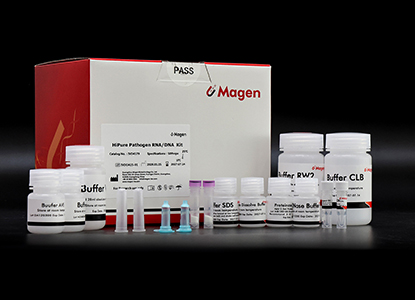
The HiPure Pathogen DNA/RNA Kit is designed for purification of pathogen nucleic acids from complex biological samples including blood, sputum and tissue homogenates. The workflow integrates chemical lysis with bead-assisted microbial disruption to improve release of nucleic acids from bacterial and fungal cells.
Following lysis, DNase treatment reduces background host DNA before nucleic acids are purified using a silica column. Purified pathogen DNA and RNA are recovered through sequential washing and elution steps.
This system is frequently used in pathogen sequencing workflows where recovery of microbial nucleic acids from complex clinical matrices is required. For magnetic bead–based pathogen extraction, laboratories may use MagPure Pathogen DNA/RNA Kit (IVD6672), while host background reduction prior to sequencing can be achieved using MagPure Pathogen DNA/RNA Enrich Kit (R6672C).
Details
Workflow

Workflow Overview
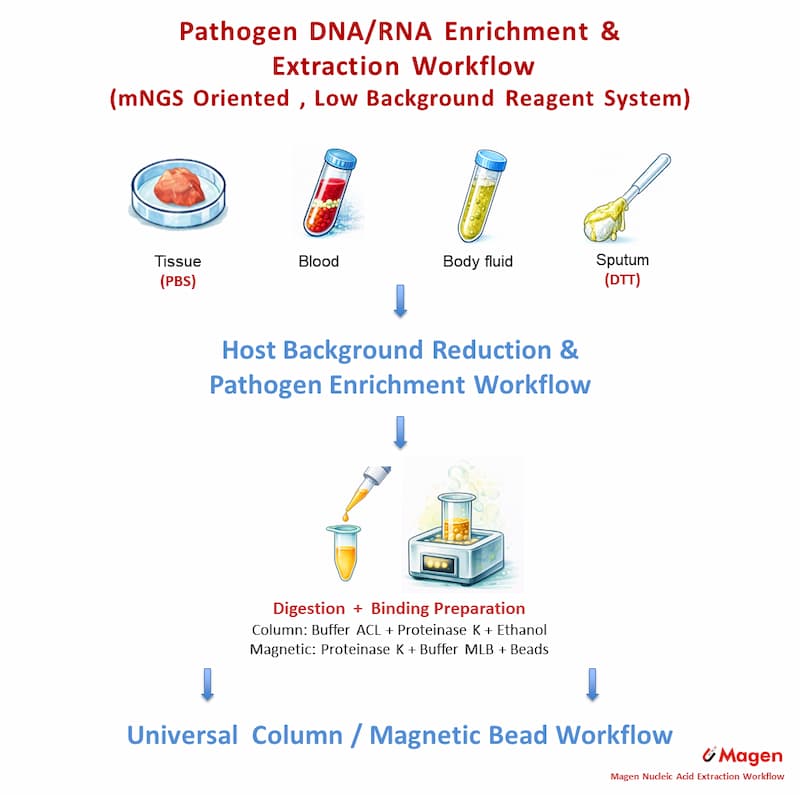
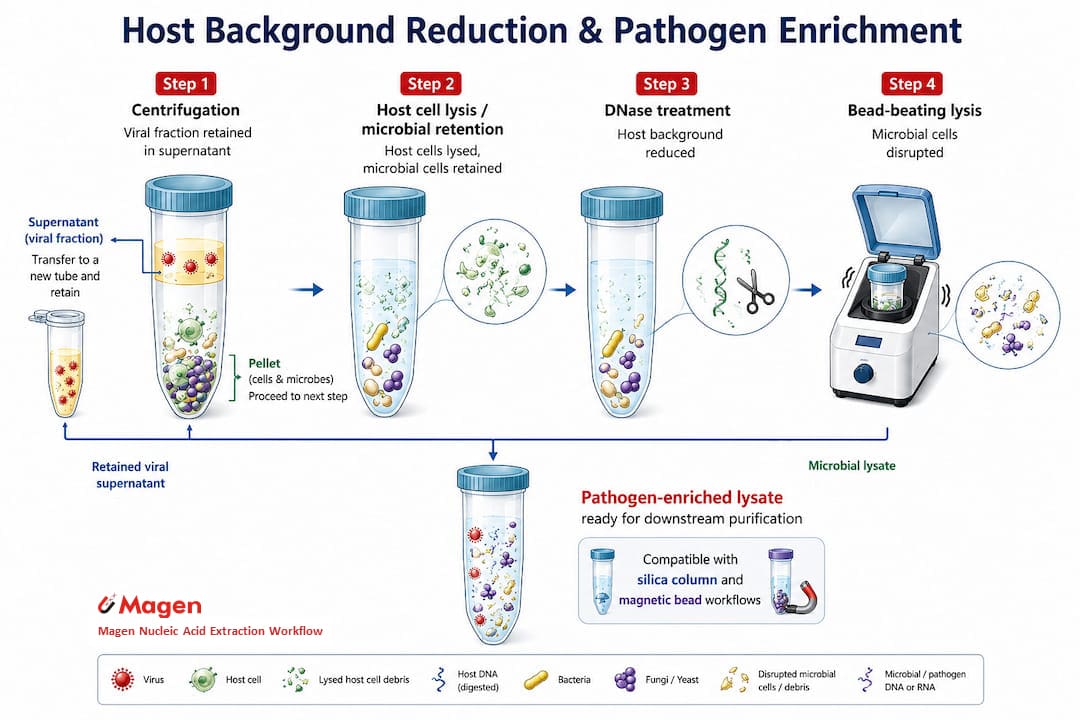
The HiPure Pathogen RNA/DNA Kit uses a host-background reduction and pathogen enrichment workflow followed by silica column purification. The sample is first processed to preserve the liquid-phase viral fraction while the sediment-associated microbial fraction is further treated for host-background reduction and pathogen recovery. After enrichment, the combined lysate enters a silica column workflow, where pathogen RNA/DNA is captured on the membrane and recovered through washing, drying and elution steps.
Sample Handling Logic
This workflow is designed for complex clinical samples where pathogen signals may be distributed between liquid and sediment-associated fractions. Direct clarification may reduce host-cell carryover but can also lose microbial material associated with cells, debris or pellets. IVD4179 addresses this by retaining the viral supernatant while processing the sediment fraction through host-background reduction, DNase treatment and bead-tube microbial disruption before recombination. This helps preserve pathogen signal while controlling host-derived background before column purification.
Time and Workflow Characteristics
Under typical manual operation, the workflow requires a longer processing time than routine viral extraction because it includes sample-specific pretreatment, fraction handling, host-background reduction, DNase treatment, bead-tube disruption and silica column purification. Processing time varies depending on sample type and pretreatment requirements. For detailed step-by-step conditions, workflow guidance and estimated processing times, please refer to the Workflow Note in the Download section.
Specifications
|
Features
|
Specifications
|
|
Main Functions
|
Extract pathogen DNA/RNA from whole blood, body fluid, serum, plasma, sputum, immersion solution, tissue homogenate supernatant, etc.
|
|
Applications
|
RT-PCR,PCR,NGS
|
|
Products
|
Pathogen DNA and RNA
|
|
Purification method
|
Mini spin column
|
|
Purification technology
|
Silica technology
|
|
Process method
|
Manual (centrifugation or vacuum)
|
|
Sample type
|
Whole blood, plasma, serum, immersion solution, tissue homogenate supernatant
|
|
Sample amount
|
200μl
|
|
Elution volume
|
≥30μl
|
|
Time per run
|
95~110 mins
|
|
Liquid carrying volume per column
|
800μl
|
|
Binding yield of column
|
100μg
|
Kit Contents
|
Contents
|
IVD4179
|
|
Purification Times
|
50 Preps
|
|
HiPure Viral Mini Column
|
50
|
2ml Collection Tubes
|
100
|
2ml Bead Tubes
|
50
|
|
Protease K
|
50 mg
|
|
Protease Dissolve Buffer
|
5 ml
|
DNase I (Powder)
|
10 mg
|
DNase Buffer
|
6 ml
|
Buffer CLB
|
100 ml
|
Buffer SDS
|
5 ml
|
Reagent DX
|
1.5 ml
|
Buffer ACL
|
30 ml
|
Buffer VHB*
|
22 ml
|
Buffer RW2*
|
20 ml
|
Buffer AVE
|
15 ml
|
Storage and Stability
Proteinase K and DNase I (Powder) should be stored at 2–8°C upon arrival. However, short-term storage (DNase I up to 1 week, Proteinase K up to 8 weeks) at room temperature (15–25°C) does not affecttheir performance. The remaining kit components can be stored at room temperature (15–25°C) and are stable for 18 months under these conditions.
Purchase Guide
For guidance on selecting the most appropriate viral or pathogen nucleic acid extraction system based on sample type, target nucleic acid, automation needs and downstream application:
👉 Viral & Pathogen Nucleic Acid Extraction Kit Selection Guide
For a broader technical overview of Magen viral / pathogen workflow routes, background-control logic and PCR, tNGS or mNGS application orientation:
👉 Magen Viral / Pathogen Workflows Explained
For detailed workflow notes covering representative pathogen extraction and enrichment routes:
👉 IVD6672 Pathogen DNA/RNA Extraction Workflow Note
👉 R6672B Low-Background Pathogen DNA/RNA Extraction Workflow Note
👉 R6672C Host-Background Reduction and Pathogen Enrichment Workflow Note
👉 IVD4179 Column-Based Pathogen Enrichment Workflow Note
Articles
Download