Introduction
HiPure Plasmid EF Maxi Kit B functions as the primary low-endotoxin column reference model within the Magen plasmid DNA extraction portfolio. Built as an upgraded version of the earlier EF maxi workflow, it retains the broad vector compatibility and low-endotoxin preparation logic of the original system while further improving endotoxin removal efficiency, workflow flexibility and RNA control. The product is positioned for medium- to low-copy plasmids, routine cell transfection, animal injection and other downstream applications requiring cleaner plasmid preparation at larger scale.
Compared with the earlier EF maxi format, this version introduces an upgraded endotoxin-removal workflow, a higher-capacity RC7 maxi column and a more flexible operating structure that supports either centrifugation or vacuum-based handling. Within the Magen plasmid system, HiPure Plasmid EF Maxi Kit B serves as the primary low-endotoxin column route. Laboratories working below this scale may refer to HiPure Plasmid EF Mini Kit (P1154) or HiPure Plasmid EF Midi Kit (P1231), while HiPure Plasmid EF Maxi Kit (P1156) remains available as the earlier support configuration within the same EF branch.
Details
Extraction Principle
Bacterial cells are lysed under alkaline conditions and neutralized to produce a clarified lysate suitable for endotoxin-oriented purification. The lysate is then treated with a dedicated endotoxin-removal step before column binding. For more sensitive downstream applications, the workflow also provides an optional enhanced cleanup process prior to loading. After binding conditions are adjusted with alcohol, plasmid DNA is captured on the maxi column, washed and eluted to recover low-endotoxin plasmid DNA.
Engineering Characteristics
Upgraded low-endotoxin purification workflow
This version builds on the earlier EF maxi route but further improves endotoxin removal and RNA control, making it better suited to more demanding downstream applications
RC7 maxi column with higher binding capacity
The upgraded maxi column is specified with binding yield up to 1500 μg, which is better aligned with larger-output plasmid preparation than the earlier EF maxi format.
Two operating routes for larger-scale handling
The workflow supports both centrifugation and vacuum-based processing, making it easier to integrate into different laboratory setups for routine larger-volume preparation.
Improved endotoxin and RNA control
The upgraded workflow refines the Triton X-114-based endotoxin removal step and adds a wash stage aimed at further reducing endotoxin and RNA carryover in the final plasmid DNA.
Large-format elution control
The protocol gives explicit elution guidance based on centrifuge type and plasmid size. Plasmids above 10 kb benefit from preheated elution buffer, and the recommended elution volume changes depending on whether angle or horizontal centrifugation is used. A second elution step is also supported to improve recovery.
Simplified drying after washing
Internal workflow verification showed that column drying can be streamlined after washing, helping reduce residual ethanol while simplifying routine handling.
Technical Validation of P1156
The HiPure Plasmid EF Maxi Kit was validated using high-copy and low-copy plasmid cultures to evaluate plasmid yield, purity and extraction scalability. In the test, high-copy vector cultures were processed from 50–100 mL input volumes, while low-copy vector cultures were processed from 100–200 mL input volumes. Purified plasmid DNA was analyzed by NanoDrop measurement and agarose gel electrophoresis.
Across the tested samples, plasmid DNA purified using P1156 showed A260/280 values of approximately 1.79–1.90 and A260/230 values of approximately 1.8–2.5, indicating suitable purity for routine molecular biology applications. For high-copy plasmid cultures, P1156 produced approximately 0.75–0.89 mg plasmid DNA from 50 mL culture and up to approximately 1.1–1.4 mg from 100 mL culture under the tested conditions.
For low-copy plasmid cultures, P1156 produced approximately 250–550 µg plasmid DNA from 100–200 mL bacterial culture. The extraction efficiency was comparable to conventional small-scale plasmid extraction when normalized by culture volume, supporting the use of P1156 for larger-volume plasmid preparation where increased total DNA output is required.
Additional testing showed that the PW1 wash step can reduce RNA-related overestimation and produce more realistic plasmid yield readings, especially when processing low-copy plasmid cultures. The results also indicate that culture volume should be selected according to plasmid copy number and column binding capacity, as excessive high-copy culture input may exceed the binding capacity and reduce extraction efficiency.
Technical Validation of P1156B
The HiPure Plasmid EF Maxi Kit B was validated as an upgraded low-endotoxin Maxi-format plasmid purification workflow using pcDNA3.1 bacterial cultures at 50 mL, 100 mL and 200 mL input volumes. Both centrifugation and vacuum-based processing were evaluated using the RC7 Maxi column format.
Across the tested culture volumes, purified plasmid DNA showed A260/280 values of approximately 1.89–1.95 and A260/230 values of approximately 2.02–2.30, supporting reliable plasmid purity after alkaline lysis, endotoxin-removal treatment and column purification. Total plasmid yields increased with culture volume, reaching approximately 404–415 µg from 50 mL culture, 646–775 µg from 100 mL culture and 1302–1543 µg from 200 mL culture under the tested conditions.
Centrifugation and vacuum processing produced comparable plasmid recovery profiles. This supports flexible operation of P1156B for laboratories using either standard centrifugation equipment or vacuum filtration devices such as QIAVAC 24 Plus or Magen MagVac 20 System.
Additional ethanol-removal testing showed that the RC7 column workflow can combine the final centrifugation and drying step to simplify operation. After PW2 washing and 8000 rpm centrifugation, further room-temperature drying for 10–20 minutes reduced residual ethanol to below approximately 10 µL under the tested conditions, supporting downstream applications that are sensitive to ethanol carryover.
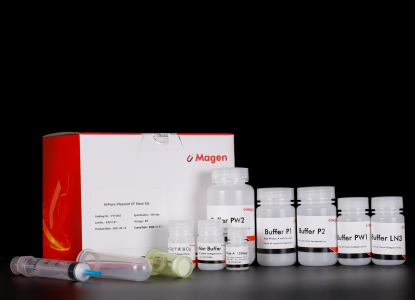
Kit Contents - P1156B (Update of P1156)
|
Contents
|
P115602B
|
P115603B
|
|
Purification Times
|
10 Preps
|
50 Preps
|
|
RNase A
|
30 mg
|
150 mg
|
|
Buffer P1
|
100 ml
|
500 ml
|
Buffer P2
|
90 ml
|
450 ml
|
Buffer NS3
|
90 ml
|
450 ml
|
Buffer PW1
|
60 ml
|
270 ml
|
|
Buffer PW2*
|
20 ml
|
100 ml
|
|
Elution Buffer
|
20 ml
|
120 ml
|
|
Buffer ER2
|
30 ml
|
150 ml
|
HiPure DNA Maxi Columns RC7
|
10
|
50
|
Lysate Clear Midi Syringe
|
10
|
50
|
50 ml Collection Tube
|
20
|
100
|
Kit Contents - P1156
|
Contents
|
P115602
|
P115603
|
|
Purification Times
|
10 Preps
|
50 Preps
|
|
RNase A
|
30 mg
|
150 mg
|
|
Buffer P1
|
100 ml
|
500 ml
|
Buffer P2
|
100 ml
|
500 ml
|
Buffer LN3
|
50 ml
|
250 ml
|
Buffer PW1
|
33 ml
|
180 ml
|
|
Buffer PW2
|
20 ml
|
100 ml
|
|
Elution Buffer
|
15 ml
|
120 ml
|
|
Buffer CL
|
33 ml
|
180 ml
|
HiPure DNA Maxi Columns C
|
10
|
50
|
Lysate Clear Midi Syringe
|
10
|
50
|
50 ml Collection Tubes C
|
20
|
100
|
Storage and Stability
The kit components can be stored dry at room temperature (15–25°C) and are stable for at least 18 months under these conditions. If any precipitates form in the buffers,warm at 37°C to dissolve. After addition of RNase A,Buffer P1 is stable for 6 months when stored at 2–8°C.