Introduction
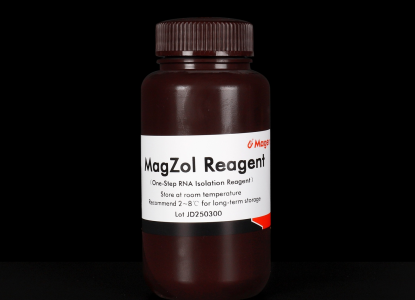
MagZol Reagent is a reagent system for the isolation of total RNA from cells and tissues. The reagent, a single-phase solution consisting of phenol and guanidine isothiocyanate, is modification of the single-step RNA isolation method developed by Chomczynski and Sacchi. The sample is homogenized and lysed in MagZol Reagent which maintains the integrity of the RNA, while disrupting and denaturing endogenous RNases and other cellular components. Extraction of the lysate with chloroform further denatures proteins and separates the mixture into an organic and an aqueous phase. RNA remains exclusively in the aqueous phase, and is subsequently recovered by isopropanol.
This method is suitable for small quantities of tissue (<100mg) and cells (<5 X10⁶), and large quantities of tissue (up to 1g) and cells (<108), of human, animal, plant, or bacterial origin. The simplicity of the MagZol Reagent method allows simultaneous processing of a large number of samples. The entire procedure can be completed in one hour. Total RNA prepared in this manner can be used for Northern blot analysis, dot blot hybridization, poly(A) + selection, in vitro translation, RNase protection assay, and molecular cloning. For use in amplification by thermal cycling, treatment of the isolated RNA with RNase-free DNase I is recommended when the two amplimers lie within a single exon.
Details
Specifications
|
Features
|
Specifications
|
|
Main Functions
|
RNA isolation solvent (substitution for Trizol/Qiazol reagent)
|
|
Applications
|
RT-PCR, Northern hybridization, poly (a) enrichment, etc.
|
|
Purification technology
|
Acid phenol guanidine isothiocyanate
|
|
Process method
|
Manual (centrifugation)
|
|
Sample type
|
Animal tissue, plant tissue, adherent cells, suspended cells, bacteria, trace fungi, etc.
|
|
Sample amount
|
Flexible
|
|
Elution volume
|
Variation with sample size
|
|
Time per run
|
Variation with sample size
|
Advantages
-
Extensive - suitable for various kinds of biological samples, including animals, plants, cultured cells, bacteria, etc.
-
High yield - efficient cleavage releases more RNA
-
High purity - purified RNA is suitable for various downstream applications
-
Flexible - sample amount can be adjusted according to the demand
-
High cost performance compared with similar products
Technical Validation
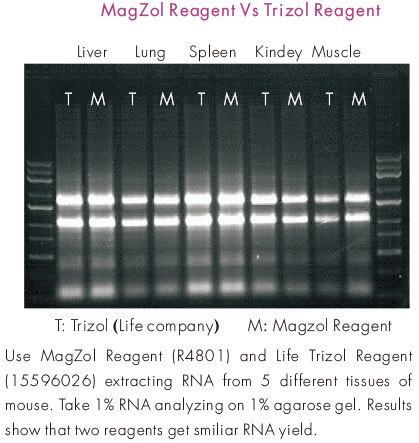
MagZol Reagent was evaluated as a phenol / guanidine-based RNA isolation reagent using animal tissue samples, including frog and fish tissues, with both precipitation-based and column-assisted recovery workflows. The validation compared MagZol Reagent with a commonly used commercial Trizol workflow to assess RNA yield, purity and workflow compatibility under tissue extraction conditions.
In frog tissue testing, MagZol Reagent produced RNA yields comparable to the reference Trizol workflow across liver, lung and heart samples. For example, frog liver extraction by precipitation produced RNA yields of 233.78–260.09 µg with MagZol Reagent, while the reference workflow produced 252.20–253.32 µg under the tested conditions. In the column-assisted workflow, MagZol Reagent also produced comparable yields, including 150.31 µg from frog liver, 101.68 µg from frog lung and 26.10 µg from frog heart.
Fish tissue testing further supported the use of MagZol Reagent across different tissue matrices. In fish liver extraction, MagZol Reagent produced RNA yields of 260.22–266.08 µg, comparable to 248.70–258.44 µg from the reference workflow. For fish gill samples, MagZol Reagent produced RNA yields of 171.24–173.41 µg, while the reference workflow produced 160.97–164.97 µg. A260/280 values were generally within the expected RNA purity range for phenol-based extraction workflows.
Across the tested tissue samples and recovery formats, MagZol Reagent showed comparable extraction behavior to the reference Trizol workflow. The validation also indicated that lysis strength required balancing yield and genomic DNA carryover, supporting the final reagent formulation as a practical RNA isolation solvent for routine tissue and cell-based total RNA preparation.
Storage and Stability
MagZol Reagent should be stored at 2-8°C upon arrival and is stable for at least 24 months under the condition. However, short-term storage (up to 12 weeks) at room temperature (15-25°C) does not affect its performance.
Experiment Data
Purchase Guide
Choosing the appropriate RNA extraction kits depends on sample type, RNA species and workflow requirements.
For detailed guidance across tissue and cell RNA extraction workflows, refer to the Tissue/Cell RNA Kits Selection Guide.