Introduction
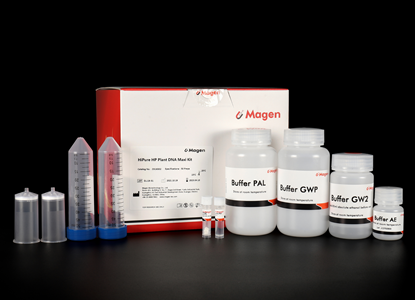
The HiPure HP Plant DNA Maxi Kit (D3163) is designed for large-scale DNA extraction from plant or fungal samples, supporting input up to gram-level tissue.
The workflow is based on CTAB lysis and organic extraction, consistent with D3187, but scaled for bulk DNA preparation.
Details
Workflow
Workflow Overview
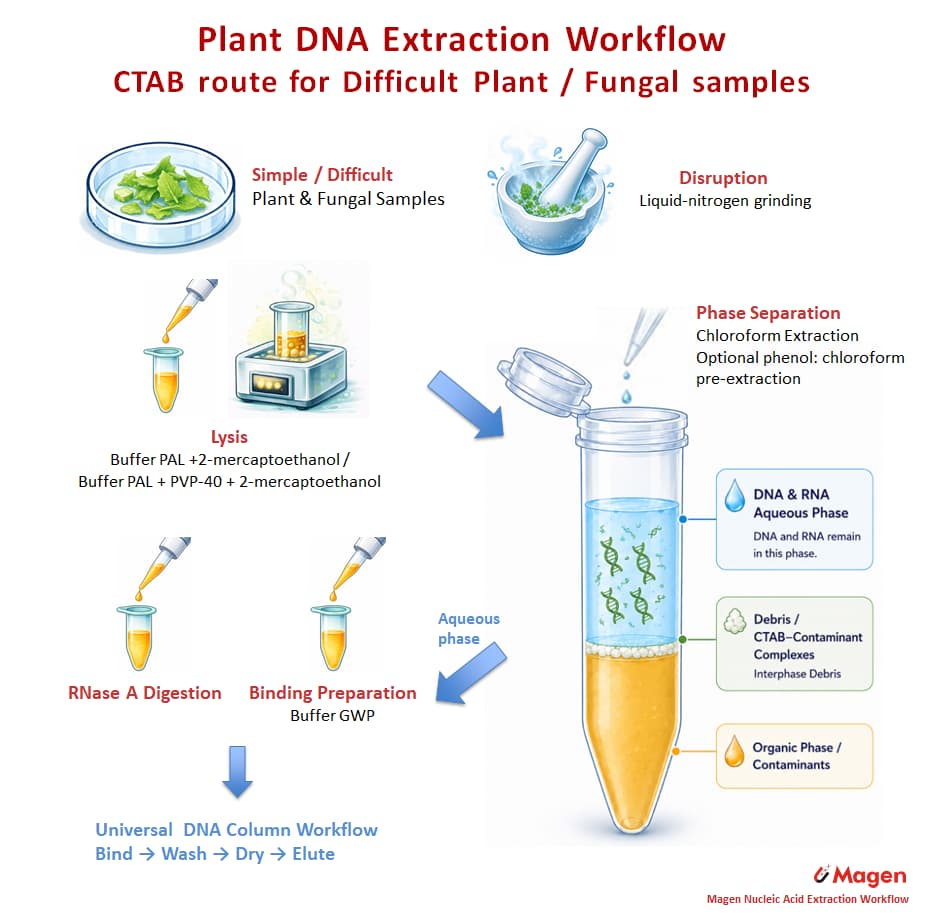
The HiPure HP Plant DNA Maxi Kit uses a large-scale CTAB-based silica column workflow for purification of genomic DNA from plant and fungal samples. Plant or fungal tissue is first disrupted under liquid nitrogen and lysed with Buffer PAL, or Buffer PAL/PVP-40 for polyphenol-rich samples. Chloroform extraction removes plant debris, proteins, polysaccharides and other contaminant-rich material from the aqueous phase. The DNA-containing aqueous phase is then treated with RNase A, adjusted with Buffer GWP and applied to a HiPure DNA Maxi Column, where DNA is captured, washed, dried and eluted in a larger elution volume.
Sample Handling Logic
This workflow follows the same CTAB-column purification principle as the mini-format HP Plant DNA workflow, but it is scaled for larger sample input and larger lysate volumes. The main workflow challenges are complete disruption, efficient PAL lysis, clean phase separation and careful transfer of the aqueous phase without disturbing the pellet or interface. Once the cleared aqueous phase has been prepared and the binding condition has been adjusted, the downstream Maxi column workflow follows the universal column sequence of bind, wash, dry and elute.
Time and Workflow Characteristics
Under typical manual operation, the workflow is usually completed within about 115–145 minutes, depending mainly on sample input, lysate volume, phase separation, RNase A treatment and the large-volume column centrifugation steps. This route is suitable for laboratories that need higher DNA recovery from larger plant or fungal inputs while maintaining CTAB-based contaminant removal before silica column purification. For detailed step-by-step conditions, workflow guidance and estimated processing times, please refer to the Workflow Note in the Download section.
Specifications
|
Features
|
Specifications
|
|
Main Functions
|
Isolation total DNA from 3g plant and fungal tissue
|
|
Applications
|
PCR, SSR, AFLP, RAPD and southern blot, etc.
|
|
Purification method
|
Maxi spin column
|
|
Purification technology
|
Silica technology
|
|
Process method
|
Manual (centrifugation or vacuum)
|
|
Sample type
|
Various plant samples (including conventional, polysaccharides and polyphenols)
|
|
Sample amount
|
Fresh / frozen plant samples: 2-3 g
Dried plant / seed samples: 0.5-1 g
|
|
Elution volume
|
≥500μl
|
|
Time per run
|
~115-145 minutes
|
|
Liquid carrying volume per column
|
20ml
|
|
Binding yield of column
|
5mg
|
Technical Notes
Maintains the same inhibitor removal strategy as D3187
Includes RNase treatment for improved DNA purity
Suitable for workflows requiring higher DNA yield rather than higher throughput
Kit Contents
|
Contents
|
D316302
|
D316303
|
|
Purification Times
|
10 Preps
|
50 Preps
|
RNase A
|
20 mg
|
90 mg
|
Protease Dissolve Buffer
|
1.8 ml
|
10 ml
|
|
Buffer PAL
|
180 ml
|
900 ml
|
|
Buffer GWP
|
150 ml
|
800 ml
|
|
Buffer GW2
|
25 ml
|
200 ml
|
Buffer AE
|
30 ml
|
120 ml
|
HiPure DNA Maxi Columns II
|
10
|
50
|
50 ml Collection Tubes
|
20
|
100
|
Storage and Stability
RNase A should be stored at 2-8°C upon arrival. However, short-term storage (up to 12 weeks) at room temperature (15-25°C) does not affect its performance. The remaining kit components can be stored dry at room temperature (15-25°C) and are stable for at least 18 months under these conditions. The entire kit can be stored at 2-8°C, but in this case buffers should be redissolved before use. Make sure that all buffers are at room temperature when used.

Purchase Guide
HiPure HP Plant DNA Maxi Kit (D3163) is suitable for large-scale DNA extraction from plant and fungal samples, particularly for inhibitor-rich tissues.
For smaller-scale extractions, HiPure HP Plant DNA Kit (D3187) provides a similar CTAB-based workflow.
For routine plant samples with low inhibitor content, SDS-based systems such as HiPure SF Plant DNA Kit (D3164) may be considered.
For a complete selection guide:
👉 Plant DNA and RNA Extraction Selection Guide