Introduction
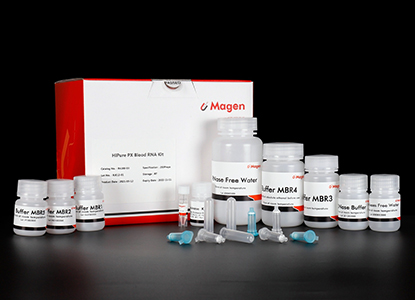
The HiPure Paxgene Blood RNA Kit is designed for RNA purification from blood samples stabilized using PAXgene blood RNA collection tubes. The workflow is compatible with stabilized whole blood samples and supports RNA purification for transcriptomic analysis.
The protocol enables efficient RNA recovery from stabilized blood samples and is commonly used in gene expression profiling studies where RNA stabilization during sample collection is required.
For automated blood RNA purification workflows laboratories may refer to the MagPure Blood RNA Kit (R6611).
Details
Specifications
|
Features
|
Specifications
|
|
Main Functions
|
Isolation total RNA from Paxgene RNA Tubes
|
|
Applications
|
RT-PCR, qPCR, Northern hybridization, NGS, nucleic acid protection, in vitro translation
|
|
Purification method
|
Mini spin column
|
|
Purification technology
|
Silica technology, DNA filtration technology
|
|
Process method
|
Manual (centrifugation or vacuum)
|
|
Sample type
|
Blood in the preservation tube
|
|
Sample amount
|
2.5ml
|
|
Elution volume
|
≥30μl
|
|
Liquid carrying volume per column
|
800µl
|
|
Binding yield of column
|
100μg
|
Principle
The Kit is for the purification of total RNA from 2.5 ml human whole blood collected in a PAXgene Blood RNA Tube. Purification begins with a centrifugation step to pellet nucleic acids in the PAXgene Blood RNA Tube. The pellet is washed and resuspended, and incubated in optimized buffers together with proteinase K. DNA wash The lysate is passed through a DNA Mini column. Ethanolis added to adjust binding conditions, and the lysate is applied to a column.RNA is selectively bound to the silica membrane as contaminants pass through. Remaining contaminants are removed in several efficient wash steps. Between the first and second wash steps, the membrane is treated with DNase I to remove trace amounts of bound DNA. After the wash steps, RNA is eluted in elution buffer and heat-denatured.
Technical Validation
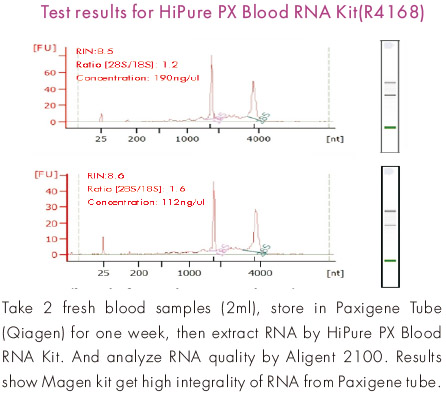
HiPure Paxigene Blood RNA Kit was evaluated as a silica column-based total RNA extraction workflow for blood samples collected in PAXgene Blood RNA Tubes or preserved with RNASafer LS Reagent. Performance testing was performed using blood samples from eight different donors stored in PAXgene Blood RNA Tubes. From 2.5 mL blood input per sample, the workflow produced total RNA yields of approximately 6.51–9.55 µg under the tested conditions. Spectrophotometric analysis showed A260/280 values of 2.09–2.16 and A260/230 values of 1.68–2.22, indicating consistent RNA purity across the tested donor samples. Agarose gel electrophoresis showed clear 28S and 18S RNA band patterns, supporting RNA integrity after extraction from stabilized blood samples.
Additional testing was performed using 1 mL fresh pig blood mixed with 4 mL RNASafer LS Reagent and stored at 2–8°C for 24 h before extraction. In a 100 µL elution volume, R4168 produced RNA yields of 28.06–30.56 µg, with A260/280 values of 2.10–2.19 and A260/230 values of 1.68–2.30. The R4168 workflow includes both gDNA filtration and on-column DNase I digestion. Related workflow testing showed that DNase I treatment effectively removed visible genomic DNA contamination from preserved blood RNA extracts, supporting the use of the complete R4168 workflow when low genomic DNA background is required.
Downstream compatibility was evaluated by RT-PCR using 2 µg of purified total RNA for reverse transcription, followed by amplification of the human β-actin target. The expected 750 bp RT-PCR product was observed from the tested RNA samples, indicating that the purified RNA was suitable for reverse transcription and endpoint PCR analysis.
Real-time PCR analysis further supported amplification compatibility. Gradient-diluted RT products produced consistent amplification behavior, with a single melt-curve peak and a linear standard curve with R² = 0.9969. The reported amplification efficiency was above 94% under the tested conditions. Together, these results support the use of R4168-purified blood RNA in downstream applications such as RT-PCR, real-time PCR, cDNA library construction and other RNA-based molecular workflows.
Kit Contents
|
Contents
|
R416802
|
R416803
|
|
Purification Times
|
10 Preps
|
50 Preps
|
|
HiPure RNA Mini Columns I
|
10
|
50
|
gDNA Filter Mini Columns
|
10
|
50
|
2ml Collection Tubes
|
30
|
150
|
|
RNase Free Water
|
60 ml
|
250 ml
|
Buffer MBR1
|
10 ml
|
30 ml
|
Buffer MBR2
|
5 ml
|
15 ml
|
Buffer RW1
|
15 ml
|
60 ml
|
Buffer RW2*
|
6 ml
|
20 ml
|
Proteinase K
|
12 mg
|
50 mg
|
Protease Dissolve Buffer
|
1.8 ml
|
5 ml
|
DNase I
|
120 µl
|
600 µl
|
DNase Buffer
|
6 ml
|
30 ml
|
Storage and Stability
Proteinase K should be stored at 2–8°C upon arrival. DNase I should be stored at -20°C. However, short-term storage (DNase I up to 1 weeks, Proteinase K up to 8 weeks) at room temperature (15–25°C) does not affect their performance. The remaining kit components can be stored at room temperature (15–25°C) and are stable for at least 18 months under these conditions.
Experiment Data
Purchase Guide
Choosing the appropriate RNA extraction system depends on sample type, RNA species and workflow requirements.
For detailed selection guidance across blood and liquid RNA workflows, refer to the Blood RNA Kits Selection Guide.