Introduction
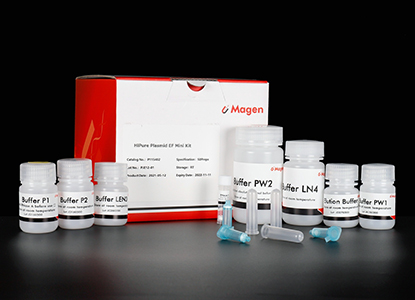
HiPure Plasmid EF Mini Kit is the salt-mediated mini-scale product within the Magen low-endotoxin plasmid branch. It processes 5–15 mL of bacterial culture and recovers up to 70 µg of transfection-grade plasmid DNA with endotoxin levels below 1 EU/µg. Its LN4 high-salt binding system provides strong plasmid selectivity and minimizes RNA carryover, producing OD-based concentration readings that more closely reflect the actual plasmid DNA yield. This is particularly useful for medium- and low-copy plasmids, where RNA contamination can otherwise cause substantial overestimation.
When the total plasmid yield is below approximately 10 µg, A260/A230 may be lower because of residual components associated with the high-salt binding system. Under validated conditions, this does not necessarily prevent downstream transfection. P1154 is the compact option for smaller cultures, while HiPure Plasmid EF Maxi Kit (P1156) remains the core routine EF product for larger culture volumes and broader vector compatibility.
Details
Technical Validation
The performance of the HiPure Plasmid EF Mini Kit (P1154) was evaluated using low- and high-copy plasmid cultures grown for 16 hours in LB medium. Plasmid DNA was eluted in 100 µL and assessed by spectrophotometry and agarose gel electrophoresis, with a standard plasmid mini-prep workflow used as the normalized yield reference.
In a low-copy plasmid scale-up study, P1154 recovered 7 µg from 4 mL culture, 12 µg from 6 mL, 19 µg from 10 mL and 38–39 µg from 20 mL. Further testing with three different low-copy plasmids produced 14.5–24.5 µg from 10 mL culture and 28.6–47.2 µg from 20 mL. The normalized yield per millilitre was 93–97% of the standard mini-prep reference. In this three-plasmid comparison, A260/A280 values ranged from 1.75 to 1.87 and A260/A230 values ranged from 1.70 to 2.21.
P1154 also supported high-copy plasmid purification when the expected plasmid load remained within the column capacity. Total yields increased from 12–15 µg with 1 mL culture to 28–30 µg with 2 mL and 46–49 µg with 4 mL. At higher culture inputs, recovery became limited by the binding capacity of the mini column rather than by the amount of plasmid present in the culture.
The salt-mediated P1154 workflow was also compared with an alcohol-mediated high-yield workflow. For the tested low-copy plasmids, OD-derived yields from P1154 showed closer agreement with agarose gel band intensity, supporting reduced RNA-related overestimation of plasmid DNA concentration. Overall, the results support P1154 as a low-copy-compatible mini-prep workflow for applications requiring scalable plasmid recovery and more representative DNA quantification.
Kit Contents
|
Contents
|
P115402
|
P115403
|
|
Purification Times
|
50 Preps
|
250 Preps
|
|
RNase A
|
5 mg
|
20 mg
|
|
Buffer P1
|
30 ml
|
140 ml
|
Buffer P2
|
30 ml
|
140 ml
|
Buffer LEN3
|
15 ml
|
70 ml
|
Buffer LN4
|
50 ml
|
250 ml
|
Buffer LN5
|
30 ml
|
140 ml
|
Buffer PW1
|
30 ml
|
140 ml
|
|
Buffer PW2
|
12 ml
|
50 ml
|
|
Elution Buffer
|
15 ml
|
30 ml
|
|
HiPure DNA Mini Columns III
|
50
|
250
|
2 ml Collection Tubes
|
50
|
250
|
Storage and Stability
The kit components can be stored dry at room temperature (15–25°C) and are stable for at least 18 months under these conditions. If any precipitates form in the buffers, warm at 37℃ to dissolve. After addition of RNase A,Buffer P1 is stable for 6 months when stored at 2–8°C.