Introduction
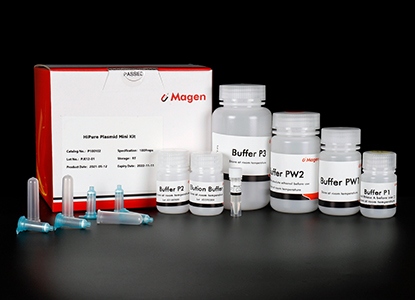
HiPure Plasmid Mini Kit is the core column product for routine molecular-biology-grade plasmid DNA preparation within the Magen portfolio. Designed for 1–5 mL overnight bacterial cultures, the kit combines optimized alkaline lysis with silica membrane purification to recover up to 35 µg of plasmid DNA. Its optimized neutralization chemistry reduces the formation and transfer of fine precipitates, helping produce a clear lysate for consistent plasmid recovery in cloning, PCR, restriction digestion, sequencing and other routine molecular biology applications.
Within the standard column branch, P1001 serves as the primary manual mini-prep format. HiPure Plasmid Mini Kit II (P1002) extends the culture input to 5–15 mL, while HiPure Plasmid Plus 96 Kit (P1006) provides a 96-well format for parallel screening. P1013 and P1014 extend the standard branch into FastFilter midi- and maxi-scale preparation. When plasmid DNA is required for transfection or animal injection, users should move to the endotoxin-free branch anchored by HiPure Plasmid EF Maxi Kit (P1156).
Details
Specifications
|
Features
|
Specifications
|
|
Main Functions
|
Isolation up to 35μg plasmid DNA from 1-5ml bacterial culture
|
|
Applications
|
Enzyme digestion, sequencing, PCR, cloning, etc.
|
|
Purification method
|
Mini spin column
|
|
Purification technology
|
Silica technology
|
|
Process method
|
Manual (centrifugation or vacuum)
|
|
Sample type
|
Conventional plasmid, plasmid less than 30KB
|
Sample amount
|
High copy plasmid: 1-5ml culture medium
Low copy number plasmid : 5-10ml culture medium
|
|
Yield
|
5-35µg
|
|
Elution volume
|
≥30μl
|
|
Time per run
|
Complete 1-24 samples in 30 minutes
|
|
Liquid carrying volume per column
|
800µl
|
|
Binding yield of column
|
35µg
|
Extraction Principle
The HiPure Plasmid procedure is based on alkaline lysis of bacterial cells followed by adsorption of DNA onto silica in the presence of high salt. The unique silica membrane used in the kit completely replaces glass or silica slurries for plasmid DNA minipreps. The procedure consists of 3 basic steps: Preparation and clearing of a bacterial lysate by alkaline method,then transfer the supernatant to column to bind DNA. After washing proteins and other impurities, nucleic acid was finally eluted with low-salt buffer (10mm Tris, pH9.0, 0.5mm EDTA).
Engineering Characteristics
Standard mini-prep membrane workflow
The kit is designed around a silica membrane mini-column format for routine 1–5mL bacterial culture processing, with protocol guidance also supportinglow-copy plasmids or cosmids when input conditions are adjusted appropriately.
Defined binding capacity for routinemini-prep use
Internal testing showed that plasmid recovery increased with culture input andbegan to level off at around 4–5 mL, supporting a practical column bindingcapacity of approximately 35 μg for this mini-prep format.
Optional background-control wash
An additional PW1 wash step is recommended when lower background contaminationor more controlled downstream performance is needed.
Technical Validation
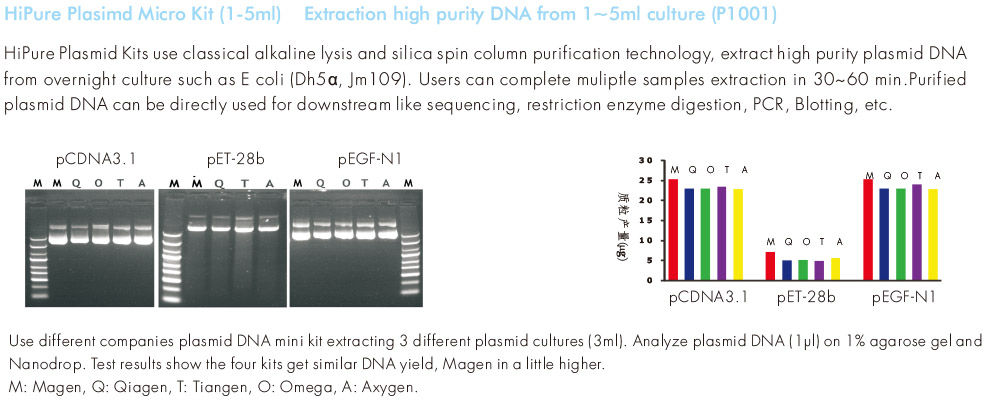
The HiPure Plasmid Mini Kit was validated using E. coli cultures carrying common plasmid vectors, including pEGF-N1, pcDNA3.1 and pET-28b. In binding-capacity testing, plasmid yield increased with bacterial culture volume from 1 mL to 5 mL, with the column binding capacity reaching approximately 35 µg under the tested conditions.
Extraction stability was evaluated using 48 samples prepared from 2 mL overnight cultures carrying pEGF-N1. The purified plasmid DNA showed stable yield and purity across replicates, with yield variation within approximately 10%, A260/280 values of about 1.81–1.92 and A260/230 values of about 2.0–2.4.
Downstream compatibility was confirmed by restriction digestion and Sanger sequencing. Plasmid DNA purified with the HiPure Plasmid Mini Kit was successfully digested with EcoRI and HindIII, and sequencing analysis on an ABI 3730 platform produced reliable read lengths of approximately 1300 bp under the tested conditions.
Comparative testing with pcDNA3.1, pEGF-N1 and pET-28b plasmids showed plasmid recovery and purity comparable to commonly used commercial miniprep kits. In the 2 mL culture tests, purified plasmid DNA showed A260/280 values around 1.8–1.9 and clear plasmid bands by agarose gel electrophoresis, supporting routine use for cloning, restriction digestion, sequencing and other molecular biology workflows.
Kit Contents
|
Contents
|
P100102
|
P100103
|
|
Purification Times
|
100 Preps
|
250 Preps
|
|
RNase A
|
5 mg
|
10 mg
|
|
Buffer P1
|
30 ml
|
80 ml
|
Buffer P2
|
30 ml
|
80 ml
|
Buffer P3
|
40 ml
|
100 ml
|
Buffer PW1
|
60 ml
|
140 ml
|
|
Buffer PW2*
|
20 ml
|
50 ml
|
|
Elution Buffer
|
15 ml
|
30 ml
|
|
HiPure DNA Mini Columns II
|
100
|
250
|
|
2 ml Collection Tubes
|
100
|
250
|
Storage and Stability
The kit components can be stored dry at room temperature (15-25°C) and are stable for at least 18 months under these conditions. If any precipitates form in the buffers, warm at 37℃ to dissolve. After addition of RNase A,Buffer P1 is stable for 6 months when stored at 2-8°C.
Experiment Data