Details
Workflow
Workflow Overview
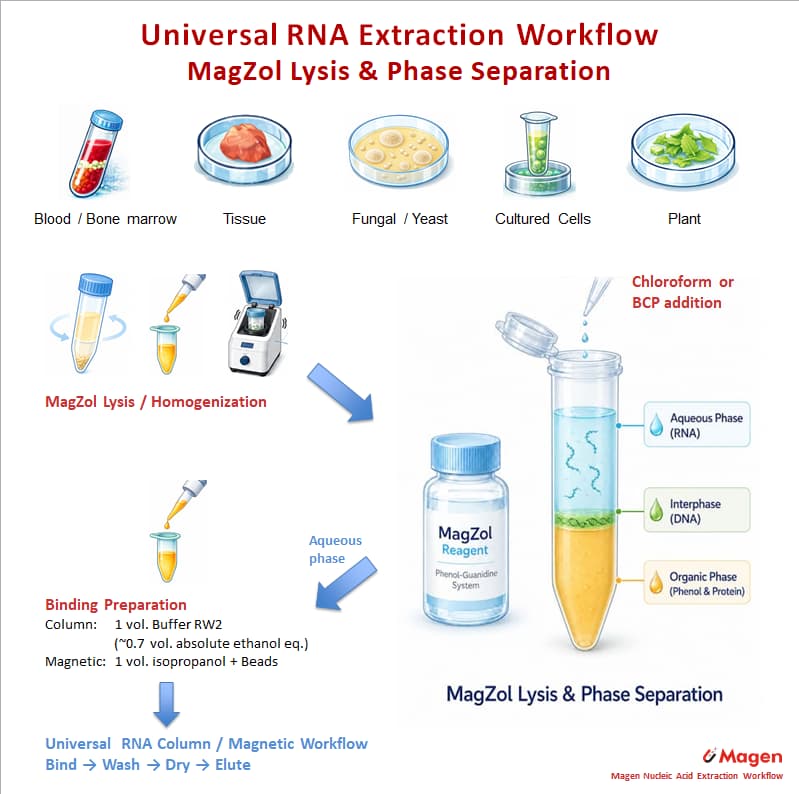
The HiPure Universal RNA Kit uses a MagZol lysis and phase-separation workflow followed by silica column purification for total RNA extraction from a broad range of biological samples. Samples are lysed in MagZol Reagent, a phenol / guanidine-based system designed for strong sample disruption and RNase inactivation. After chloroform addition and centrifugation, RNA is recovered in the upper aqueous phase, while much of the DNA, protein and organic-phase background is separated away. The aqueous RNA phase is then adjusted with Buffer RW2 and loaded onto a silica spin column, where RNA is captured, washed, dried and eluted in RNase-free water.
Sample Handling Logic
This workflow is suitable for animal tissue, plant material, fungal samples, bacteria, cultured cells and other sample types that benefit from stronger front-end lysis and phase-based cleanup before column purification. The main variation is concentrated in the sample disruption and MagZol homogenization stage. Tissue and plant samples may require mechanical homogenization or liquid-nitrogen grinding, while fungal, yeast or bacterial samples may require more intensive disruption. Once the aqueous phase has been recovered, the downstream silica column workflow remains consistent.
Time and Workflow Characteristics
Under typical manual operation, the workflow is usually completed within about 40–55 minutes, depending mainly on sample disruption quality, phase separation handling and repeated column loading volume. Compared with a direct column workflow, this route is more involved because of the MagZol and chloroform phase-separation step, but it provides stronger front-end cleanup for complex or difficult samples. For detailed step-by-step conditions, workflow guidance and estimated processing times, please refer to the Workflow Note in the Download section.
Specifications
|
Features
|
Specifications
|
|
Main Functions
|
Isolation total RNA from 100mg lipid tissue, tissue, cell, plant, body fluids using columns and MagZol reagent
|
|
Applications
|
RT-PCR, qRT-PCR, Northern hybridization, second generation sequencing
|
|
Purification method
|
Mini spin column
|
|
Purification technology
|
Silica technology, acid phenol / guanidine extraction technology (MagZol pretreatment technology)
|
|
Process method
|
Manual (centrifugation or vacuum)
|
|
Sample type
|
Animal tissue, muscle fiber containing tissue,adipose tissue, cultured cells, lymphocytes, simple plants and other biological samples
|
Sample amount
|
Animal tissue sample: 1-60mg (spleen≤ 10mg)
Cultured cells: 5 x 10⁶
Plant leaves: 50-100mg
|
|
Yield
|
2-200μg
|
|
Elution volume
|
≥50μl
|
|
Time per run
|
~40-55 minutes
|
|
Liquid carrying volume per column
|
800µl
|
|
Binding yield of column
|
100µg
|
Technical Validation
HiPure Universal RNA Kit was evaluated as a hybrid RNA extraction workflow combining MagZol-based phenol / guanidine lysis with silica membrane purification. The workflow uses MagZol Reagent for efficient sample disruption and RNase inactivation, followed by chloroform phase separation, ethanol-assisted RNA binding, column washing and elution. This design is intended to combine the broad sample compatibility of one-step extraction with the purity advantage of silica column cleanup.
In animal tissue testing, total RNA was extracted from 50 mg chicken tissue samples including liver, kidney, spleen, heart, muscle and lung. From 50 mg chicken liver input, RNA yields reached 169.2–181.5 µg, with A260/280 values of 2.07–2.11 and A260/230 values of 1.94–1.98. From 50 mg kidney and spleen inputs, RNA yields were 103.7–103.9 µg and 127.6–127.7 µg, respectively. Lower-yielding tissues such as muscle and lung produced 6.7–11.2 µg and 32.4–34.8 µg RNA under the tested conditions. Agarose gel electrophoresis showed clear RNA band patterns, supporting RNA integrity across the tested tissue types.
Plant sample compatibility was tested using 100 mg soybean, maize and paddy leaf inputs. From 100 mg soybean leaf input, the kit produced RNA yields of 72.34–81.02 µg with A260/280 values of 2.19–2.20. From 100 mg maize and paddy leaf inputs, RNA yields were 9.94–12.40 µg and 13.38–14.58 µg, respectively, with A260/280 values of approximately 2.06–2.12. Electrophoresis analysis showed visible large-molecular RNA bands, supporting the use of the MagZol-plus-column workflow across both animal and plant sample types.
A comparison with commonly used commercial RNA extraction workflows was performed using 50 mg liver and heart tissue inputs. From 50 mg liver input, R4130 produced RNA yields of 160.7–173.8 µg, with A260/280 values of 2.13–2.14 and A260/230 values of 2.12–2.16. The reference workflows produced liver RNA yields in a similar range, while R4130 showed higher A260/230 values under the tested conditions. From 50 mg heart input, R4130 produced RNA yields of 14.1–15.7 µg, with A260/280 values of 2.12–2.13 and A260/230 values of 1.34–1.52, supporting comparable recovery and acceptable purity for lower-yielding tissue samples.
Batch consistency was further evaluated using 10 mg pig liver input. The reference batch produced RNA yields of 61.18–62.15 µg, while the QC batch produced 61.61–62.72 µg. A260/280 values remained at 2.08–2.10 and A260/230 values were 2.03–2.25 across the tested batches. Electrophoresis analysis showed clear RNA bands without obvious degradation, supporting consistent extraction performance between the tested batches.
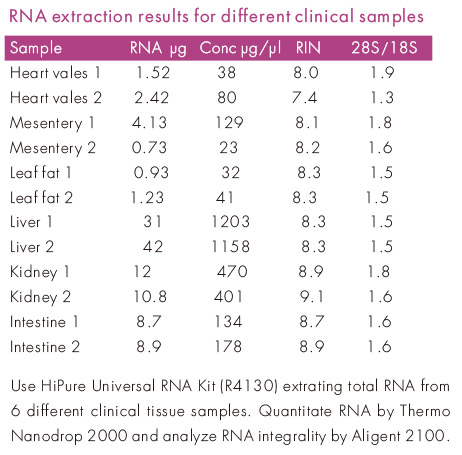
Application-oriented testing was performed using six different clinical tissue sample types, including heart valves, mesentery, leaf fat, liver, kidney and intestine. The R4130 workflow produced total RNA amounts of 0.73–42 µg, with RNA concentrations of 23–1203 ng/µL. RNA integrity assessment showed RIN values of 7.4–9.1 and 28S/18S ratios of 1.3–1.9 across the tested samples. These results support the use of R4130-prepared RNA as input for downstream applications requiring intact RNA, including sequencing-oriented library preparation workflows, while final library performance should still be interpreted together with sample condition and library QC results.
Application Scenario Summary
R4130 uses a MagZol-based front-end combined with column purification, making it suitable for universal RNA extraction from difficult or heterogeneous samples. The MagZol phase-separation step supports strong sample lysis and front-end cleanup before RNA enters the silica column purification stage. The selected applications below demonstrate its use across tumor tissue, liver metabolic models, cancer metastasis and drug-resistance studies, plant stress transcriptomics, bacterial competition research and other complex sample systems.
|
Application Scenario
|
Sample Source
|
Downstream Research Use
|
|
Post-ablation tumor immune microenvironment and localized chemoimmunotherapy research
|
CT26 colorectal tumor tissues after incomplete microwave ablation and chemoimmunotherapeutic hydrogel treatment
|
RNA-seq analysis of residual tumor tissues to evaluate immune suppression, cytokine / chemokine expression, myeloid cell-mediated tumor progression and antitumor immune activation after localized chemoimmunotherapy
|
|
Diabetes, hepatic gluconeogenesis and metabolic signaling research
|
Liver tissues and hepatocyte-related metabolic models from DIO, db/db and AKG-treated diabetic mouse models
|
Transcriptomic and qRT-PCR analysis of hepatic gluconeogenesis-related genes, supporting investigation of how α-ketoglutaric acid regulates serpina1e, P2RX4 / SLC25A11 signaling, H3K27 demethylation and hepatic glucose production in diabetes.
|
View more application scenarios
|
Application Scenario
|
Sample Source
|
Downstream Research Use
|
|
Triple-negative breast cancer immune checkpoint glycosylation research
|
TNBC tumor tissues and breast cancer cell models used for FUT8 / B7H3 glycosylation studies
|
Gene-expression and functional validation analysis to study how FUT8-mediated B7H3 N-glycosylation stabilizes B7H3, suppresses antitumor immune response and supports glycosylation-targeted immunotherapy strategies in TNBC.
|
|
Breast cancer mitophagy deficiency and bone metastasis research
|
MDA-MB-231 and 4T1 breast cancer cells, ULK1-knockout / rescue models and bone metastasis experimental systems under hypoxia
|
RNA-based expression analysis combined with metastasis models to investigate how MAPK1/3-dependent ULK1 degradation attenuates mitophagy, activates NLRP3 inflammasome signaling and promotes breast cancer bone metastasis.
|
|
Colorectal cancer metastasis and vemurafenib resistance research
|
Vemurafenib-resistant RKO cells, highly invasive colorectal cancer cells and ARF1 / IQGAP1-related CRC models
|
RNA-seq and qRT-PCR analysis combined with DIA proteomics to identify ARF1-mediated ERK reactivation, supporting studies of ARF1–IQGAP1 interaction, colorectal cancer metastasis, vemurafenib resistance and LY2835219-based combination treatment.
|
|
Lung squamous cell carcinoma chemoresistance and SOX2 condensate-mediated drug resistance research
|
LSCC cell models including SOX2-overexpressing, SOX2-knockdown and peptide-treated cells
|
qRT-PCR analysis of SOX2-related expression changes, supporting investigation of how SOX2 self-association and phase-separated condensate formation drive chemotherapeutic drug resistance, and how Hx1R8 peptide disrupts SOX2 condensates to restore drug sensitivity.
|
|
Chloroplast stress signaling and plant retrograde transcriptome research
|
6-day-old Arabidopsis flu and flu toc33-1 mutant seedlings under singlet oxygen-induced stress signaling conditions
|
RNA-seq analysis of nuclear transcriptome changes downstream of chloroplast singlet oxygen signaling, supporting investigation of how TOC33 relays EX1-mediated chloroplast-to-nucleus retrograde signaling and regulates stress-response gene expression in Arabidopsis.
|
|
Vibrio-specific microbial competition and bacterial bioenergetics research
|
Vibrio cholerae and related bacterial competition models involving TseVs / T6SS effector systems
|
RNA-seq-supported analysis of bacterial responses associated with T6SS-mediated Vibrio competition, supporting investigation of how the TseVs effector disrupts ion homeostasis, membrane potential and ATP production to reshape Vibrio population dynamics.
|
|
Plant floral polymorphism, heterostyly and S-locus supergene evolution research
|
Gelsemium elegans styles and filaments from L-, S- and H-morph flowers at multiple developmental stages
|
Transcriptome sequencing of floral organs to identify differentially expressed genes and candidate S-locus supergene components involved in distylous floral syndrome, style-length control and convergent evolution of heterostyly.
|
Kit Contents
|
Contents
|
R413002
|
D413003
|
|
Purification Times
|
50 Preps
|
250 Preps
|
|
HiPure RNA Mini Columns
|
50
|
250
|
|
2ml Collection Tubes
|
50
|
250
|
MagZol Reagent
|
60 ml
|
270 ml
|
|
Buffer RW1
|
50 ml
|
200 ml
|
Buffer RW2*
|
20 ml
|
50 ml
|
RNase Free Water
|
10 ml
|
30 ml
|
Storage and Stability
MagZol Reagent should be stored at 2-8°C upon arrival. However, short-term storage (up to 12 weeks) at room temperature (15-25°C) does not affect its performance. The remaining kit components can be stored at room temperature (15-25°C) and are stable for at least 18 months under these conditions.
Experiment Data