Details
Specifications
|
Features
|
Specifications
|
|
Concentration
|
70 mg/ml
|
|
Appearance
|
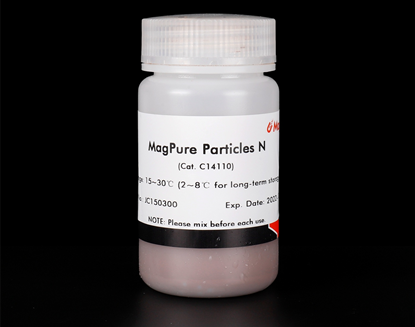
Suspension of yellowish brown particles
|
|
Surface functional group
|
Si-OH, Silanol
|
|
Dispersibility
|
Polydisperse Amorphous
|
|
Particle size
|
0.2-2 μm
|
|
Preservation conditions
|
Room Temperature, valid for up to 2 years.
It is recommended to store in 2-8°C to prevent microbial growth.
|
Magnetic response speed
|
~60 seconds
|
Settling velocity
|
>10 minutes
|
High salt mediated binding
|
>2M guanidine isothiocyanate, DNA recovery up to 80%
|
Alcohol mediated binding
|
2M guanidine hydrochloride / isopropanol (30%), and the recovery of DNA / RNA was as high as 85%
|
PEG8000 mediated binding
|
The recovery of DNA/RNA was up to 85%
|
DNase/RNase
|
Not detected
|
DNA residue
|
<1 ppm
|
Recommended application
|
Plasmid extraction, gel DNA recovery, viral nucleic acid isolation
|
Principle
Highsalt mediated binding: in the solution containing 2-4M guanidine isothiocyanate, Magpure particles can selectively recover DNA molecules, and impurities such as protein polysaccharides are not adsorbed.
Alcohol mediated binding: in the solution containing guanidine salt and alcohol (>25%), Magpure particles can selectively recover DNA/RNA molecules, and proteins and other impurities are not adsorbed.
After biological samples are treated with digestive solution or lysis Buffer, DNA/RNA is released from cells, organelles and protein complexes (ribosomes and nucleosomes) into reagents. After Magpure particles and binding solution are added, DNA/RNA is adsorbed to the surface of Magpure particles to form DNA/RNA bead complex. Under the action of the magnetic field, the magnetic beads are separated and collected, and the impurities such as protein are removed with the waste liquid. After two or three steps of further cleaning, the DNA/RNA magnetic bead complex is resuspended in sterilized water or TE buffer, and the DNA/RNA falls off from the surface of the magnetic beads, so as to achieve the purpose of purification.
Technical Validation
MagPure Particles N were evaluated in blood, tissue, soil, aged blood and viral nucleic acid extraction workflows. In tissue DNA extraction using the D6315 system, MagPure Particles N produced DNA concentrations of approximately 456–507 ng/µL, higher than the tested standard MagPure Particles under the same conditions.
In whole blood and aged blood testing, MagPure Particles N improved DNA recovery across multiple blood samples, with extracted DNA concentrations higher than the standard bead format in most tested samples. In aged blood sample testing using D6315 and D6310 workflows, MagPure Particles N showed comparable performance in non-pause workflows and better recovery in pause workflows.
Viral nucleic acid extraction was further evaluated using automated magnetic bead workflows. In RNA virus testing with Newcastle disease vaccine samples, MagPure Particles N produced Ct values comparable to a reference commercial bead system across 1,000×, 10,000× and 50,000× dilutions. In HBV DNA virus testing, MagPure Particles N also showed comparable or slightly improved Ct values compared with the tested reference bead system, especially at higher dilution levels.
Repeatability and batch-to-batch consistency were also tested using RNA virus samples. Replicate extraction showed stable Ct values at both 1,000× and 10,000× dilutions, and three tested MagPure Particles N batches produced similar Ct values without obvious batch-to-batch variation. Additional PCR interference testing showed that bead supernatant from different residual bead concentrations did not inhibit PCR amplification under the tested conditions.
Soil DNA extraction testing using the D6356 workflow also confirmed that MagPure Particles N can be used for environmental DNA extraction. The extracted DNA showed clear gel bands and acceptable purity profiles, supporting the use of MagPure Particles N in genomic DNA and viral nucleic acid extraction workflows where recovery consistency, broad sample compatibility and automation performance are important.
Ordering information
|
CAT.No.
|
Product Name
|
Package
|
C14110
|
MagPure Particles N
|
100 ml
|
C14111
|
MagPure Particles N
|
400 ml
|
C14112
|
MagPure Particles N
|
3 x 400 ml
|
C14113
|
MagPure Particles N
|
10 x 400 ml
|