Introduction
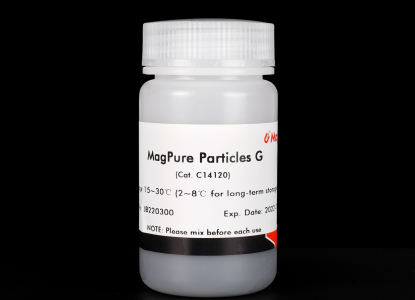
MagPure Particles G are designed for nucleic acid purification from low-input and small-volume circulating DNA (cfDNA) samples. The system supports stable adsorption of fragmented DNA under controlled binding conditions, enabling consistent recovery in workflows where sample input is limited.
Compared with large-volume extraction systems, MagPure Particles G are optimized for efficient handling of small plasma volumes, providing reliable performance in routine cfDNA processing and fragmented DNA applications.
For large-volume plasma or high-recovery cfDNA workflows, MagPure Particles F may be considered as an alternative system with enhanced recovery efficiency.
Details
Specifications
|
Features
|
Specifications
|
|
Concentration
|
40 mg/ml
|
|
Appearance
|
Suspension of dark brown particles
|
|
Surface functional group
|
Si-OH, Silanol
|
|
Dispersibility
|
Monodisperse,spherical
|
|
Particle size
|
1.0-1.5 μm
|
|
Preservation conditions
|
Room Temperature, valid for up to 2 years.
It is recommended to store in 2-8°C to prevent microbial growth.
|
Magnetic response speed
|
~30 seconds
|
Settling velocity
|
>3 minutes
|
High salt mediated binding
|
>2M guanidine isothiocyanate, DNA recovery up to 80%
|
Alcohol mediated binding
|
2M guanidine hydrochloride / isopropanol (30%), and the recovery of DNA / RNA was as high as 85%
|
PEG8000 mediated binding
|
The recovery of DNA/RNA was up to 85%
|
DNase/RNase
|
Not detected
|
DNA residue
|
Not detected
|
Recommended application
|
Genomic DNA extraction, RNA extraction, viral nucleic acid extraction, circulating DNA isolation
|
Principle
Highsalt mediated binding: in the solution containing 2-4M guanidine isothiocyanate, Magpure particles can selectively recover DNA molecules, and impurities such as protein polysaccharides are not adsorbed.
Alcohol mediated binding: in the solution containing guanidine salt and alcohol (>25%), Magpure particles can selectively recover DNA/RNA molecules, and proteins and other impurities are not adsorbed.
After biological samples are treated with digestive solution or lysis Buffer, DNA/RNA is released from cells, organelles and protein complexes (ribosomes and nucleosomes) into reagents. After Magpure particles and binding solution are added, DNA/RNA is adsorbed to the surface of Magpure particles to form DNA/RNA bead complex. Under the action of the magnetic field, the magnetic beads are separated and collected, and the impurities such as protein are removed with the waste liquid. After two or three steps of further cleaning, the DNA/RNA magnetic bead complex is resuspended in sterilized water or TE buffer, and the DNA/RNA falls off from the surface of the magnetic beads, so as to achieve the purpose of purification.
Technical Validation
MagPure Particles G were evaluated as monodisperse spherical silica magnetic beads for nucleic acid purification. In DNA marker recovery testing, MagPure Particles G showed effective DNA recovery under guanidine isothiocyanate-based binding conditions, with performance comparable to other tested MagPure bead formats.
Binding-condition testing showed that MagPure Particles G has a distinct short-fragment recovery profile. Under 40% ethanol binding conditions, MagPure Particles G showed reduced recovery of fragments below approximately 200 bp, while differences among bead formats were less obvious under guanidine isothiocyanate-based conditions. This profile is useful in workflows where reduced recovery of very short DNA fragments is preferred.
Long-term storage testing was performed using G-type beads from different production years. After room-temperature storage for up to two years, different batches showed no obvious difference in recovery of DNA marker fragments of 100 bp and above, supporting stable bead performance during routine storage and use.
Ordering information
|
CAT.No.
|
Product Name
|
Package
|
C14120
|
MagPure Particles G
|
100 ml
|
C14121
|
MagPure Particles G
|
400 ml
|
C14122
|
MagPure Particles G
|
3 x 400 ml
|
C14123
|
MagPure Particles G
|
10 x 400 ml
|