Introduction
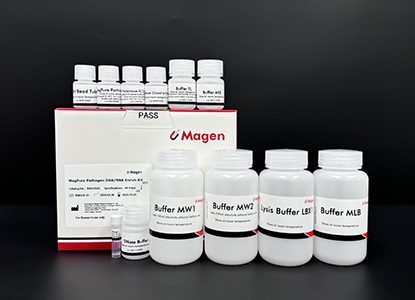
MagPure Pathogen DNA/RNA Enrich Kit is an mNGS-oriented extraction and enrichment system for host-rich clinical samples where human nucleic acids can interfere with low-abundance pathogen detection. The kit is designed to reduce sample-derived host background and increase the relative proportion of pathogen DNA/RNA before downstream sequencing preparation.
Its key value lies in dedicated host-background reduction and pathogen enrichment, helping recover pathogen material from both liquid and sediment-associated fractions while limiting excess human DNA carryover. Within the Magen pathogen extraction portfolio, R6672C is positioned as the advanced enrichment workflow for blood mNGS and other host-rich sequencing applications. For direct tNGS-oriented pathogen extraction without enrichment, laboratories may consider MagPure Pathogen DNA/RNA Kit B (R6672B).
Details
Workflow

Workflow Overview
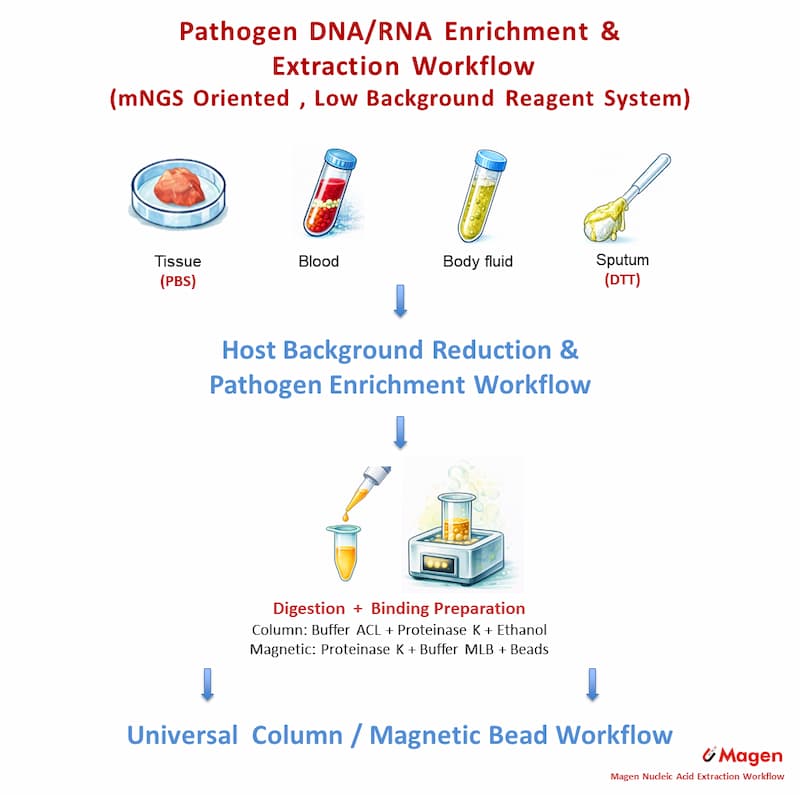
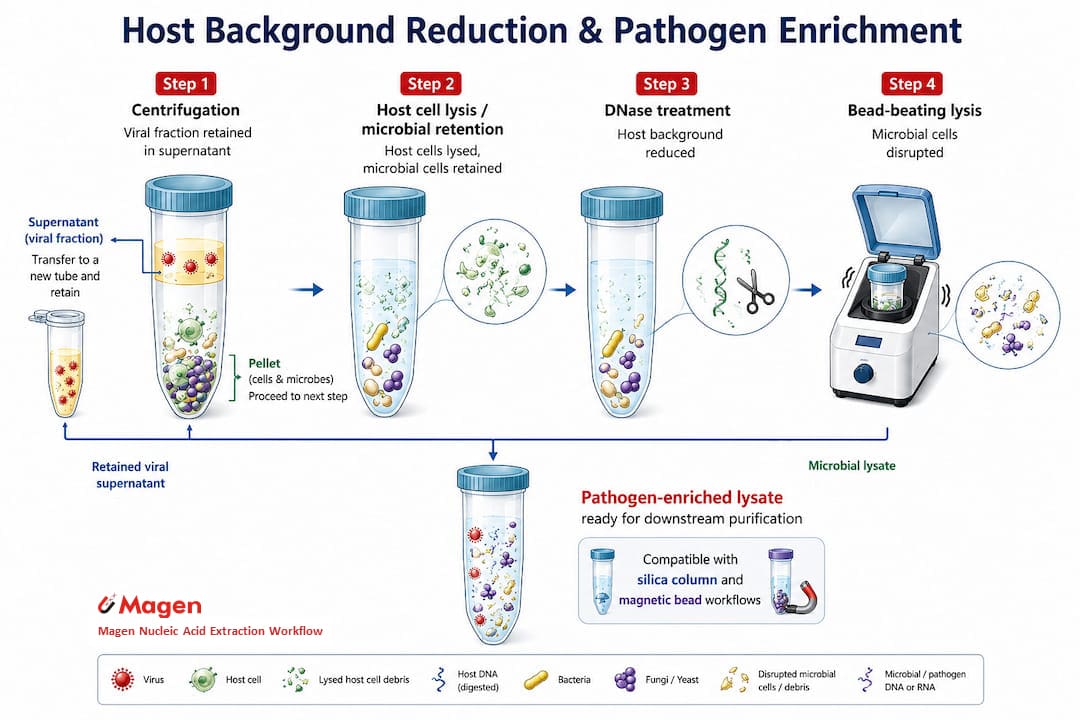
The MagPure Pathogen DNA/RNA Enrich Kit uses a dedicated host-background reduction and pathogen enrichment workflow before magnetic bead purification. The sample is first separated into a retained liquid fraction and a sediment fraction. The liquid fraction preserves viral and mycoplasma-associated nucleic acids, while the sediment fraction is processed to reduce host-derived background and recover sediment-associated microbial pathogens. After enrichment, the fractions are recombined and purified through magnetic bead binding, washing, drying and elution. This workflow is designed for mNGS-oriented preparation of blood and other host-rich clinical samples.
Sample Handling Logic
The workflow addresses a key limitation of direct clarification methods: sediment-associated bacteria, fungi or cell-associated microbial material may be lost if the pellet is discarded, while direct lysis of the pellet can introduce excessive human DNA background. R6672C processes the sediment through host-background reduction, DNase treatment and bead-tube microbial disruption before recombining it with the retained supernatant. This design helps preserve pathogen signal while controlling host-derived background before downstream purification.
Time and Workflow Characteristics
Under typical manual operation, the enrichment workflow requires a longer processing time than direct extraction routes because it includes fraction separation, host-background reduction, DNase treatment, bead-tube disruption and recombination before magnetic bead purification. The workflow is used when improved pathogen recovery and reduced host background are more important than minimum handling time. For detailed step-by-step conditions, workflow guidance and estimated processing times, please refer to the Workflow Note in the Download section.
Specifications
|
Features
|
Specifications
|
|
Main Functions
|
Extract Pathogen RNA/DNA from 1.0-1.5ml whole blood, plasma, serum, body fluid, homogenate suspension, culture solution, cell suspension, soaking solution or concentrate pathogen solution for mNGS/tNGS application, remove host background nucleic acid.
|
|
Applications
|
Real Time PCR, biochip analysis, NGS
|
|
Products
|
Pathogen DNA / RNA
|
|
Purification method
|
Polydisperse magnetic beads
|
|
Purification technology
|
Magnetic beads technology
|
|
Process method
|
Manual or automatic
|
|
Sample type
|
whole blood, plasma, serum, body fluid, homogenate suspension, culture solution, cell suspension, soaking solution or concentrate pathogen solution
|
|
Sample amount
|
1.0 - 1.5 ml
|
Adaptive instrument
|
Nucleic acid extractor, pipetting workstation
|
Extraction Principle
Complex biological samples often contain abundant host DNA released from lysed cells, while microbial and viral genomes are present at much lower levels. To address this imbalance, the MagPure Pathogen DNA/RNA Enrich Kit incorporates a host nucleic acid reduction step prior to pathogen nucleic acid purification.
During the initial treatment stage, DNase digestion selectively degrades exposed host DNA. Microbial and viral nucleic acids remain protected within intact cell walls or viral particles during this step. Subsequent chemical lysis releases pathogen nucleic acids, which are then captured by magnetic beads under chaotropic binding conditions and purified through washing and elution steps.
Engineering Features
The system integrates host nucleic acid reduction with magnetic bead purification in a workflow compatible with automated extraction platforms.
Key engineering elements include controlled DNase digestion conditions to reduce host DNA background, optimized bead-binding chemistry for efficient recovery of fragmented nucleic acids, and stable purification performance from larger input volumes. Reagents are processed to minimize background nucleic acids, helping reduce potential interference from reagent-derived DNA in sequencing workflows. These features support pathogen sequencing applications where host or environmental DNA can otherwise dominate sequencing reads.
Kit Contents
|
Contents
|
R667200C
|
R667202C
|
|
Purification Times
|
24 Preps
|
96 Preps
|
|
2ml Bead Tube (0.4g)
|
24
|
96
|
|
DNase I (Powder)
|
10 mg
|
15 mg
|
|
DNase Buffer
|
5 ml
|
20 ml
|
|
Protease Dissolve Buffer
|
3 ml
|
10 ml
|
Lysis Buffer LBX1
|
40 ml
|
180 ml
|
Buffer TL
|
5 ml
|
30 ml
|
Proteinase K
|
24 mg
|
120 mg
|
Particles MPN9
|
1.2 ml
|
5 ml
|
Buffer MLB
|
30 ml
|
120 ml
|
Buffer MW1*
|
13 ml
|
110 ml
|
Buffer MW2*
|
10 ml
|
50 ml
|
Buffer AVE
|
10 ml
|
20 ml
|
Storage and Stability
Proteinase K, DNase I powder and Particles MPN9 should be stored at 2–8°C upon arrival. However, short-term storage (up to 8 weeks) at room temperature (15–25°C) does not affect their performance. The remaining kit components can be stored at room temperature (15–25°C) and are stable for at least 18 months under these conditions.
Purchase Guide
For guidance on selecting the most appropriate viral or pathogen nucleic acid extraction system based on sample type, target nucleic acid, automation needs and downstream application:
👉 Viral & Pathogen Nucleic Acid Extraction Kit Selection Guide
For a broader technical overview of Magen viral / pathogen workflow routes, background-control logic and PCR, tNGS or mNGS application orientation:
👉 Magen Viral / Pathogen Workflows Explained
For detailed workflow notes covering representative pathogen extraction and enrichment routes:
👉 IVD6672 Pathogen DNA/RNA Extraction Workflow Note
👉 R6672B Low-Background Pathogen DNA/RNA Extraction Workflow Note
👉 R6672C Host-Background Reduction and Pathogen Enrichment Workflow Note
👉 IVD4179 Column-Based Pathogen Enrichment Workflow Note