Introduction
DNA extraction from FFPE tissue samples can be challenging due to the presence of crosslinked proteins, pigments, and residual fixation reagents that may inhibit downstream molecular assays.
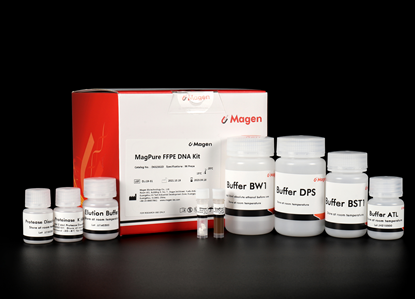
The MagPure FFPE DNA Kit (High Pure) (D6323D) is developed to provide enhanced purification performance for FFPE genomic DNA isolation using magnetic bead technology. The binding chemistry combines optimized salt conditions with alcohol-mediated adsorption to improve removal of contaminants commonly present in FFPE tissue extracts.
This purification strategy supports recovery of highly purified DNA suitable for PCR, qPCR, and other inhibitor-sensitive molecular assays where DNA purity is critical for reliable amplification.
For laboratories focusing on sequencing workflows where fragment distribution control may be beneficial, the MagPure FFPE DNA Kit (D6323B) provides an alternative magnetic bead system designed to manage small DNA fragment recovery during purification.
Column-based purification workflows are available through the HiPure FFPE DNA Kit (D3126), which represents the membrane-based FFPE DNA extraction system in the Magen product portfolio.
For applications requiring simultaneous extraction of both DNA and RNA from FFPE tissue sections, the MagPure FFPE DNA/RNA Kit (R6327) provides a co-extraction workflow using magnetic bead adsorption chemistry.
Details
Specifications
|
Features
|
Specifications
|
|
Main Functions
|
Isolation high pure total DNA from FFPE using high bind beads
|
|
Applications
|
PCR and viral DNA detection, etc.
|
|
Purification technology
|
Magnetic beads technology
|
|
Process method
|
Manual or automatic
|
|
Sample type
|
Paraffin embedded tissue samples
|
|
Sample amount
|
1-6 slices of 10-20μm
|
|
Elution volume
|
≥30μl
|
|
Time per run
|
~3 hours
|
Extraction Principle
Samples are first deparaffinized and digested with Proteinase K to release nucleic acids from the FFPE tissue matrix.
Following digestion, DNA purification can be performed using two alternative binding strategies depending on sample characteristics.
In the high-salt binding mode, a chaotropic binding buffer promotes selective adsorption of DNA while improving removal of pigments and polysaccharides commonly present in FFPE samples.
In the alcohol-mediated binding mode, ethanol is introduced during the adsorption step to enhance DNA binding efficiency and improve overall DNA recovery.
This dual-binding design allows the purification workflow to be adapted according to sample composition and DNA quality.
After washing steps to remove residual contaminants, purified DNA is eluted in a low-salt buffer suitable for downstream molecular workflows.
Technical Validation
The MagPure FFPE DNA Kit (High Pure) was evaluated using FFPE-derived DNA samples to assess DNA recovery, purity and electrophoresis compatibility. The validation compared D6323D with column-based purification and other magnetic bead FFPE DNA workflows across FFPE samples with different DNA concentrations.
In low-concentration FFPE sample testing, D6323D produced Qubit-measured DNA recovery of approximately 3.15–3.22 ng/µL, compared with approximately 1.80–2.64 ng/µL from the tested column-based workflow under the same sample conditions. These results support the use of D6323D for FFPE samples where input DNA is limited and recovery efficiency is important.
Additional high-, medium- and low-concentration FFPE tests showed that D6323D maintained stable recovery across different sample levels. In a separate comparison, D6323D showed Qubit concentrations of approximately 63.4–74.4 ng/µL in high-concentration FFPE samples, approximately 11.7–13.8 ng/µL in medium-concentration samples, and approximately 3.3–5.0 ng/µL in low-concentration samples under the tested conditions.
Electrophoresis evaluation also showed that the D6323D workflow helped reduce gel loading-well residue observed with some magnetic bead FFPE DNA workflows. This supports its use for high-purity FFPE DNA extraction where cleaner electrophoresis behavior, PCR/qPCR compatibility and sequencing-related sample preparation are required.
Application Scenario Summary
FFPE DNA extraction workflows are selected according to the downstream assay. For focused PCR-based applications such as MSI-PCR, Sanger sequencing or mutation-specific analysis, the main requirement is amplifiable DNA from FFPE sections. For sequencing-oriented applications such as WES, targeted NGS, methylation profiling, HRD-related analysis, TMB evaluation or matched tissue-reference studies, fragment handling, inhibitor background and library preparation compatibility may become more important.
The selected examples below summarize published research workflows involving Magen FFPE DNA extraction formats, including D3126 / HiPure FFPE DNA Kit, D6323B / MagPure FFPE DNA Kit and D6323D / MagPure FFPE DNA Kit High Pure. These examples are organized to illustrate typical FFPE DNA application contexts rather than to compare kit performance directly.
|
Application Scenario
|
Related Format
|
Sample / cfDNA Source
|
Downstream Research Use
|
|
De novo high-grade meningioma TERT promoter mutation analysis for post-radiotherapy progression risk research
|
D3126
|
FFPE tumor tissue from de novo WHO grade 2–3 high-grade meningioma patients treated with postoperative radiotherapy
|
Genomic DNA extraction for PCR amplification and Sanger sequencing of TERT promoter mutations, supporting analysis of tumor progression, PFS and postoperative radiotherapy outcome
|
|
CRC and gastric cancer MSI-PCR panel comparison for optimized molecular pathology testing
|
D3126
|
FFPE biopsy and surgical specimens from colorectal and gastric cancer patients
|
Genomic DNA extraction for PCR-based MSI status detection using NCI, five-mononucleotide and six-mononucleotide panels, supporting comparison of panel performance, MSI-L interpretation and optimal MSI-PCR workflow selection
|
|
Pulmonary nodule malignancy assessment using paired FFPE tissue and plasma methylation profiling
|
D6323B
|
Malignant and benign FFPE lung tissue samples from patients with CT-detected pulmonary nodules
|
Tissue gDNA extraction for DNA methylation sequencing, paired tissue–plasma methylation concordance analysis and validation of an integrative blood-based model for distinguishing malignant lung nodules from benign lesions
|
View more application scenarios
|
Application Scenario
|
Related Format
|
Sample / cfDNA Source
|
Downstream Research Use
|
|
Pancreatic adenocarcinoma CNV-driven molecular subtyping for prognosis and treatment stratification research
|
D6323B
|
FFPE tumor samples from pathologically diagnosed pancreatic adenocarcinoma patients in a 608-patient Chinese cohort
|
Tumor genomic DNA extraction for 566-gene / 764-gene targeted sequencing, somatic mutation profiling, germline HRR variant analysis, CNV-based molecular subtyping and relapse-risk model construction
|
|
NSCLC postoperative MRD monitoring using tumor-informed personalized ctDNA analysis
|
D6323D
|
FFPE tumor tissue sections from early-stage NSCLC patients, paired with peripheral blood or buffy coat normal DNA
|
Tumor gDNA and matched normal gDNA extraction for WES, patient-specific PROPHET panel design, postoperative plasma ctDNA MRD monitoring, recurrence risk prediction and TNMB prognostic classification
|
|
FFPE tumor HRD assessment using genomic scar and allele-specific CNV analysis
|
D6323B
|
FFPE human tissue samples from ovarian and breast cancer cohorts
|
Tumor DNA extraction for capture-based HRD panel sequencing, allele-specific CNV analysis, Genomic Scar Score modeling and PARP inhibitor response prediction
|
|
Early TNBC HRR mutation profiling for immune infiltration and prognosis association research
|
D6323B
|
Archival FFPE tumor blocks from early triple-negative breast cancer patients
|
Tumor genomic DNA extraction for HRR-targeted NGS, mutation spectrum analysis, CD8+ T cell / PD-L1 association study and combined immune-genomic prognosis stratification
|
|
Pediatric hepatoblastoma trans-ancestry mutation landscape research using paired FFPE tumor and noncancerous tissue WES
|
D6323B
|
FFPE hepatoblastoma tumor samples and corresponding noncancerous liver tissues from pediatric patients
|
Tumor and matched noncancerous tissue DNA extraction for WES, somatic mutation detection, copy number alteration analysis, pathway enrichment and trans-ancestry genomic comparison
|
|
Matched FFPE tumor sequencing for distinguishing clonal hematopoiesis interference in liquid biopsy
|
D6323B
|
FFPE tumor tissue samples from Chinese pan-cancer patients with matched PBL DNA and plasma cfDNA
|
Tumor genomic DNA extraction for targeted sequencing, validation of candidate CH mutations, exclusion of tumor-derived variants and improved interpretation of cfDNA liquid biopsy results
|
|
LUAD tumor mutation burden and immune phenotype profiling for EGFR-mutant immunotherapy response research
|
D6323B
|
FFPE lung adenocarcinoma tissue blocks from treatment-naïve surgical patients
|
Tumor DNA extraction for targeted panel sequencing, TMB evaluation, EGFR/KRAS/BRCA2 mutation comparison and association analysis with PD-L1 / CD8-based immune phenotypes
|
Note: The selected examples are provided to illustrate application fit for FFPE DNA workflows, including PCR-based molecular pathology, Sanger sequencing, targeted sequencing, WES, methylation profiling, HRD-related analysis and tissue-reference studies. They do not represent a complete publication list or direct comparative kit-performance evaluation. Product selection should consider whether the downstream assay mainly requires routine amplifiable DNA, sequencing-compatible DNA, or high-purity DNA for inhibitor-sensitive applications.
Kit Contents
|
Contents
|
D632301D
|
D632302D
|
|
Purification Times
|
48 Preps
|
96 Preps
|
|
MagPure Particles N
|
1.1 ml
|
2.5 ml
|
|
RNase A
|
10 mg
|
20 mg
|
|
Proteinase K
|
24 mg
|
48 mg
|
|
Protease Dissolve Buffer
|
3 ml
|
6 ml
|
|
Buffer DPS
|
60 ml
|
100 ml
|
Buffer ATL
|
15 ml
|
30 ml
|
Buffer BST1
|
30 ml
|
60 ml
|
Buffer BW1
|
13 ml
|
44 ml
|
Elution Buffer
|
15 ml
|
30 ml
|
Storage and Stability
Proteinase K, RNase A and MagPure Particles N should be stored at 2-8°C upon arrival. However, short-term storage (up to 12 weeks) at room temperature (15-25°C) does not affect their performance. The remaining kit components can be stored at room temperature (15-25°C) and are stable for at least 18 months under these conditions.
Purchase Guide
For guidance on selecting the most appropriate FFPE nucleic acid extraction system based on target analyte, workflow format and downstream application requirements:
👉 FFPE Nucleic Acid Extraction Purchase Guide
For a broader technical overview of FFPE DNA, RNA and DNA/RNA co-extraction workflow routes, processing logic and application-oriented route design:
👉 FFPE Nucleic Acid Extraction Workflows Explained
For detailed workflow structure, estimated processing time and route-specific handling logic across representative FFPE workflows: