CN
Magen contact QR code.png
banner
Your present location:Home/Products/DNA&RNA Purification/DNA/RNA Coisolation/DNA/RNA Coisolation/Column Kits/HiPure FFPE DNA/RNA Kit
  • FFPE DNA RNA co extraction column workflow.png

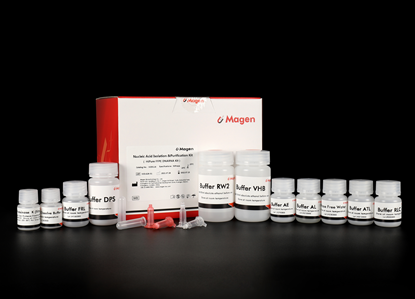
HiPure FFPE DNA/RNA Kit

IVD5116
CAT NO PRODUCT NAME SIZE PRICE
IVD5116 HiPure FFPE DNA/RNA Kit 50 preps $298.00

Introduction

HiPure FFPE DNA/RNA Kit enables sequential purification of genomic DNA and RNA from a single FFPE tissue digestion workflow. This configuration supports studies requiring both mutation analysis and gene expression analysis from limited archived tissue material.

Following tissue digestion, nucleic acids are separated through sequential adsorption steps allowing purification of DNA and RNA fractions for independent downstream workflows.

For magnetic bead-based co-extraction workflows see MagPure FFPE DNA/RNA Kit - R6327.

Laboratories focusing on individual nucleic acid purification may refer to HiPure FFPE DNA Kit - D3126 or HiPure FFPE RNA Kit - R4143.

Details

Workflow

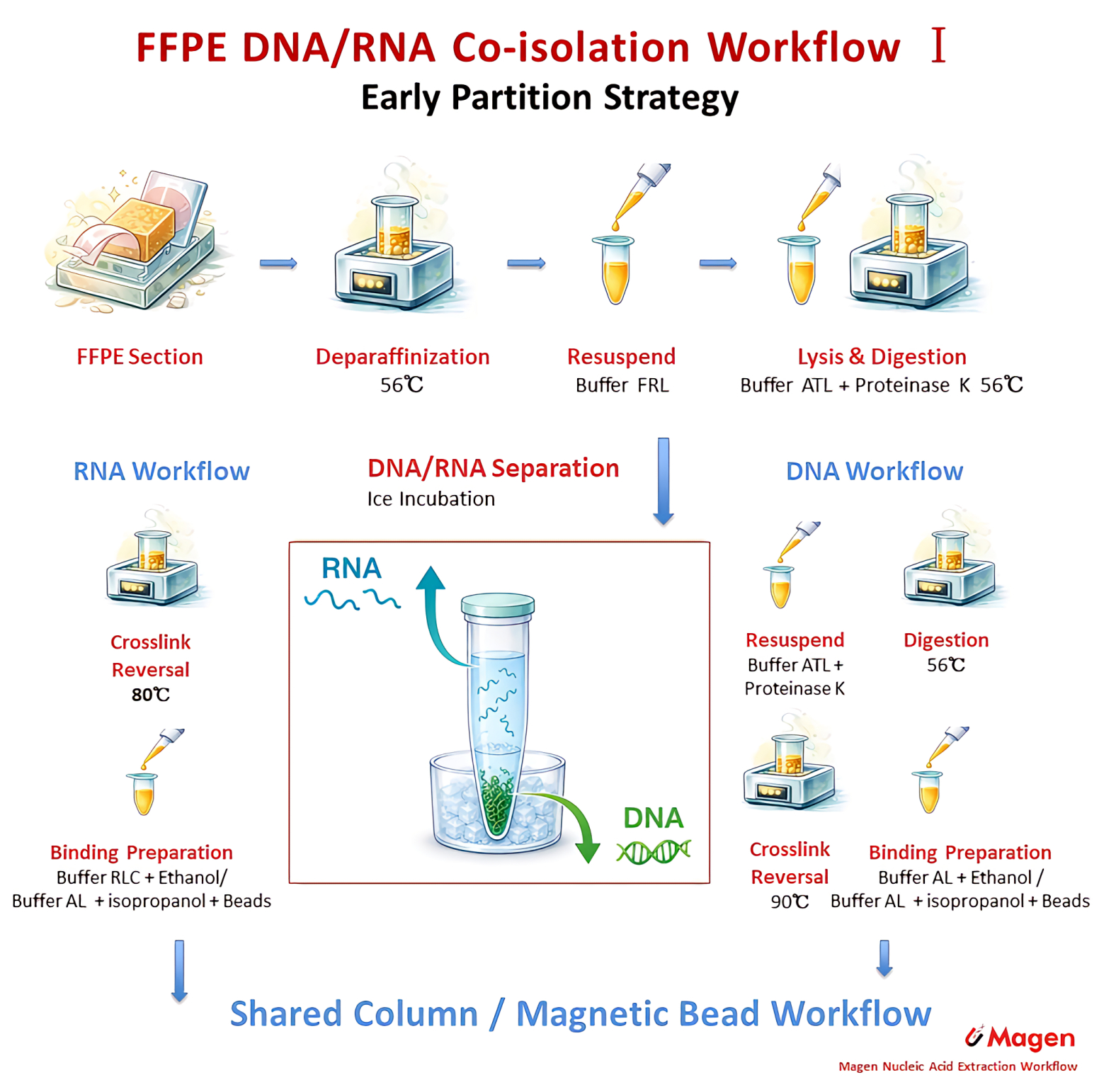
FFPE DNA RNA coextraction workflow

Workflow Overview

FFPE DNA/RNA Co-isolation Workflow I is based on an early partition strategy for recovering DNA and RNA from the same FFPE input. After shared FFPE pretreatment, the workflow separates the RNA-containing supernatant from the DNA-containing pellet. The two fractions then enter separate downstream routes, allowing RNA-oriented handling and DNA-oriented processing to be managed independently before final purification by column or magnetic bead workflow, depending on the kit format.

Sample Handling Logic

The key feature of this route is the early separation of RNA and DNA fractions. The RNA-containing supernatant is removed from the digestion residue and handled under RNA-oriented conditions, while the DNA-containing pellet can undergo additional processing and stronger heat-assisted reversal before DNA purification. This strategy is especially useful when RNA preservation and same-sample DNA/RNA recovery are both important considerations.

Time and Workflow Characteristics

Under typical manual operation, the early-partition column route represented by IVD5116 usually requires about 4.5 hours, while the early-partition magnetic route represented by IVD3026 usually requires about 4.7 hours. A dual-output workflow is complete only after both the RNA and DNA paths have been processed. For detailed step-by-step handling logic and route-specific timing, please refer to the Workflow Note in the Download section.


Specifications

Features Specifications
Main FunctionsC Co-isolation DNA and RNA from a single FFPE tissue sample
Applications RT-PCR, cDNA synthesis, PCR and second-generation sequencing, etc.
Purification method Mini spin column
Purification technology Silica technology
Process method Manual (centrifugation or vacuum)
Sample type FFPE slice, FFPE embedded tissue
Sample amount No more than six 10µm sections of 150mm2 surface area or three 20µm sections of 150mm2 surface area.

Application Scenario Summary

FFPE DNA/RNA-compatible workflows are useful when limited archived tissue may need to support more than one molecular direction, or when the study design requires flexibility between DNA-based and RNA-based analysis. The selected examples below involve Magen FFPE DNA/RNA extraction formats, including IVD3026, R6327 and IVD5116.

Application Scenario Related Format Sample Source Downstream Research Use
FFPE NSCLC RNA-NGS validation of non-canonical RET rearrangements for fusion diagnostics IVD3026 FFPE tissue samples from RET-rearranged Chinese NSCLC patients Total RNA extraction for targeted RNA-NGS, functional RET fusion transcript confirmation, non-canonical fusion partner validation and comparison of NGS, FISH and IHC diagnostic methods
Locally recurrent rectal cancer genomic profiling for Wnt pathway recurrence mechanism research R6327 FFPE tissue blocks from primary rectal cancer, locally recurrent rectal cancer, non-recurrent rectal cancer and matched normal rectal tissue samples DNA extraction for whole-exome sequencing, mutation landscape comparison, LRRC-specific pathway enrichment and Wnt signaling pathway candidate gene analysis
View more application scenarios
Application Scenario Related Format Sample Source Downstream Research Use
Advanced NSCLC tumor–ctDNA paired genomic profiling for immunochemotherapy stratification research R6327 Tumor-derived genomic DNA used as paired tissue reference in advanced NSCLC; tissue samples were paired with pretreatment ctDNA samples for WES analysis Tissue-based WES combined with plasma ctDNA 520-gene targeted NGS and low-pass WGS to support ctDNA-based genomic immune subtype analysis, tissue–blood comparison and PD-1 inhibitor benefit stratification research
EGFR-mutant NSCLC tumor genomic profiling for neoadjuvant immunochemotherapy response and MRD research R6327 + D6323B Pre-treatment biopsy and post-treatment resected tumor samples from EGFR-mutant stage IIB–IIIB NSCLC patients Tumor tissue gDNA extraction for WES, baseline and post-treatment genomic feature analysis, tumor-informed MRD panel design and response / resistance mechanism research
Locally advanced OSCC perioperative immunochemotherapy and ctDNA-MRD monitoring research R6327 FFPE endoscopic biopsy tumor specimens from primary esophageal squamous cell carcinoma before neoadjuvant nivolumab plus chemotherapy Tumor gDNA extraction for WES, patient-specific mutation selection and personalized ctDNA-MRD panel design, supporting perioperative immunochemotherapy response evaluation, pCR / non-pCR stratification, ctDNA clearance analysis and recurrence-risk monitoring
Advanced NSCLC tumor-informed ctDNA biomarker analysis for first-line immunochemotherapy selection R6327 FFPE tumor biopsy or archived tumor tissue specimens and matched blood-derived normal controls from advanced NSCLC patients in the CHOICE-01 biomarker cohort Tissue WES combined with plasma 520-gene ctDNA sequencing to identify patient-specific tumor mutations, compare tumor-informed and tumor-naïve ctDNA approaches, and evaluate ctDNA positivity / clearance as predictive biomarkers for ICI-chemo benefit.
ESCC post-nCRT residual disease detection and organ-sparing treatment decision research R6327 Pretreatment FFPE endoscopic biopsy tumor specimens from locally advanced ESCC patients undergoing neoadjuvant chemoradiotherapy Tumor gDNA extraction for WES and personalized ctDNA assay construction, supporting MRD detection after nCRT, integration of ctDNA with clinical response evaluation, non-pCR prediction, organ-sparing strategy assessment and adjuvant immunotherapy guidance.
Metastatic nonsquamous NSCLC tumor microenvironment RNA-seq biomarker analysis in the IMpower151 trial IVD5116 FFPE tumor tissue slides from metastatic nonsquamous NSCLC patients enrolled in the randomized IMpower151 trial Total RNA extraction for FFPE RNA-seq, immune gene-signature analysis and tumor microenvironment profiling, supporting evaluation of T cell, dendritic cell, MHC and myeloid-family signatures associated with EGFR mutation status and progression-free survival under atezolizumab plus bevacizumab and chemotherapy.

Note: The selected examples involve FFPE DNA/RNA-compatible extraction formats, but the downstream nucleic acid differs by study. Some workflows use FFPE RNA for fusion transcript validation, while others use DNA extracted with a DNA/RNA-compatible format for WES or tumor genomic profiling. These examples should not be described as DNA/RNA multi-omics unless both DNA and RNA are explicitly used in the same study.

Kit Contents

Contents IVD5116
Purification Times 50 Preps
HiPure DNA Micro Column 50
HiPure RNA Mini Column I 50
2ml Collection Tubes
150
Proteinase K
50 mg
Protease Dissolve Buffer 5 ml
Buffer DPS
60 ml
Buffer FRL
15 ml
Buffer ATL 15 ml
Buffer RLC 15 ml
Buffer AL
15 ml
Buffer VHB
44 ml
Buffer RW2
25 ml
RNase Free Water 10 ml
Buffer AE 10 ml

Storage and Stability

Proteinase K should be stored at 2-8°C upon arrival. However, short-term storage (up to 12 weeks) at room temperature (15-25°C) does not affect their performance. The remaining kit components can be stored at room temperature (15-25°C) and are stable for at least 18 months under these conditions.

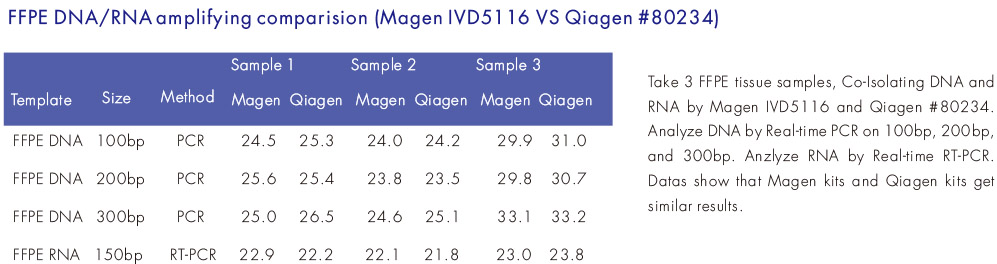
Experiment Data


Purchase Guide

For guidance on selecting the most appropriate FFPE nucleic acid extraction system based on target analyte, workflow format and downstream application requirements:

👉 FFPE Nucleic Acid Extraction Purchase Guide

For a broader technical overview of FFPE DNA, RNA and DNA/RNA co-extraction workflow routes, processing logic and application-oriented route design:

👉 FFPE Nucleic Acid Extraction Workflows Explained

For detailed workflow structure, estimated processing time and route-specific handling logic across representative FFPE workflows:

Workflow Route Detailed Workflow Note
FFPE DNA column route D3126 HiPure FFPE DNA Kit Workflow Note
FFPE RNA column route R4143 / R4144 HiPure FFPE RNA Workflow Note
Early Partition Column Co-Extraction IVD5116 HiPure FFPE DNA/RNA Workflow Note
Early Partition Magnetic Co-Extraction IVD3026 MagPure FFPE DNA/RNA Workflow Note
Sequential Adsorption Magnetic Co-Extraction R6327 MagPure FFPE DNA/RNA Workflow Note
Fragment-selection FFPE DNA route D6323B MagPure FFPE DNA Workflow Note
Dual-binding high-purity FFPE DNA route D6323D MagPure FFPE DNA Workflow Note
Magnetic FFPE RNA with DNase IVD3022 MagPure FFPE RNA Workflow Note

Leave A Message

Leave A Message

    Please provide us with the information below, and we'll contact you as soon as possible.

This site uses cookies to improve your online experience,allow you to share content on social media,measure traffic to this website and display customised ads based on your browsing activity.