Introduction
RNA extraction from formalin-fixed paraffin-embedded tissues requires digestion conditions capable of releasing fragmented RNA molecules while minimizing degradation during purification.
HiPure FFPE RNA Kit applies silica membrane column technology to recover total RNA from FFPE tissue sections commonly used in oncology research laboratories.
The workflow integrates optimized digestion and column adsorption chemistry to support RNA purification suitable for downstream molecular analysis.
For RNA workflows requiring genomic DNA removal see HiPure FFPE RNA Plus Kit - R4144.
Laboratories performing combined DNA and RNA analysis from limited FFPE material may refer to MagPure FFPE DNA/RNA Kit - R6327.
Details
Workflow
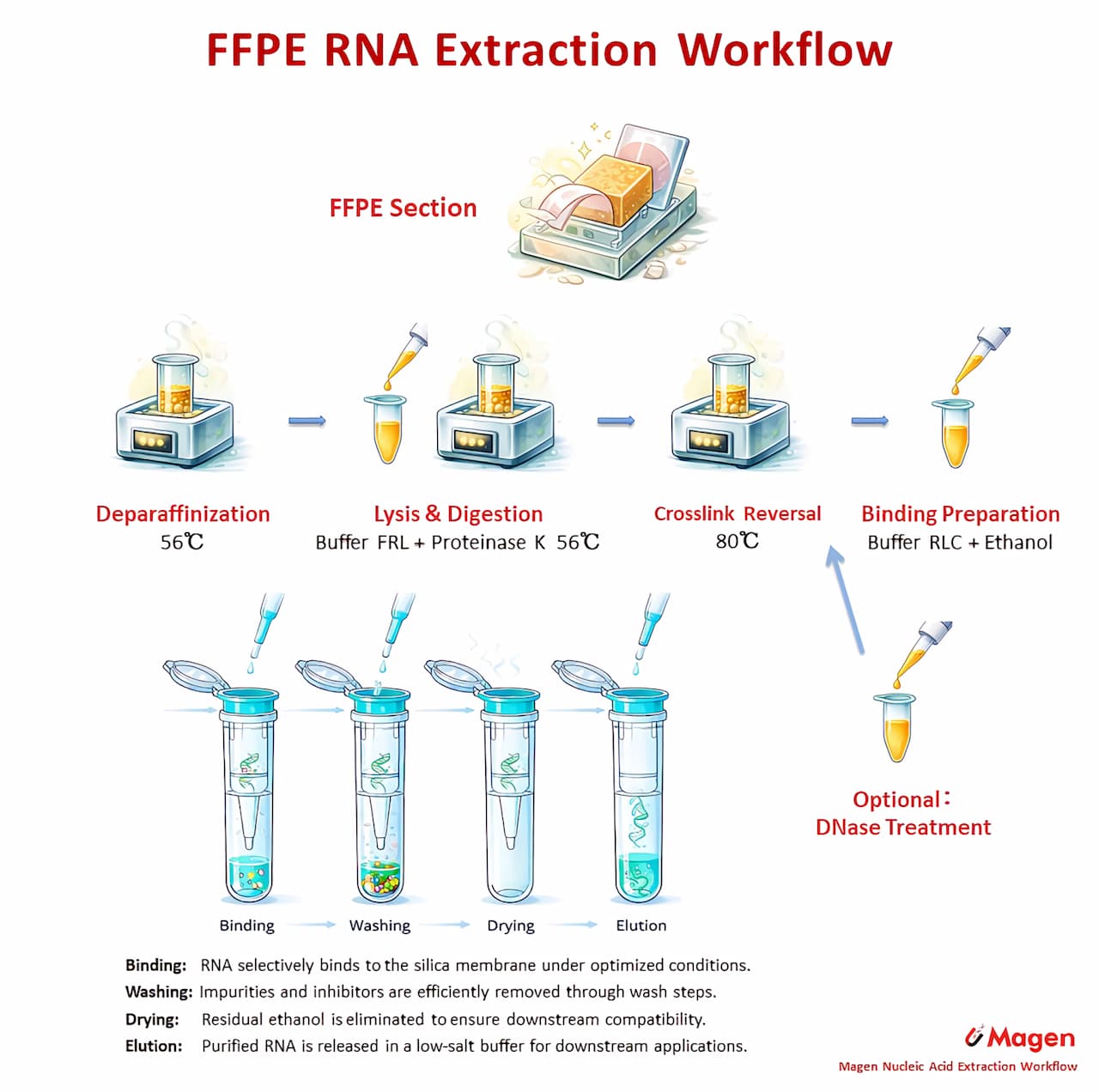
Workflow Overview
The HiPure FFPE RNA workflow uses a silica column–based route for purification of RNA from FFPE sections. Following deparaffinization, proteinase K digestion and controlled heat treatment, RNA binding conditions are established and RNA is purified through membrane binding, washing, drying and elution. An optional DNase treatment route is included when reduced genomic DNA carryover is required for downstream RNA analysis.
Sample Handling Logic
This workflow is designed for FFPE RNA recovery, where controlled heat exposure and residual DNA management are especially important. FFPE RNA is often fragmented before extraction begins, so the workflow balances tissue digestion and heat-assisted release with conditions intended to avoid unnecessary additional stress. When downstream assays are sensitive to genomic DNA contribution, the DNase treatment route provides an additional control point.
Time and Workflow Characteristics
Under typical manual operation, the overall workflow usually requires about 1~1.5 hours, depending on whether DNase treatment is included and on sample handling conditions. For detailed step-by-step conditions, workflow guidance and estimated processing times, please refer to the Workflow Note in the Download section.
Specifications
|
Features
|
Specifications
|
|
Main Functions
|
Isolation total RNA from FFPE tissue and section samples
|
|
Applications
|
RT-PCR, quantitative RT-PCR, Northern hybridization, Poly A purification, nucleic acid protection and in vitro translation
|
|
Purification method
|
Mini spin column
|
|
Purification technology
|
Silica technology
|
|
Process method
|
Manual (centrifugation or vacuum)
|
|
Sample type
|
FFPE tissue sample
|
Sample amount
|
6mg
|
|
Yield
|
20μg
|
|
Elution volume
|
≥20μl
|
|
Time per run
|
~60 minutes
|
|
Liquid carrying volume per column
|
800µl
|
|
Binding yield of column
|
100µg
|
Principle
This product is based on silica column purification. Remove paraffin by Buffer DPS. Sample lysis with proteinase K digestion requires only 15 minutes. After lysis, samples are incubated at 80ºC for 15 minutes. Transfer to an adsorption column and RNA is adsorbed on the membrane, while protein is not adsorbed and is removed with filtration. After washing proteins and other impurities, RNA was finally eluted with low-salt buffer.
Technical Validation
HiPure FFPE RNA Kit was evaluated as a silica column-based RNA extraction workflow for formalin-fixed, paraffin-embedded tissue samples. The workflow includes deparaffinization, proteinase K digestion, 80°C heat treatment for reversal of formaldehyde-related modifications, and column-based RNA purification without phenol / chloroform extraction or alcohol precipitation.
In FFPE tissue testing, RNA was extracted from 9 mg paraffin-embedded tissue samples, including grass carp liver, grass carp muscle, chicken liver, and chicken heart. From 9 mg FFPE fish liver input, RNA yields were 14.8–22.9 µg. From 9 mg FFPE chicken liver input, RNA yields were 21.2–25.1 µg. Lower-yielding tissue types, including fish muscle and chicken heart, produced 1.5–1.7 µg and approximately 2.8 µg RNA, respectively, under the tested conditions.
Additional workflow testing showed that RNA integrity was maintained after the 80°C heat-treatment step used in the FFPE protocol. Using 200 µL cell input and 6 mg plant leaf input as model materials, RNA extracted after 55°C digestion followed by 80°C treatment showed clear electrophoresis band patterns, and the eluted RNA remained stable after overnight storage at 4°C before electrophoresis analysis.
Functional compatibility was evaluated by adding Newcastle disease virus RNA into the lysis system followed by extraction and fluorescent RT-PCR analysis. R4143 extracts produced Ct values of approximately 20.1–20.6, close to the standard viral reference reagent under the tested conditions, indicating that the purified RNA did not show obvious inhibition in downstream RT-PCR detection.
Application Scenario Summary
FFPE RNA workflows are commonly used when archived tissue is needed for RT-PCR, qRT-PCR or gene expression analysis. The practical goal is not full-length RNA recovery, but RNA fragments suitable for reverse transcription and target amplification. The selected examples below illustrate typical RNA-focused application contexts for R4143 / HiPure FFPE RNA Kit, including RNA biomarker analysis and tumor microenvironment gene-expression validation.
|
Application Scenario
|
Related Format
|
Sample Source
|
Downstream Research Use
|
|
Papillary renal cell carcinoma FFPE lncRNA expression profiling for postoperative recurrence risk prediction
|
R4143
|
FFPE tumor tissue sections from localized stage I–III papillary renal cell carcinoma patients
|
RNA extraction for qRT-PCR measurement of prognostic lncRNAs, construction of a four-lncRNA risk score and integration with whole-slide image and clinicopathological classifiers for recurrence-free survival prediction
|
|
DLBCL tumor microenvironment gene expression validation for immune prognostic biomarker research
|
R4143
|
Paraffin-embedded DLBCL tissue samples and normal lymph node controls
|
mRNA extraction for qPCR validation of CCL8 and CD163 expression, supporting analysis of M2 macrophage interaction, immune checkpoint association and DLBCL prognosis-related tumor microenvironment research
|
Note: The selected examples reflect FFPE RNA expression analysis by qRT-PCR or qPCR. They are provided to illustrate application fit, not as a complete publication list or direct kit-performance comparison. For RNA assays sensitive to genomic DNA background, DNase-inclusive formats such as R4144 / HiPure FFPE RNA Plus Kit may be considered. For laboratories requiring magnetic handling or automated FFPE RNA workflows, magnetic bead-based FFPE RNA formats may be selected according to workflow requirements.
Kit Contents
|
Contents
|
R414302
|
D414303
|
|
Purification Times
|
50 Preps
|
250 Preps
|
HiPure RNA Micro Columns
|
50
|
250
|
|
2ml Collection Tubes
|
50
|
250
|
Buffer DPS
|
60 ml
|
250 ml
|
Buffer FRL
|
15 ml
|
60 ml
|
Buffer RLC
|
15 ml
|
60 ml
|
|
Buffer RWC*
|
10 ml
|
50 ml
|
Buffer RW2*
|
20 ml
|
2 x 50 ml
|
Protease Dissolve Buffer
|
1.8 ml
|
10 ml
|
Proteinase K
|
24 mg
|
120 mg
|
RNase Free Water
|
10 ml
|
20 ml
|
Storage and Stability
Proteinase K should be stored at 2-8°C upon arrival. However, short-term storage (up to 12 weeks at room temperature (15-25°C) does not affect their performance. The remaining kit components can be stored at room temperature (15-25°C) and are stable for at least 18 months under these conditions. The entire kit can be stored at 2-8°C, but in this case buffers should be redissolved before use. Make sure that all buffers are at room temperature when used.