Introduction
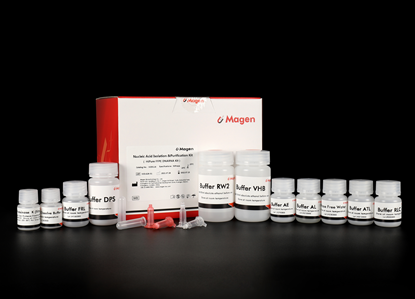
HiPure FFPE DNA/RNA Kit enables sequential purification of genomic DNA and RNA from a single FFPE tissue digestion workflow. This configuration supports studies requiring both mutation analysis and gene expression analysis from limited archived tissue material.
Following tissue digestion, nucleic acids are separated through sequential adsorption steps allowing purification of DNA and RNA fractions for independent downstream workflows.
For magnetic bead-based co-extraction workflows see MagPure FFPE DNA/RNA Kit - R6327.
Laboratories focusing on individual nucleic acid purification may refer to HiPure FFPE DNA Kit - D3126 or HiPure FFPE RNA Kit - R4143.
Details
Workflow
Workflow Overview
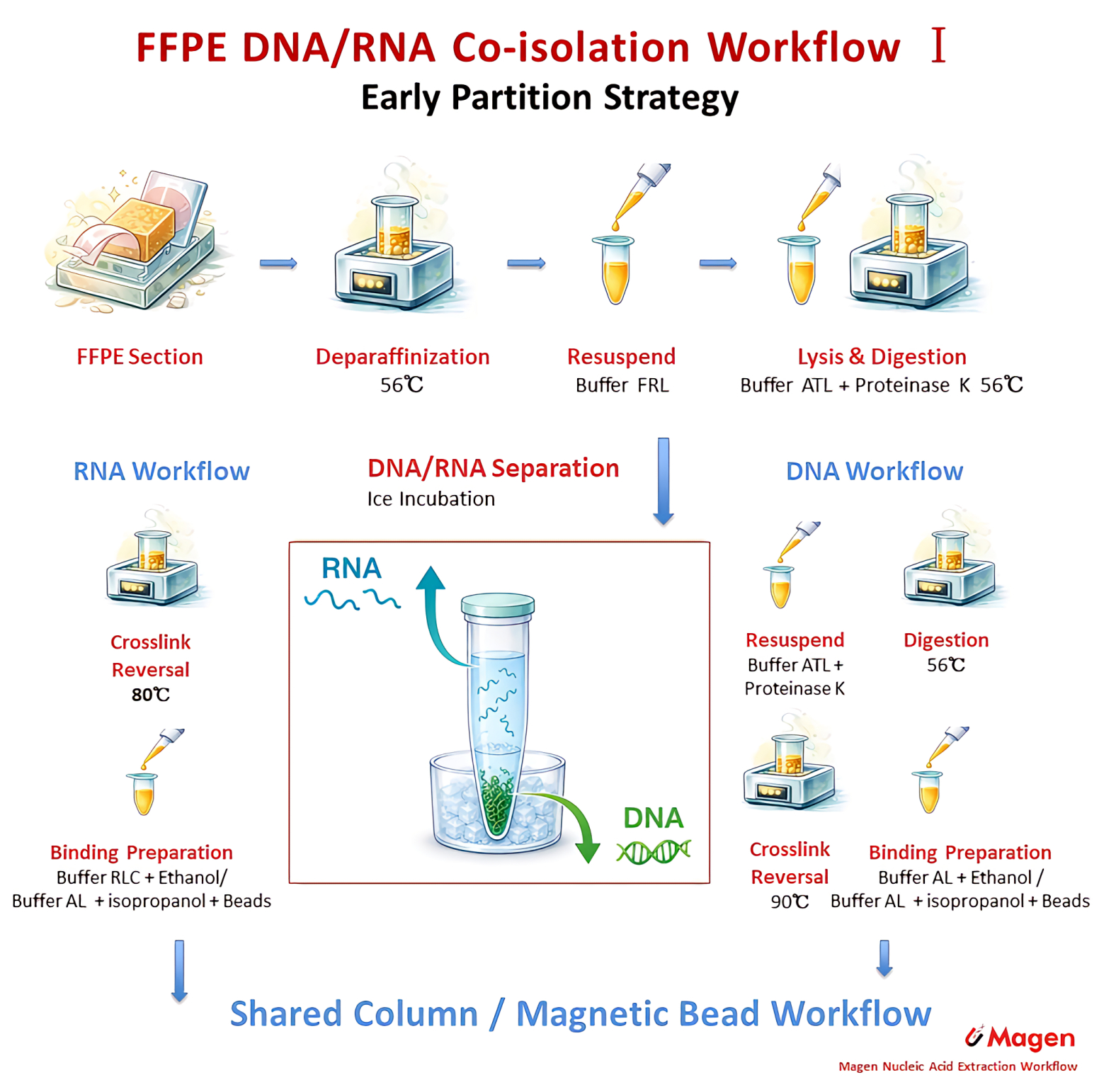
FFPE DNA/RNA Co-isolation Workflow I is based on an early partition strategy for recovering DNA and RNA from the same FFPE input. After shared FFPE pretreatment, the workflow separates the RNA-containing supernatant from the DNA-containing pellet. The two fractions then enter separate downstream routes, allowing RNA-oriented handling and DNA-oriented processing to be managed independently before final purification by column or magnetic bead workflow, depending on the kit format.
Sample Handling Logic
The key feature of this route is the early separation of RNA and DNA fractions. The RNA-containing supernatant is removed from the digestion residue and handled under RNA-oriented conditions, while the DNA-containing pellet can undergo additional processing and stronger heat-assisted reversal before DNA purification. This strategy is especially useful when RNA preservation and same-sample DNA/RNA recovery are both important considerations.
Time and Workflow Characteristics
Under typical manual operation, the early-partition column route represented by IVD5116 usually requires about 4.5 hours, while the early-partition magnetic route represented by IVD3026 usually requires about 4.7 hours. A dual-output workflow is complete only after both the RNA and DNA paths have been processed. For detailed step-by-step handling logic and route-specific timing, please refer to the Workflow Note in the Download section.
Specifications
|
Features
|
Specifications
|
|
Main FunctionsC
|
Co-isolation DNA and RNA from a single FFPE tissue sample
|
|
Applications
|
RT-PCR, cDNA synthesis, PCR and second-generation sequencing, etc.
|
|
Purification method
|
Mini spin column
|
|
Purification technology
|
Silica technology
|
|
Process method
|
Manual (centrifugation or vacuum)
|
|
Sample type
|
FFPE slice, FFPE embedded tissue
|
|
Sample amount
|
No more than six 10µm sections of 150mm2 surface area or three 20µm sections of 150mm2 surface area.
|
Principle
FFPE samples are incubated in an optimized lysis buffer, which results in the release of RNA and precipitation of DNA. After centrifugation, the RNA-containing supernatant and DNA-containing pellet are then processed separately to purify RNA and DNA. For RNA purification, transfer RNA Lysate to an adsorption column and RNA is adsorbed on the membrane, while protein is not adsorbed and is removed with filtration. After washing proteins and other impurities, RNA was finally eluted with low-salt buffer. For DNA purification, transfer DNA Lysate to an adsorption column and DNA is adsorbed on the membrane, while protein is not adsorbed and is removed with filtration. After washing proteins and other impurities, DNA was finally eluted with low-salt buffer.
Kit Contents
|
Contents
|
IVD5116
|
|
Purification Times
|
50 Preps
|
|
HiPure DNA Micro Column
|
50
|
|
HiPure RNA Mini Column I
|
50
|
2ml Collection Tubes
|
150
|
Proteinase K
|
50 mg
|
|
Protease Dissolve Buffer
|
5 ml
|
Buffer DPS
|
60 ml
|
Buffer FRL
|
15 ml
|
|
Buffer ATL
|
15 ml
|
|
Buffer RLC
|
15 ml
|
Buffer AL
|
15 ml
|
Buffer VHB
|
44 ml
|
Buffer RW2
|
25 ml
|
|
RNase Free Water
|
10 ml
|
|
Buffer AE
|
10 ml
|
Storage and Stability
Proteinase K should be stored at 2-8°C upon arrival. However, short-term storage (up to 12 weeks) at room temperature (15-25°C) does not affect their performance. The remaining kit components can be stored at room temperature (15-25°C) and are stable for at least 18 months under these conditions.
Experiment Data
Purchase Guide
For guidance on selecting the most appropriate FFPE nucleic acid extraction system based on target analyte, workflow format and downstream application requirements:
👉 FFPE Nucleic Acid Extraction Purchase Guide
For a broader technical overview of FFPE DNA, RNA and DNA/RNA co-extraction workflow routes, processing logic and application-oriented route design:
👉 FFPE Nucleic Acid Extraction Workflows Explained
For detailed workflow structure, estimated processing time and route-specific handling logic across representative FFPE workflows: