Introduction
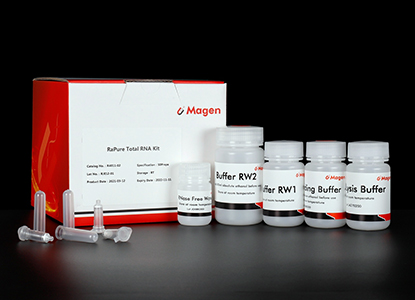
The HiPure Total RNA Kit provides a single-column silica membrane workflow for purification of large RNA molecules (>200 nt) from cultured cells and soft tissues. The method relies on chaotropic lysis followed by selective RNA adsorption on a silica membrane and sequential washing steps to remove proteins, salts and other contaminants.
The streamlined workflow is widely used for routine RNA preparation in molecular biology laboratories and supports downstream applications such as RT-PCR, qPCR and gene expression analysis. The protocol is suitable for standard laboratory workflows requiring consistent RNA purification from cultured cells or soft animal tissues.
Within the Magen RNA extraction systems, laboratories requiring genomic DNA removal during RNA purification may refer to the HiPure Total RNA Plus Kit (R4111), while automated RNA purification workflows can be implemented using the MagPure Universal RNA Kit (IVD3020).
Details
Workflow
Workflow Overview
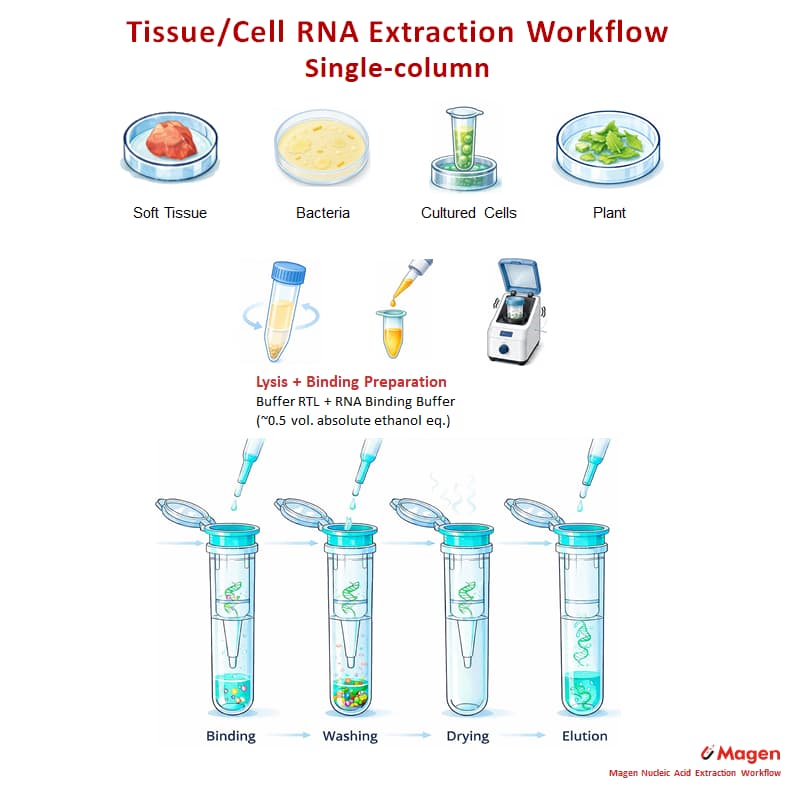
The HiPure Total RNA Kit uses a single-column silica membrane workflow for routine purification of total RNA from cultured cells, soft tissues, plant material, yeast and bacterial samples. Following sample disruption and lysis in RTL Lysis Buffer, RNA binding conditions are established by adding RNA Binding Buffer. The prepared lysate is then loaded directly onto the RNA column, where RNA is captured on the silica membrane and recovered through washing, drying and elution steps. For downstream applications that are highly sensitive to residual DNA, optional on-column DNase treatment can be incorporated into the workflow.
Sample Handling Logic
This workflow is designed as a direct RNA purification route, with the main sample-dependent variation concentrated in the disruption and lysis stage. Soft tissue and cultured cell samples can usually enter the workflow after homogenization and clarification, while plant material, yeast and bacterial samples may require stronger mechanical disruption before column loading. Once lysis and binding preparation are complete, the downstream single-column purification steps remain consistent, providing a straightforward format for routine total RNA recovery.
Time and Workflow Characteristics
Under typical manual operation, the overall workflow is usually completed within about 25–45 minutes, depending mainly on sample type, disruption method and lysate viscosity. The workflow is shorter and operationally simpler than dual-column or phase-separation routes because RNA binding, washing, drying and elution are performed on a single RNA column. For detailed step-by-step conditions, workflow guidance and estimated processing times, please refer to the Workflow Note in the Download section.
Specifications
|
Features
|
Specifications
|
|
Main Functions
|
Isolation total RNA (not include miRNA) from animal tissues, cells and simple plant tissues using one column
|
|
Applications
|
RT-PCR, qRT-PCR, Northern hybridization, second generation sequencing
|
|
Purification method
|
Mini spin column
|
|
Purification technology
|
Silica technology
|
|
Process method
|
Manual (centrifugation or vacuum)
|
|
Sample type
|
Animal soft tissue, cultured cells, lymphocytes, simple plant tissue
|
Sample amount
|
Cells: ≤1 x 10⁷
Animal tissue: 1-20 mg
Plant leaves: 50-150 mg
Yeast cells: 5 x 10⁶
|
|
Yield
|
2-100μg
|
|
Elution volume
|
≥50μl
|
|
Time per run
|
~25-45 minutes(Depends on sample type)
|
|
Liquid carrying volume per column
|
800µl
|
|
Binding yield of column
|
100µg
|
Technical Validation
HiPure Total RNA Kit was evaluated using animal and plant tissue samples to assess RNA yield, purity and integrity in a silica membrane spin-column workflow. The validation included manual extraction from 20 mg animal tissues and 100 mg plant tissues, with purified RNA analyzed by Nanodrop and agarose gel electrophoresis.
In animal tissue testing, RNA was extracted from kidney, spleen and liver samples and compared with a reference column-based RNA extraction workflow. From 20 mg tissue input, RNA yields ranged from 56–60 µg for kidney, 50–52 µg for spleen, and 81–105 µg for liver samples. The measured A260/280 values were 2.06–2.11, and A260/230 values were generally within 2.06–2.23, supporting recovery of RNA with suitable purity for routine downstream analysis.
Plant tissue extraction was further evaluated using pepper leaves, pumpkin leaves and Pachira macrocarpa leaves. From 100 mg plant input, the kit produced RNA yields of 55.47–70.31 µg from pepper leaves, 76.26–77.20 µg from pumpkin leaves and 46.13–50.31 µg from Pachira macrocarpa leaves. A260/280 values were 1.97–1.99, with most A260/230 values above 2.2 in the tested R4011 samples.
Electrophoresis analysis showed intact RNA band patterns from both animal and plant samples, supporting RNA integrity after extraction. The kit format also supports optional on-column DNase treatment for applications sensitive to residual genomic DNA, and the purified RNA is suitable for downstream workflows such as RT-PCR, Northern blotting, poly(A)+ RNA purification, nuclease protection and in vitro translation.
Application Scenario Summary
R4011 is designed for routine total RNA extraction from tissue and cell samples, supporting standard gene expression analysis, RNAi validation, inflammatory-response studies, tissue transcript analysis and downstream qRT-PCR or RNA-seq workflows. The selected research examples below show how this single-column total RNA route has been applied in liver metabolism, macrophage signaling, cell reprogramming, extracellular vesicle-related inflammation and recurrent airway disease studies.
|
Application Scenario
|
Sample Source
|
Downstream Research Use
|
|
Live-cell organelle and cytoskeletal interaction research with RNAi validation
|
siRNA-treated U2OS cells used in ER, mitochondria, lysosome and cytoskeleton interaction studies
|
qRT-PCR validation of RNAi knockdown efficiency for motor-adaptor genes such as RILP and FYCO1, supporting super-resolution live-cell imaging analysis of organelle contact and intracellular transport mechanisms.
|
|
Fructose metabolism and hepatic lipogenesis research in metabolic disease models
|
Mouse liver tissues and primary hepatocyte-related metabolic models under fructose diet, high-fat diet, leptin-deficient and TK-related conditions
|
qRT-PCR analysis of metabolic and lipogenic gene expression, used together with isotope tracing and triglyceride analysis to study fructose-driven hepatic lipogenesis, NAFLD-related metabolism and dietary fructose tolerance.
|
View more application scenarios
|
Application Scenario
|
Sample Source
|
Downstream Research Use
|
|
Somatic cell reprogramming and pluripotency regulation through R-loop-associated gene expression control
|
Mouse embryonic fibroblasts, reprogramming intermediates and induced pluripotent stem cells during OSKM-mediated reprogramming
|
Time-course RNA-seq and RT-qPCR analysis of gene expression changes during MEF-to-iPSC reprogramming, supporting investigation of R-loop dynamics, SOX2 function and RNaseH1/Ddx5-mediated regulation of pluripotency acquisition.
|
|
Macrophage mechanosensing and TLR4-mediated antibacterial response research
|
Immortalized murine macrophages, BMDMs and infection / LPS / Piezo1-related macrophage experimental systems
|
qPCR analysis of macrophage mRNA responses, supporting studies of how TLR4 signaling coordinates with Piezo1-mediated calcium influx, actin remodeling, phagocytosis, ROS production and bacterial clearance.
|
|
Lung tissue-derived extracellular vesicle regulation of neutrophil chemotaxis during inflammation
|
Human and murine lung tissue EV models; murine neutrophils treated with lung EVs, DNase-treated lung EVs or inflammatory stimulation
|
Real-time PCR and mRNA-seq analysis of chemokine responses, especially Cxcl1 and Cxcl2, to study how lung EV-DNA activates TLR9 signaling and promotes neutrophil recruitment during inflammation.
|
|
Sepsis-associated macrophage inflammatory signaling and TLR hyperactivation research
|
BMDMs, BMDCs, peritoneal macrophages and immune-cell co-culture systems stimulated with LPS, poly(I:C), CpG ODN, VSV or treated with soluble CD4
|
qPCR measurement of inflammatory genes such as tnf and il-6, used to validate how soluble CD4–MHC II signaling suppresses excessive TLR inflammatory activation in sepsis-related models.
|
|
Liver cancer drug-response and N-myristoylation-related signaling mechanism research
|
HCC cell lines, xenograft-derived tumor models and patient-derived HCC experimental systems
|
RNA-seq and qRT-PCR analysis of drug-treated HCC cells to evaluate desloratadine-associated transcriptional changes, NFκB/Bcl-2 pathway regulation and NMT1/VILIP3-related liver cancer progression mechanisms.
|
|
Recurrent airway inflammatory disease and pathogenic CD8+ memory T cell analysis
|
Human nasal polyp tissues from recurrent airway inflammatory disease and control nasal tissues
|
Bulk TCR sequencing from total RNA extracted from nasal tissues, supporting analysis of persistent CD8+ T cell clones associated with recurrent nasal polyps, asthma comorbidity and GZMK-driven airway inflammation.
|
Kit Contents
|
Contents
|
R401102
|
R401103
|
|
Purification Times
|
50 Preps
|
250 Preps
|
|
HiPure RNA Mini Columns
|
50
|
250
|
|
2ml Collection Tubes
|
50
|
250
|
RTL Lysis Buffer
|
50 ml
|
200 ml
|
RNA Binding Buffer
|
15 ml
|
75 ml
|
|
Buffer RW1
|
50 ml
|
200 ml
|
Buffer RW2*
|
20 ml
|
2 x 50 ml
|
RNase Free Water
|
10 ml
|
30 ml
|
Storage and Stability
The Kit can be stored dry at room temperature (15-25°C) and are stable for at least 18 months under these conditions.