Introduction
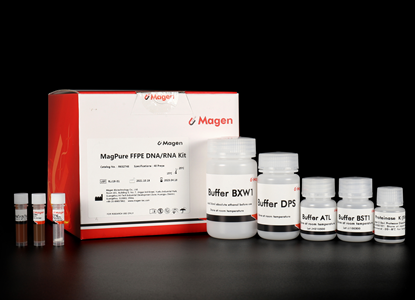
MagPure FFPE DNA/RNA Kit (R6327) represents the magnetic bead co-extraction configuration within the Magen FFPE nucleic acid purification portfolio. The system is designed to recover both genomic DNA and RNA from formalin-fixed paraffin-embedded tissue samples using a magnetic adsorption workflow.
Following tissue digestion, nucleic acids are separated through magnetic bead binding behavior, allowing DNA and RNA fractions to be isolated during the adsorption stage. This configuration supports efficient recovery of fragmented nucleic acids typically present in FFPE samples and is optimized for Higher total DNA and RNA yield.
Magnetic particle chemistry and bead-to-lysate ratios were refined through internal development cycles to improve adsorption efficiency and recovery stability across different FFPE tissue conditions.
Laboratories prioritizing RNA integrity during extraction may refer to MagPure FFPE DNA/RNA Kit – IVD3026, where nucleic acid partitioning occurs earlier during the digestion stage.
Column-based purification workflows are available through HiPure FFPE DNA Kit – D3126 for genomic DNA extraction and HiPure FFPE RNA Kit – R4143 for RNA purification.
R6327 functions as the High-recovery magnetic reference workflow within the Magen FFPE extraction system.
Details
Workflow
Workflow Overview
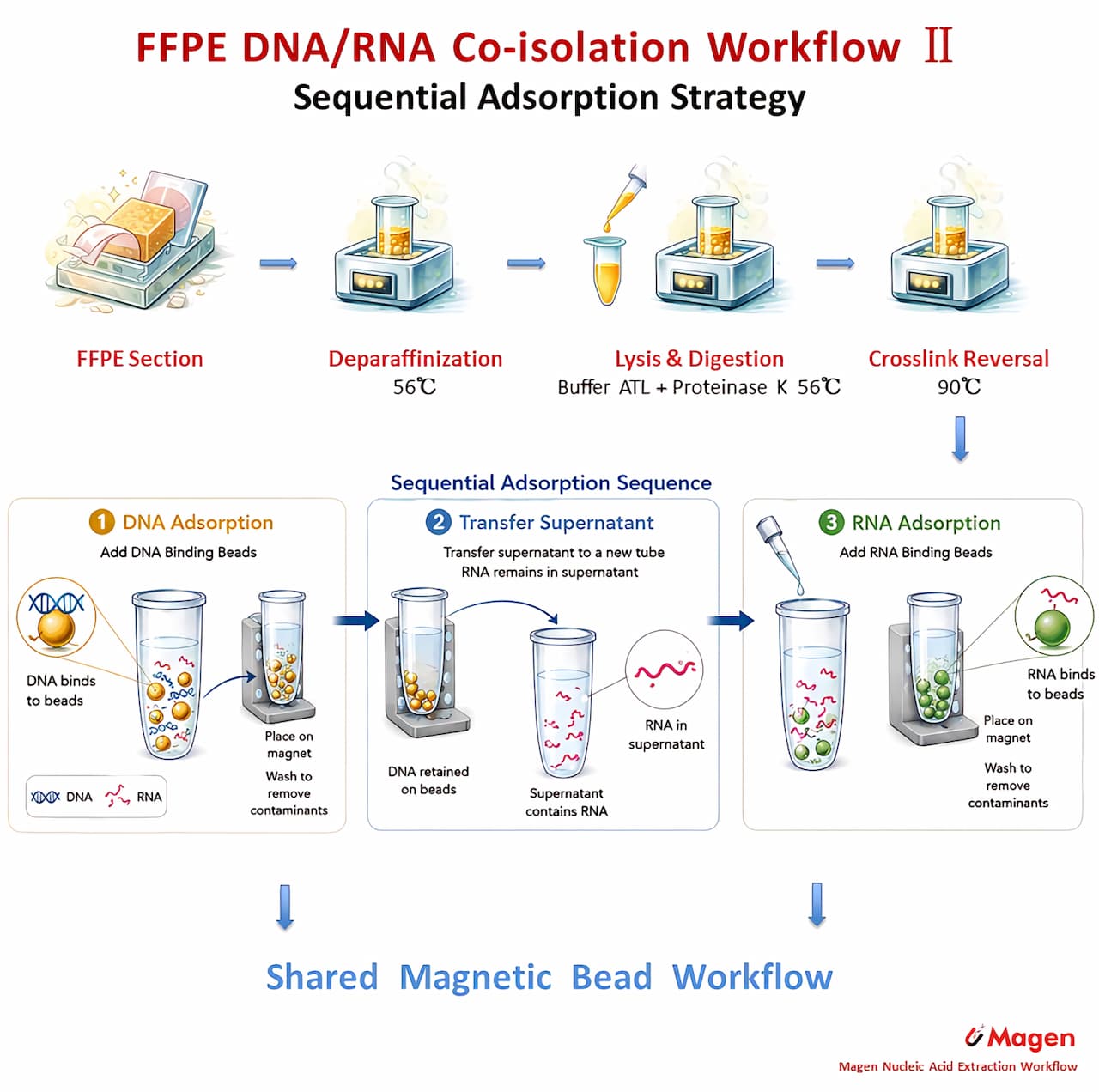
FFPE DNA/RNA Co-isolation Workflow II is based on a sequential magnetic adsorption strategy. After shared FFPE pretreatment and lysis, DNA is first captured by magnetic particles. The RNA-containing supernatant is then transferred into a second magnetic binding route for RNA purification. This staged adsorption design allows both DNA and RNA to be recovered from a shared FFPE lysate system through sequential magnetic binding.
Sample Handling Logic
The central partition point in this workflow is not physical pellet/supernatant separation at the early pretreatment stage, but the first DNA adsorption step. DNA is captured first, while RNA remains in the supernatant and is subsequently recovered through a separate magnetic binding route. This strategy is useful when the workflow objective is efficient same-sample recovery of both DNA and RNA, especially for parallel analysis or multi-omics-oriented applications.
Time and Workflow Characteristics
Under typical manual operation, the sequential adsorption workflow represented by R6327 usually requires about 3.3–14.5 hours, with the longer range mainly reflecting sample-dependent digestion before sequential magnetic binding. Because both DNA and RNA are recovered through staged adsorption, workflow completion should be interpreted based on the processing of both analyte routes. For detailed step-by-step conditions, workflow guidance and estimated processing times, please refer to the Workflow Note in the Download section.
Specifications
|
Features
|
Specifications
|
|
Main Functions
|
Co-isolation DNA and RNA from FFPE tissue
|
|
Applications
|
RT-PCR, cDNA synthesis, PCR and second-generation sequencing, etc.
|
Purification method
|
Polydisperse silicon based magnetic beads (DNA)
Monodisperse carbonyl magnetic beads (RNA)
|
|
Purification technology
|
Magnetic beads technology
|
|
Process method
|
Manual or automatic
|
Adaptive instrument
|
Nucleic acid extractor and pipetting workstation
|
|
Sample type
|
FFPE slice, FFPE puncture sample, embedded tissue
|
|
Sample amount
|
No more than six 10 µm sections of 150 mm2 surface area or three 20µm sections of 150 mm2 surface area
|
|
Yield
|
DNA: 1 - 10 μg, RNA: 1 - 25 μg
|
Extraction Principle
Formalin fixation introduces crosslinks between nucleic acids and proteins, while paraffin embedding introduces hydrophobic contaminants that complicate nucleic acid recovery. In addition, nucleic acids extracted from FFPE tissues are typically fragmented due to fixation and long-term storage.
In the MagPure FFPE DNA/RNA workflow, tissue sections are first deparaffinized and digested with Proteinase K to release nucleic acids from the FFPE tissue matrix. A high-temperature incubation step is included to partially reverse formaldehyde crosslinking, improving accessibility of both DNA and RNA molecules.
Unlike conventional nucleic acid purification workflows where DNA or RNA is extracted separately, the MagPure FFPE DNA/RNA Kit uses a sequential magnetic adsorption strategy to isolate both nucleic acid types from the same lysate.
Genomic DNA is first captured by magnetic particles under optimized binding conditions. The remaining supernatant containing RNA is then transferred to a second adsorption step where RNA molecules bind to a separate magnetic particle system.
This staged adsorption design enables efficient recovery of both DNA and RNA from a single digestion process while maintaining compatibility with fragmented nucleic acids commonly present in FFPE tissues.
Engineering Characteristics
Magnetic Particle Adsorption
Silica-coated magnetic particles provide efficient adsorption of fragmented DNA and RNA commonly present in FFPE tissue lysates.
DNA/RNA Co-Isolation Workflow
The workflow enables recovery of both nucleic acid types from a single digestion process, supporting multi-omics analysis from limited FFPE tissue material
Fragment Recovery Performance
Magnetic bead binding conditions support recovery of short and degraded nucleic acid fragments typical of formalin-fixed tissues.
Low-Input Sample Recovery
Optimized bead-to-lysate ratios improve adsorption efficiency when processing low-concentration FFPE lysates.
Technical Validation
The performance of the DNA/RNA co-extraction workflow was evaluated through internal validation experiments together with external testing data generated under routine laboratory conditions.
Recovery Consistency and Production Stability
Internal evaluation using FFPE lysates with varying nucleic acid concentrations demonstrated consistent recovery across replicate extractions. In parallel, magnetic particle physicochemical parameters and extraction performance remained stable across validated production batches, supporting reproducible workflow performance.
RNA Integrity and PCR Compatibility
Electrophoresis analysis showed intact RNA bands without detectable degradation, including samples stored overnight at 4 °C after extraction. RT-PCR experiments further demonstrated comparable amplification efficiency between extracted RNA and reference controls, indicating effective removal of inhibitors that could affect downstream amplification.
Customer Sample Validation
Further validation was obtained from routine testing data generated in a leading oncology testing laboratory using FFPE specimens processed with the DNA/RNA co-extraction workflow.
In this dataset, qualified DNA results were obtained in 135 of 139 samples, while qualified RNA results were obtained in 114 of 116 samples. These results demonstrate reliable recovery performance for both analytes across routine FFPE sample testing workflows.
The evaluated specimens covered multiple common FFPE sample types, including surgical tissue, biopsy-derived samples and wax roll materials, supporting the applicability of the workflow across typical pathology laboratory inputs.
These findings provide additional evidence that the system is suitable for downstream molecular analysis workflows requiring FFPE-derived DNA and RNA from archived clinical specimens.
Application Scenario Summary
FFPE DNA/RNA-compatible workflows are useful when limited archived tissue may need to support more than one molecular direction, or when the study design requires flexibility between DNA-based and RNA-based analysis. The selected examples below involve Magen FFPE DNA/RNA extraction formats, including IVD3026, R6327 and IVD5116.
|
Application Scenario
|
Related Format
|
Sample Source
|
Downstream Research Use
|
|
FFPE NSCLC RNA-NGS validation of non-canonical RET rearrangements for fusion diagnostics
|
IVD3026
|
FFPE tissue samples from RET-rearranged Chinese NSCLC patients
|
Total RNA extraction for targeted RNA-NGS, functional RET fusion transcript confirmation, non-canonical fusion partner validation and comparison of NGS, FISH and IHC diagnostic methods
|
|
Locally recurrent rectal cancer genomic profiling for Wnt pathway recurrence mechanism research
|
R6327
|
FFPE tissue blocks from primary rectal cancer, locally recurrent rectal cancer, non-recurrent rectal cancer and matched normal rectal tissue samples
|
DNA extraction for whole-exome sequencing, mutation landscape comparison, LRRC-specific pathway enrichment and Wnt signaling pathway candidate gene analysis
|
View more application scenarios
|
Application Scenario
|
Related Format
|
Sample Source
|
Downstream Research Use
|
|
Advanced NSCLC tumor–ctDNA paired genomic profiling for immunochemotherapy stratification research
|
R6327
|
Tumor-derived genomic DNA used as paired tissue reference in advanced NSCLC; tissue samples were paired with pretreatment ctDNA samples for WES analysis
|
Tissue-based WES combined with plasma ctDNA 520-gene targeted NGS and low-pass WGS to support ctDNA-based genomic immune subtype analysis, tissue–blood comparison and PD-1 inhibitor benefit stratification research
|
|
EGFR-mutant NSCLC tumor genomic profiling for neoadjuvant immunochemotherapy response and MRD research
|
R6327 + D6323B
|
Pre-treatment biopsy and post-treatment resected tumor samples from EGFR-mutant stage IIB–IIIB NSCLC patients
|
Tumor tissue gDNA extraction for WES, baseline and post-treatment genomic feature analysis, tumor-informed MRD panel design and response / resistance mechanism research
|
|
Locally advanced OSCC perioperative immunochemotherapy and ctDNA-MRD monitoring research
|
R6327
|
FFPE endoscopic biopsy tumor specimens from primary esophageal squamous cell carcinoma before neoadjuvant nivolumab plus chemotherapy
|
Tumor gDNA extraction for WES, patient-specific mutation selection and personalized ctDNA-MRD panel design, supporting perioperative immunochemotherapy response evaluation, pCR / non-pCR stratification, ctDNA clearance analysis and recurrence-risk monitoring
|
|
Advanced NSCLC tumor-informed ctDNA biomarker analysis for first-line immunochemotherapy selection
|
R6327
|
FFPE tumor biopsy or archived tumor tissue specimens and matched blood-derived normal controls from advanced NSCLC patients in the CHOICE-01 biomarker cohort
|
Tissue WES combined with plasma 520-gene ctDNA sequencing to identify patient-specific tumor mutations, compare tumor-informed and tumor-naïve ctDNA approaches, and evaluate ctDNA positivity / clearance as predictive biomarkers for ICI-chemo benefit.
|
|
ESCC post-nCRT residual disease detection and organ-sparing treatment decision research
|
R6327
|
Pretreatment FFPE endoscopic biopsy tumor specimens from locally advanced ESCC patients undergoing neoadjuvant chemoradiotherapy
|
Tumor gDNA extraction for WES and personalized ctDNA assay construction, supporting MRD detection after nCRT, integration of ctDNA with clinical response evaluation, non-pCR prediction, organ-sparing strategy assessment and adjuvant immunotherapy guidance.
|
|
Metastatic nonsquamous NSCLC tumor microenvironment RNA-seq biomarker analysis in the IMpower151 trial
|
IVD5116
|
FFPE tumor tissue slides from metastatic nonsquamous NSCLC patients enrolled in the randomized IMpower151 trial
|
Total RNA extraction for FFPE RNA-seq, immune gene-signature analysis and tumor microenvironment profiling, supporting evaluation of T cell, dendritic cell, MHC and myeloid-family signatures associated with EGFR mutation status and progression-free survival under atezolizumab plus bevacizumab and chemotherapy.
|
Note: The selected examples involve FFPE DNA/RNA-compatible extraction formats, but the downstream nucleic acid differs by study. Some workflows use FFPE RNA for fusion transcript validation, while others use DNA extracted with a DNA/RNA-compatible format for WES or tumor genomic profiling. These examples should not be described as DNA/RNA multi-omics unless both DNA and RNA are explicitly used in the same study.
Kit Contents
|
Contents
|
R632701
|
R632702
|
R632703
|
|
Purification Times
|
48 Preps
|
96 Preps
|
5 x 96 Preps
|
|
MagBind Particles
|
1.1 ml
|
2.5 ml
|
11 ml
|
|
MagPure Particles N
|
1.1 ml
|
2.5 ml
|
11 ml
|
Proteinase K
|
24 mg
|
48 mg
|
220 mg
|
Protease Dissolve Buffer
|
3 ml
|
10 ml
|
15 ml
|
Buffer DPS
|
50 ml
|
100 ml
|
2 x 250 ml
|
|
Buffer ATL
|
20 ml
|
30 ml
|
120 ml
|
|
Buffer BST1
|
20 ml
|
40 ml
|
200 ml
|
|
Buffer BXW1*
|
44 ml
|
110 ml
|
3 x 110 ml
|
RNase Free Water
|
15 ml
|
30 ml
|
120 ml
|
Storage and Stability
Proteinase K, MagPure Particles N and MagBind Particles should be stored at 2–8°C upon arrival. However, short-term storage (up to 12 weeks) at room temperature (15–25°C) does not affect their performance. The remaining kit components can be stored at room temperature (15–25°C) and are stablefor at least 18 months under these conditions.
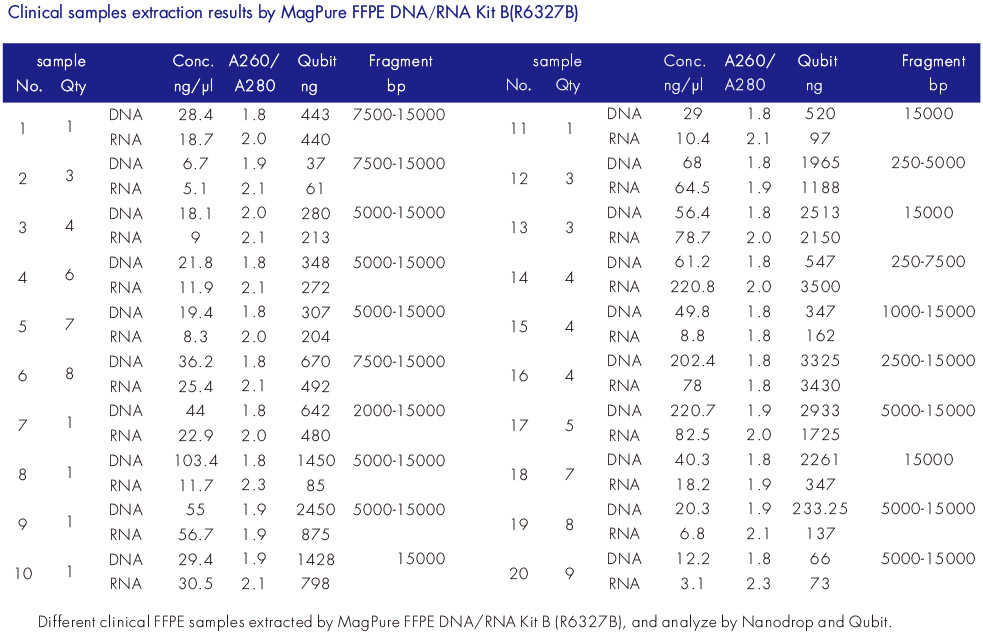
Experiment Data